
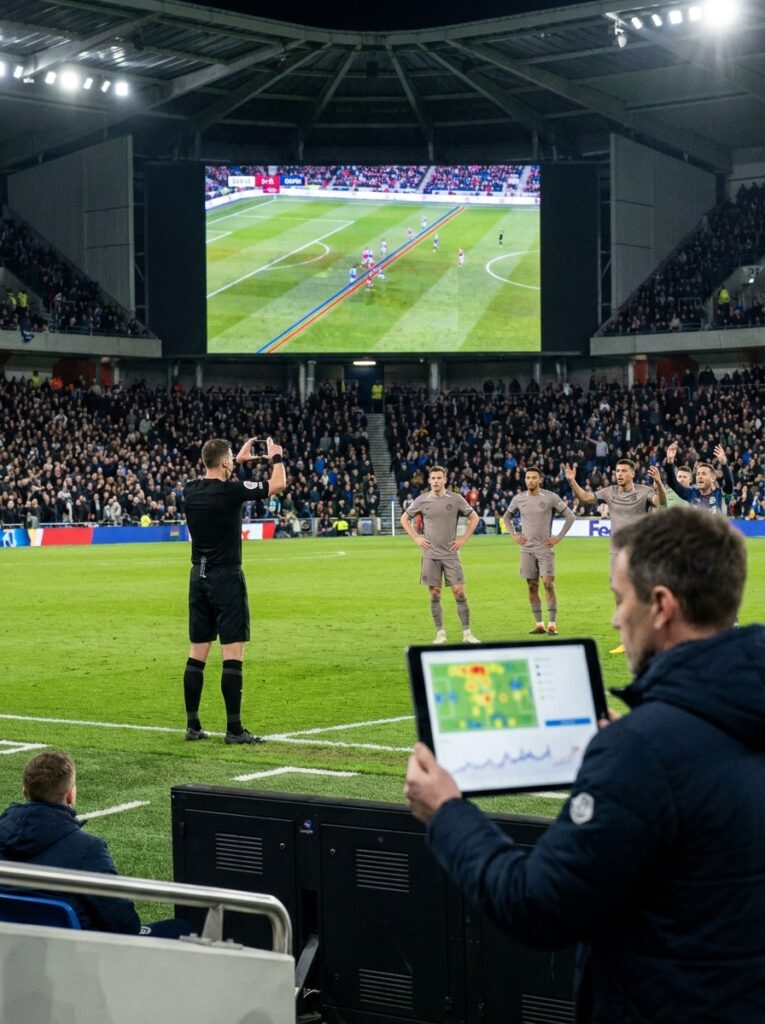
From VAR and smartwatches to wearable sensors, data analytics and AI-assisted training, technology is changing how athletes compete, how coaches prepare and how fans understand the game.
Sport has always depended on human judgment. A referee’s whistle, a coach’s instinct, an athlete’s feel for timing and a fan’s memory of a decisive moment once shaped the story of competition. Today, that story is increasingly written with cameras, sensors, algorithms and data dashboards. Modern sport is no longer only played on grass, courts, tracks, pools and ice. It is also played inside replay rooms, performance labs, cloud servers and training apps.
The transformation is visible in almost every major sport. Football uses video assistant referees and semi-automated offside systems. Basketball teams study optical tracking data to understand spacing and shot quality. Rugby has introduced smart mouthguards to help identify head impacts. Runners train with watches that measure pace, heart rate and recovery. Cyclists, swimmers and tennis players use sensors to refine technique. Clubs and national teams employ analysts who can break a match into thousands of measurable events.
The result is a new sporting era defined by precision. Decisions that once depended only on the eye can now be reviewed frame by frame. Training loads that once relied mainly on the athlete’s feeling can now be monitored through GPS, heart-rate variability, accelerometers and sleep data. Tactical trends that once emerged through experience can now be identified through large datasets. Technology has not removed uncertainty from sport, but it has made uncertainty harder to ignore.
VAR is the most public and controversial example. Its promise is simple: fewer decisive mistakes. In football, video review can help officials check goals, penalties, direct red cards and cases of mistaken identity. Semi-automated offside technology goes further by using tracking cameras, artificial intelligence and sometimes connected-ball data to support decisions that are too close for the naked eye. For competitions under intense global scrutiny, the appeal is obvious. A World Cup knockout match, a Champions League final or a domestic title race should not turn on an error that technology can correct.
Yet VAR also shows the limits of technological authority. Many decisions still require interpretation. Was contact enough for a penalty? Did a defender make a deliberate play? Was a handball natural or punishable? The screen can slow the moment down, but it cannot always remove disagreement. Fans often complain that VAR interrupts the emotional rhythm of the game. A goal once triggered instant celebration; now it may be followed by a pause, a line on a screen and a delayed verdict. Accuracy has improved in many situations, but spontaneity has been weakened.
The tension is not only about football. Tennis has long used electronic line-calling, cricket relies on ball-tracking and ultra-edge tools, and American football reviews plays from multiple angles. In each case, technology shifts authority away from the immediate human eye and toward a system of evidence. That can make sport fairer, but it can also make it feel more technical, more legalistic and less human. The best systems are not the ones that replace officials entirely. They are the ones that help officials make better decisions while preserving the flow and spirit of the contest.
For athletes, the deeper revolution is happening before competition begins. Smartwatches and wearable devices have turned the body into a stream of data. Heart rate, distance covered, sprint speed, acceleration, jump load, sleep quality and recovery scores can be tracked daily. What was once available only in elite laboratories is now on the wrists of amateurs and in the vests of professional players. A runner can adjust training based on pace and recovery. A footballer can be withdrawn from an intense session after a GPS unit shows excessive load. A coach can identify whether a player is undertrained, overtrained or returning safely from injury.
This data has changed training culture. The old model often celebrated toughness and repetition: more laps, more drills, more contact, more pain. The new model emphasizes adaptation. The question is not simply how hard an athlete can work, but whether the work is producing the right response. Recovery is no longer treated as laziness. It is measured as part of performance. Sleep, nutrition, muscle soreness and stress are increasingly discussed in the same conversation as tactics and talent.
Training equipment has also become more intelligent. Motion-capture systems can analyze a golfer’s swing, a pitcher’s release, a sprinter’s stride or a swimmer’s stroke. Force plates measure jump power and asymmetry. Virtual reality can simulate game situations without full physical contact. Ball machines, smart bikes, connected treadmills and resistance devices allow athletes to repeat movements with precise feedback. For injured players, rehabilitation can be guided by sensors that detect imbalance before the athlete returns to full competition.
Data analytics has changed coaching strategy as much as physical preparation. In football, analysts study pressing patterns, passing lanes, expected goals and defensive spacing. In basketball, teams examine shot selection, lineup combinations and player movement. In baseball, analytics has transformed pitching, defensive positioning and roster construction. In cycling, race plans are built around power output and energy management. In Formula One, sport has become inseparable from real-time telemetry.
This analytical approach can reveal truths that intuition misses. A player who looks quiet may be creating space through movement. A shot that feels spectacular may be statistically inefficient. A team that appears dominant may be conceding dangerous chances. Data gives coaches a second language, one that can challenge old assumptions. But it also brings the risk of overconfidence. Not everything important is easily measured. Leadership, courage, creativity, chemistry and pressure remain difficult to reduce to numbers.
Technology has also changed the spectator experience. Fans now watch replays with virtual lines, live statistics, player-speed graphics, heat maps and win-probability models. Broadcasts explain tactics in ways that were once reserved for coaches. Fantasy sports and betting markets have increased demand for real-time data. Younger fans often consume matches through clips, dashboards and second-screen commentary. The game on the field is now accompanied by a parallel game of information.
For smaller teams and developing athletes, technology can be both an opportunity and a challenge. Affordable watches, phone cameras and analysis apps have widened access to performance feedback. A young runner, cyclist or footballer can learn more about training than previous generations could with limited resources. But elite technology is expensive. Clubs with larger budgets can buy better tracking systems, hire data scientists and build advanced medical departments. If regulators are not careful, technology can widen the gap between rich and poor competitors.
Privacy is another unresolved issue. Athlete data can be deeply personal. It may reveal fatigue, injury risk, sleep patterns, stress levels, menstrual cycles, recovery status or mental strain. Teams may argue that such data helps protect athletes and improve performance. Athletes may worry that the same data could affect contracts, selection, transfers or public reputation. The question is not whether performance data should be used, but who owns it, who can see it and how long it is stored.
There is also the question of fairness. Advanced shoes, aerodynamic equipment, swimsuits, prosthetics and sensor-guided training can all push the boundary between natural performance and technological assistance. Sport has always involved equipment, but regulators must decide when equipment becomes an unfair advantage. Rules on footwear, bikes, suits and devices are attempts to protect competition from becoming a contest of laboratories rather than athletes.
The future will bring even more complexity. Artificial intelligence will help scouts evaluate talent, coaches design strategies and medical teams detect injury risk. Smart stadiums will collect more information about players and fans. Refereeing systems will become faster and more automated. Training devices will become smaller, cheaper and more personal. Some sports will welcome these tools quickly. Others will resist, arguing that imperfection is part of drama.
The central challenge is balance. Technology should make sport safer, fairer and more understandable. It should not make athletes feel constantly surveilled, officials powerless or fans detached from emotion. The best sporting technology is almost invisible when it works: a correct decision, a healthier player, a better recovery plan, a fairer race, a smarter tactic. The worst technology becomes the story itself.
Modern sport is being transformed because competition has always searched for edges. The difference now is that the edge is measured in pixels, milliseconds, heartbeats and datasets. Athletes still have to run, jump, pass, shoot, tackle, swim and endure pressure. Coaches still have to judge people, not only numbers. Referees still have to make decisions that matter. Fans still come for emotion. Technology is not replacing sport. It is changing the conditions under which sport is played, watched and judged.
The winners of this era will not be those who collect the most data or install the most cameras. They will be the teams, leagues and athletes that know how to use technology without forgetting why people care about sport in the first place: uncertainty, excellence, courage and the human drama of competition.
“””
