
A private investment group led by Grant Gustavson has stepped forward with a proposal to buy the MLS club and relocate it, intensifying pressure on Vancouver officials to produce a viable local solution.
VANCOUVER, British Columbia — The future of the Vancouver Whitecaps has entered its most uncertain phase in years after an investment group led by Las Vegas businessman Grant Gustavson surfaced with plans to buy the Major League Soccer club and move it to Nevada, raising the prospect that one of Canadian soccer’s most established names could leave the city where it built its modern identity.
The proposal does not mean a relocation is inevitable. MLS would have to approve any ownership change and any move, and the Whitecaps’ current owners say their preference remains to find a path that keeps the team in Vancouver. But the emergence of a publicly identified Las Vegas group has changed the tone of the debate. What had been months of difficult stadium talks, ownership uncertainty and speculation is now a concrete test of whether Vancouver can assemble the financial and political conditions needed to keep the club.
Gustavson, the grandson of Public Storage founder B. Wayne Hughes and the son of billionaire Tamara Gustavson, said his group would privately finance the purchase and relocation. In a statement, he said the investors were withholding further details while league deliberations continue, but he framed the effort as one intended to benefit the sport, the league, fans and Las Vegas. The group also said the plan is not connected to recently announced arena proposals in the city.
The Whitecaps have been for sale since December 2024, when owners Greg Kerfoot, Steve Luczo, Jeff Mallett and Steve Nash began a formal process and retained Goldman Sachs to advise on sale and transition options. At the time, the club described Vancouver as a first-class soccer market and said it wanted ownership with the resources to help the team compete at the highest levels of MLS. Sixteen months later, the search has become more urgent.
In a brief but pointed statement this week, the Whitecaps said the club had held serious conversations with more than 100 parties but had not received a viable offer that would keep the team in Vancouver. The club cited structural challenges around stadium economics, venue access and revenue limitations, saying those issues had made it difficult to attract buyers committed to the local market. It also urged any local ownership group with the vision and resources to step forward.
The central problem is BC Place, the government-owned stadium where the Whitecaps play home matches. MLS Commissioner Don Garber has described the arrangement as increasingly difficult because the club does not control the venue, faces scheduling restrictions and lacks the premium seating and revenue opportunities that have become central to modern MLS business models. BC Place will also be a World Cup venue this summer, adding symbolic significance to a city that could host the global game while simultaneously fighting to keep its MLS club.
British Columbia officials have said they are working with the Whitecaps to reduce costs and increase revenue opportunities at BC Place, but they have ruled out buying the team. Ravi Kahlon, the province’s minister of jobs and economic growth, said the current arrangement allows the team to use the stadium at no cost and returns up to about $1.5 million in annual revenue from hosting games. The province has also signaled willingness to explore additional revenue options.
For MLS, the issue is whether those measures are enough to satisfy current owners, prospective buyers and league leadership. The league has grown rapidly in franchise value since Vancouver entered MLS in 2011. Expansion fees that once cost tens of millions of dollars now sit in the hundreds of millions. San Diego paid a $500 million expansion fee to become the league’s 30th team, a benchmark that has changed how owners and investors view the economics of MLS membership.
Las Vegas has long been seen as a desirable market for professional sports, and MLS has repeatedly considered the city as part of its expansion map. The Gustavson proposal places Las Vegas directly into the Whitecaps conversation, but Garber has also said the city could still become an expansion market if Vancouver resolves its local issues. In that sense, the league’s choice may not be only between Vancouver and Las Vegas. It may also be whether Vancouver can make a convincing enough case to remain part of a league increasingly shaped by stadium control, premium hospitality and private capital.
Vancouver officials are trying to show that such a case exists. Mayor Ken Sim has said losing the Whitecaps is not an option and has called for a bridge agreement that would make BC Place financially workable while a long-term stadium project is developed. The city and the Whitecaps have already signed a memorandum of understanding to explore a new stadium and entertainment district at Hastings Park, with an exclusive negotiation period running through the end of 2026. The city would retain ownership of the land, and any project would still require public processes, regulatory approvals and financing.
That timeline may be too slow for MLS unless a short-term fix emerges. The Whitecaps’ current lease at BC Place is only a temporary arrangement, and the league’s patience appears limited. Stadium uncertainty has become a familiar flashpoint in North American sports, but in MLS it carries particular weight because soccer-specific venues have often been tied to franchise stability, fan culture and commercial growth.
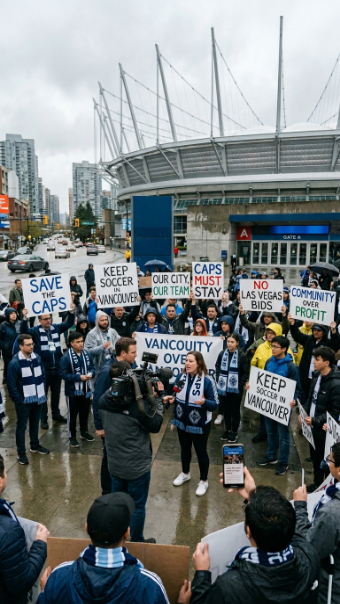
Supporters have responded with visible resistance. Fans have held signs reading “Save the ‘Caps” outside matches and around Vancouver during FIFA Congress events. For many, the club is more than an MLS asset. The Whitecaps name dates to 1974, when the original team played in the North American Soccer League. The modern club’s MLS era began in 2011, but its identity reaches across generations of players, youth programs and supporters in British Columbia.
The possibility of relocation also arrives at a striking moment on the field. Vancouver has recently been among the league’s more competitive clubs, and its profile has risen through strong attendance, playoff appearances and deeper ties to Canada’s soccer ecosystem. The disconnect between sporting momentum and business insecurity has fueled frustration among fans who see the city as a proven market rather than a failed one.
For the current ownership group, the problem appears less about whether soccer can work in Vancouver and more about whether the club can operate under conditions attractive enough for a new buyer. Without stadium control, broader revenue access or a clear path to a purpose-built home, prospective owners may be reluctant to pay modern MLS valuations while accepting old constraints.
For Las Vegas, the opportunity is different. A relocation would deliver an established MLS franchise without the uncertainty of waiting for a new expansion slot. The city has demonstrated appetite for major sports investment, and a privately financed bid would likely appeal to a league that has increasingly prioritized strong ownership groups and stadium plans. Still, relocating a club with deep roots carries reputational risks, especially in a league that has often presented itself as community-driven.
The next phase will depend on negotiations happening on multiple fronts: between the Whitecaps and potential buyers, between MLS and investors, between the club and provincial officials, and between Vancouver leaders and any local ownership group that may still emerge. The outcome could preserve the Whitecaps in their home city, send them to Las Vegas, or push MLS toward a different structure that separates relocation from expansion.
For now, Vancouver remains in the game, but the clock is moving faster. The Las Vegas bid has turned an abstract threat into an active alternative. Unless local officials, the province, the club and prospective investors can produce a workable plan, one of Canada’s most recognizable soccer brands may soon become the latest test case in MLS’s transformation from a growth league into a high-value sports property where market loyalty must compete with stadium economics.