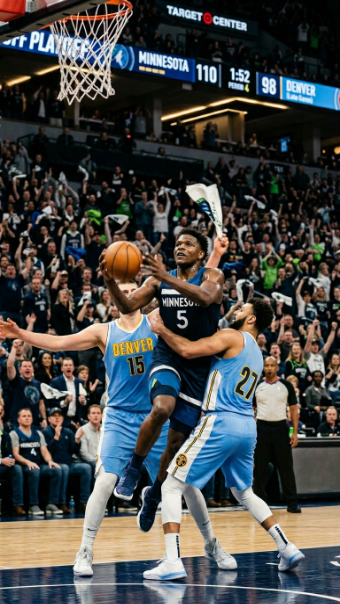
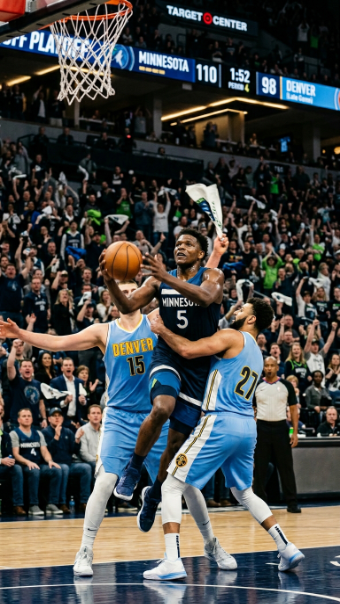
Minnesota’s shorthanded roster delivered a defining Game 6 performance, beating Denver 110-98 to win the series 4-2 and send the 2023 champions out of the playoffs.
MINNEAPOLIS — The Minnesota Timberwolves, battered by injuries and forced deep into their bench, eliminated the Denver Nuggets with a 110-98 victory in Game 6 on Thursday night, closing a tense first-round playoff series 4-2 and advancing to a Western Conference semifinal matchup against the San Antonio Spurs.
It was a result that carried more than the usual weight of a series clincher. Minnesota did it without several of its most important perimeter players, including Anthony Edwards, Donte DiVincenzo and Ayo Dosunmu. The Timberwolves did it against Nikola Jokic, the league’s most complete offensive force and the face of Denver’s championship era. And they did it with the kind of collective toughness that can redefine a postseason run.
Jaden McDaniels delivered the best performance of the night, scoring 32 points and grabbing 10 rebounds. Terrence Shannon Jr., thrust into a surprise starting role because of Minnesota’s injury problems, added 24 points in one of the most important games of his young career. Rudy Gobert, Julius Randle and Naz Reid gave the Timberwolves the size and control they needed inside, helping Minnesota dominate the paint and the glass.
The Timberwolves outscored Denver 64-40 in points in the paint and won the rebounding battle 50-33, two numbers that told the story of the game as clearly as the final score. Minnesota did not win by outshooting Denver from the perimeter or by leaning on a single superstar. It won by turning a depleted rotation into a physical advantage and by forcing the Nuggets to spend much of the night chasing loose balls, second chances and drives to the rim.
Gobert finished with 10 points, 13 rebounds and eight assists, a line that reflected his influence beyond rim protection. Randle added force in the frontcourt, Reid provided spacing and strength, and McDaniels took on the dual burden of scoring and defending. For a team missing so much shot creation, Minnesota found offense through movement, pressure and simple determination.
Denver’s season ended with Jokic once again carrying a heavy load. He finished with 28 points, 10 assists and nine rebounds, just short of a triple-double, but the Nuggets never found the balance needed to extend the series. Cameron Johnson scored 27 points and helped Denver remain within reach from three-point range, but Jamal Murray struggled under Minnesota’s defensive pressure, finishing with 12 points on 4-for-17 shooting.
The Nuggets entered the postseason as the No. 3 seed in the Western Conference and still had the championship experience that made them dangerous in any series. But Minnesota, seeded sixth, looked more urgent and more adaptable when the series reached its decisive stage. After dropping Game 1, the Timberwolves won four of the next five games, including three victories by double digits.
Thursday night’s win at Target Center also extended Minnesota’s recent rise as one of the West’s most resilient playoff teams. For the third straight season, the Timberwolves are headed to the conference semifinals. Their path, however, has become unusually complicated. Edwards, the team’s leading star and emotional engine, is dealing with a knee injury. DiVincenzo is out for the rest of the postseason with an Achilles injury. Dosunmu was unavailable with a calf issue. Kyle Anderson was also sidelined by illness.
That left Minnesota with only eight active players for the clinching game, a fact that would normally be treated as a warning sign against a former champion. Instead, it became part of the team’s rallying point. The Timberwolves played with urgency, leaning into bigger lineups and accepting that their margin for error had narrowed. The result was one of the more impressive wins of the opening round.
The game also deepened the postseason rivalry between Minnesota and Denver. The two teams have met repeatedly in high-stakes moments, and each matchup has carried a sense of unfinished business. Denver’s 2023 championship remains the foundation of its identity, but Minnesota has increasingly become one of the teams most capable of disrupting the Nuggets’ rhythm. McDaniels’ defense on Murray, Gobert’s presence near the basket and Minnesota’s ability to attack with size all contributed to that pattern.
For Denver, the offseason now begins with difficult questions. Jokic remains one of basketball’s defining players, but the Nuggets’ supporting structure looked strained in the series. Murray’s inconsistency, the lack of sustained secondary creation and the challenge of matching Minnesota’s physicality will likely shape internal discussions. The core is still formidable, but the West has become less forgiving, and Denver’s margin has narrowed since its championship run.
For Minnesota, the reward is a second-round series against the second-seeded San Antonio Spurs, who eliminated the Portland Trail Blazers in five games. Game 1 is set to be played in San Antonio, with the Spurs holding home-court advantage. The matchup brings together two teams at different points of their development but with similar ambitions. Minnesota brings playoff scars and defensive toughness. San Antonio brings youth, length and the rising force of Victor Wembanyama.
The Spurs won their first playoff series since 2017 by beating Portland, a breakthrough for a franchise that has rapidly moved from rebuilding to contention. Wembanyama gives San Antonio a matchup problem unlike any other in the league, and the Spurs’ offensive versatility has made them one of the most difficult teams to prepare for. Minnesota, especially if Edwards remains sidelined early in the series, will have to rely again on depth, size and defensive discipline.
The regular-season meetings between Minnesota and San Antonio hinted at the tension ahead. The Timberwolves won the season series 2-1, but the games featured major individual performances, including a 39-point night from Wembanyama in a Spurs victory and high-scoring efforts from Edwards before his injury. The semifinal series may depend heavily on availability. If Edwards returns, Minnesota’s ceiling changes dramatically. If he does not, the Timberwolves will again ask McDaniels, Shannon, Randle, Reid and Gobert to carry expanded responsibilities.
Thursday’s victory gave Minnesota reason to believe that formula can work, at least for now. The Timberwolves did not simply survive without their star guard; they closed out the defending-era Nuggets with authority. The final minutes brought the sound of a crowd that understood the significance of the moment: not just advancement, but validation of a roster built around defense, depth and physical resolve.
For the Nuggets, the defeat ended a season that never fully regained championship certainty. For the Timberwolves, it opened a new test. San Antonio will be younger, longer and rested after finishing its series earlier. Minnesota will arrive bruised but emboldened, carrying the momentum of a win that demanded nearly everything from the players still standing.
The playoffs often turn on stars. On Thursday night in Minneapolis, they turned on the players left available, the rebounds contested, the defensive assignments accepted and the willingness of a shorthanded team to keep attacking a champion until the champion finally ran out of answers.