
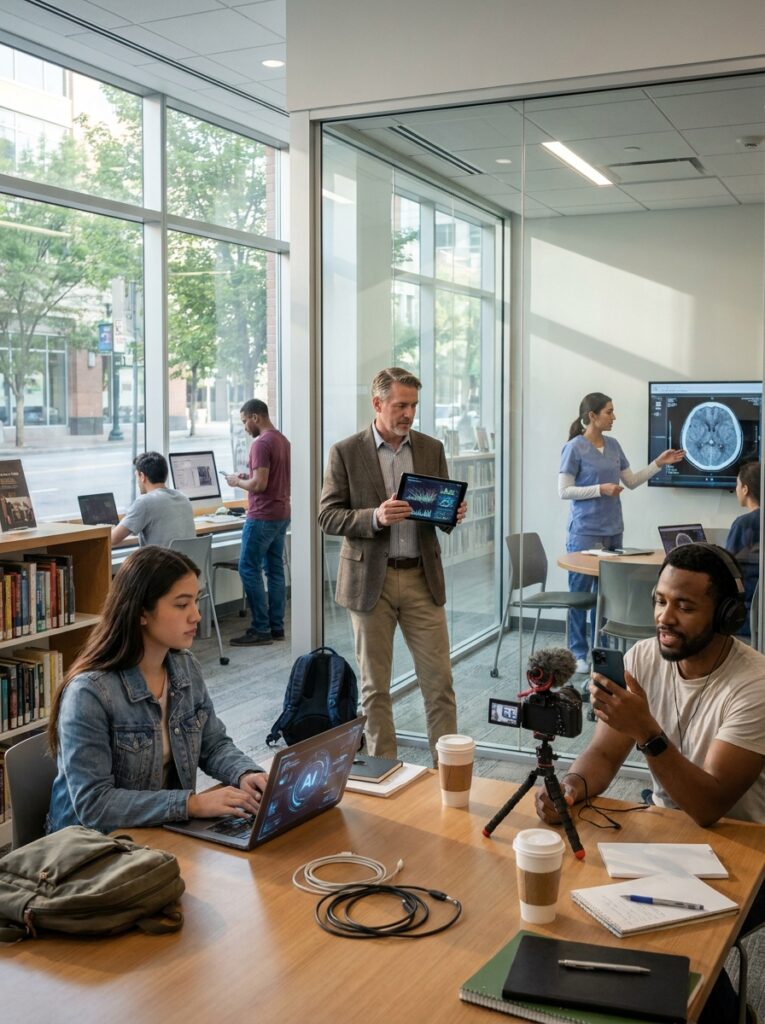
From classrooms and workplaces to hospitals, creative studios and household routines, AI is becoming a quiet infrastructure of modern life, bringing new power as well as new responsibilities.
Artificial intelligence is no longer a distant technology discussed only by computer scientists, investors or science-fiction writers. It is now part of ordinary life. Students use it to summarize lessons. Workers use it to draft emails, analyze data and automate repetitive tasks. Doctors and researchers use it to read images, search medical literature and support diagnosis. Creators use it to edit videos, generate music, design images and translate content. At home, people use AI through search engines, maps, recommendation systems, smart speakers, cameras, banking apps and customer service chatbots. The change is not always dramatic, but it is becoming constant.
The most important shift is that AI is moving from a specialized tool to a general assistant. Earlier digital technologies often required users to learn menus, commands or technical language. Generative AI changed the relationship by allowing people to interact with machines through ordinary words, images, voice and instructions. A person can ask for a lesson plan, a business proposal, a travel itinerary, a medical explanation or a social media caption and receive an instant draft. This does not mean the answer is always correct. It means the first barrier to using advanced software has been lowered.
In education, AI is reshaping how students learn and how teachers teach. A student who struggles with mathematics can ask an AI tutor to explain a problem step by step. A language learner can practice conversation at any hour. A university student can use AI to organize notes, compare theories or prepare for an exam. For students in remote areas or under-resourced schools, these tools may provide access to explanations and practice that would otherwise be unavailable.
Teachers can also benefit. AI can help prepare quizzes, adapt reading materials for different levels, generate examples, translate instructions and reduce administrative work. In a classroom where one teacher supports many students, AI may help personalize learning. But the promise comes with risks. Students may copy answers without understanding them. AI systems can produce false information with confidence. Data privacy becomes a serious concern when minors use commercial platforms. Education must therefore teach students not only how to use AI, but how to question it.
The future of learning will not be defined by whether AI is allowed or banned. It will be defined by whether schools can build responsible habits around it. Students need to learn when AI is useful, when it is unreliable, how to verify information, how to cite assistance and how to preserve their own thinking. The best use of AI in education is not to replace effort. It is to make effort more targeted and feedback more available.
In the workplace, AI is changing both tasks and expectations. Office workers use it to draft documents, summarize meetings, prepare presentations, write code, analyze spreadsheets and answer customer questions. Lawyers, accountants, marketers, engineers, journalists and managers are all seeing parts of their work accelerated by AI. The technology can remove repetitive tasks and free employees for judgment, strategy and human communication. It can also create pressure to produce more in less time.
The impact on jobs is complicated. AI will not affect every worker in the same way. Some roles may disappear, others may be redesigned and many new tasks will emerge around AI supervision, data quality, cybersecurity, ethics, compliance and human review. Workers who learn to use AI effectively may gain an advantage, while those without access to training may fall behind. The central workplace question is not only what AI can do, but who benefits from the productivity it creates.
Businesses are learning that AI cannot simply be added to old systems and expected to transform performance automatically. To produce real value, organizations must redesign workflows, train employees, protect data and create clear rules for accountability. A chatbot that gives a wrong answer to a customer, a hiring system that discriminates or an automated decision that cannot be explained can cause serious harm. The workplace of the future will require both technical skill and ethical judgment.
In healthcare, AI may bring some of its most important benefits. Algorithms can help detect patterns in X-rays, scans, lab results and patient records. They can support doctors in identifying disease earlier, matching patients to treatment options, predicting risk and managing hospital resources. AI can also help researchers search scientific literature, design drug candidates and analyze large medical datasets. In countries with shortages of specialists, carefully validated AI tools could extend medical expertise to more patients.
But healthcare also shows why AI must be handled carefully. A wrong movie recommendation is inconvenient. A wrong medical recommendation can be dangerous. AI systems may perform well in one hospital but poorly in another if patient populations, equipment or data quality differ. They may reflect biases in the data used to train them. Patients also need to know how their sensitive health information is used. AI should support doctors and nurses, not remove human responsibility from care. Trust in medicine depends on safety, explanation and accountability.
In creative content, AI is transforming production. Writers use it for brainstorming. Designers use it to generate visual concepts. Video editors use it to cut footage, create captions and translate speech. Musicians use it to separate instruments, master tracks or test melodies. Small creators can produce work that once required a full studio. A teacher, journalist, small business owner or independent artist can create images, scripts, audio and video more quickly than before.
This expansion of creative access is significant. AI can help people who lack expensive equipment or technical training express ideas professionally. It can assist creators working in multiple languages and help small teams compete with larger organizations. Yet it also raises difficult questions about originality, copyright and labor. If an AI model is trained on the work of artists without consent, who should be compensated? If a synthetic voice sounds like a real singer, who owns that performance? If platforms are flooded with generated content, how will audiences find work made with care?
The value of human creativity may become more important, not less. When machines can produce endless images, songs, articles and videos, audiences may place greater value on authenticity, lived experience and trust. AI can generate material, but people still decide what matters, what feels honest and what deserves attention. The creative future is likely to be hybrid: machines assisting with speed and variation, humans providing judgment, emotion and meaning.
In everyday life, AI is already present in ways many people barely notice. Navigation apps predict traffic. Streaming platforms recommend films and music. Phones organize photos. Banking systems detect fraud. Translation tools help travelers communicate. Smart home devices adjust lights, temperature and security. Online stores predict what users may want to buy. Customer service chatbots answer routine questions. These systems make life more convenient, but they also collect data and shape choices.
That influence deserves attention. Recommendation algorithms can guide what people watch, read, buy and believe. AI can make services more personal, but it can also create filter bubbles, manipulate attention and deepen dependence on platforms. Facial recognition, predictive policing and automated surveillance raise civil rights concerns. The same technology that helps a person unlock a phone can also be used to monitor a crowd. The difference lies in governance, consent and limits.
AI also changes the meaning of basic skills. In the past, digital literacy meant knowing how to use a computer or search the internet. Now it must include knowing how AI systems work, why they make mistakes, how to verify outputs and how personal data is used. People do not need to become engineers, but they do need enough understanding to avoid blind trust. A society surrounded by AI requires citizens who can ask better questions.
The biggest danger is not that AI will suddenly replace all human life. The more immediate danger is that people may adopt it faster than they build rules, habits and protections. Speed can outpace judgment. Schools may use tools before policies are ready. Companies may automate decisions before workers are trained. Hospitals may buy systems before validation is complete. Governments may regulate too slowly or too broadly. The challenge is to gain the benefits of AI without surrendering human dignity, privacy and accountability.
Artificial intelligence is changing human life because it changes the relationship between people and knowledge, labor, creativity and decision-making. It can make learning more personal, work more efficient, healthcare more precise, creativity more accessible and daily routines more convenient. It can also spread errors, widen inequality, weaken privacy, disrupt jobs and blur the line between human and machine-made content.
The future will not be determined by AI alone. It will be shaped by human choices: how schools teach it, how companies deploy it, how doctors supervise it, how artists protect their rights, how governments regulate it and how individuals decide when to rely on it. AI is becoming one of the defining tools of modern life. Whether it becomes a force for broad human progress or another source of division will depend on whether people remain at the center of the systems they build.
“””
