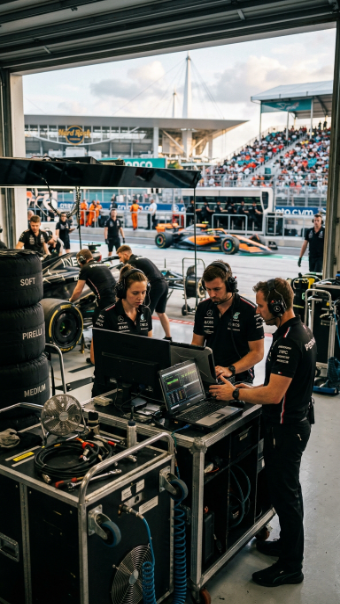
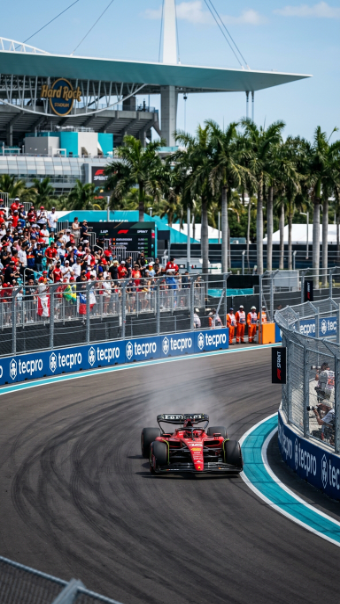
The 2026 Miami Grand Prix runs from May 1 to 3, bringing F1 back to the Hard Rock Stadium complex after an unexpected April pause and into a compressed format that leaves little room for error.
Formula 1 returns to Miami this weekend with more than a race on offer. The 2026 Miami Grand Prix, staged from May 1 to 3 at the Miami International Autodrome in Miami Gardens, arrives as a Sprint weekend, a commercial showcase, and an early test of a season that has already been reshaped by disruption.
The official schedule gives teams just one practice session before the competitive running begins. Friday features Practice 1 followed by Sprint Qualifying. Saturday brings the Sprint Race at midday local time and Grand Prix qualifying later in the afternoon. The main race is scheduled for Sunday at 4 p.m. local time, over 57 laps around the 5.412-kilometer circuit built around the Hard Rock Stadium complex.
That timetable matters. On a conventional Grand Prix weekend, teams can build speed gradually through several practice sessions before qualifying. In Miami, the Sprint format compresses preparation into a sharper, less forgiving rhythm. Drivers and engineers must decide early how much risk to take, how aggressively to set up the car, and how quickly to trust data from a circuit where heat, wind, track evolution and traffic can all change the picture.
Formula 1 confirmed Miami as one of six Sprint venues for 2026, alongside China, Canada, Great Britain, the Netherlands and Singapore. The series has promoted the format as a way to deliver competitive action on every day of a race weekend, with Sprint Qualifying on Friday, the Sprint and Grand Prix qualifying on Saturday, and the Grand Prix on Sunday. For fans, it means more meaningful track action. For teams, it means fewer excuses.
The race also resumes the championship after an unusual break. Formula 1 announced in March that the Bahrain and Saudi Arabian Grands Prix would not take place in April because of the ongoing situation in the Middle East region, and no replacement events were scheduled for that month. As a result, Miami has taken on the feel of a restart rather than just the next round on the calendar.
That interruption has given teams more time to analyze the opening races, but it has not given them more running. The field arrives in Florida with limited competitive evidence from the early season and a Sprint weekend that will quickly punish wrong assumptions. A car that looks stable in simulation may behave differently over Miami’s bumps and slow-speed sections. A driver who needs time to build confidence may not have it.
Mercedes enters the weekend with the strongest championship position. Kimi Antonelli leads the drivers’ standings with 72 points, ahead of teammate George Russell on 63. Ferrari follows with Charles Leclerc on 49 and Lewis Hamilton on 41, while McLaren’s Lando Norris and Oscar Piastri sit fifth and sixth. Those numbers give Miami an immediate competitive frame: Mercedes has the advantage, Ferrari is close enough to pressure, and McLaren needs a strong weekend to prevent the leaders from stretching away.
Antonelli’s position gives the race one of its clearest storylines. The 19-year-old Italian has started the season with the poise of a veteran and the statistical profile of a title contender. Miami will test whether that early momentum can survive a high-profile American weekend filled with media attention, limited setup time and the added volatility of Sprint points. For Russell, the weekend offers a chance to keep the internal Mercedes fight close. For Ferrari, it is an opportunity to turn consistency into a more direct challenge.
Hamilton’s presence in Ferrari colors remains one of the central images of the 2026 season. Miami, with its celebrity-heavy paddock and American audience, gives that storyline a global stage. But the sporting question is simpler: can Ferrari unlock enough performance over one practice session to threaten Mercedes on both Saturday and Sunday? The Sprint format can reward teams that arrive with a strong baseline and punish those still searching for balance.
McLaren also returns to a venue with emotional weight. Miami was the site of Lando Norris’s first Grand Prix victory in 2024, a result that helped establish him as a leading force in Formula 1’s recent era. The team arrives in 2026 needing more than nostalgia. Norris and Piastri have the pace to affect the front of the race, but the championship table already shows the cost of falling behind early. A Sprint weekend offers extra points, but also extra ways to lose ground.
Red Bull’s position is unusually subdued. Max Verstappen sits ninth in the standings with 12 points, a place that would have seemed improbable during the years when he and Red Bull dominated Formula 1. Miami will not decide whether that form is temporary or structural, but it will add evidence. The circuit’s long straights, heavy braking zones and slower technical sequence from Turns 13 to 16 should expose weaknesses as clearly as strengths.
The Miami International Autodrome remains one of Formula 1’s most distinctive modern venues. It is a temporary circuit designed to feel permanent, with 19 corners, three long straights, and top speeds listed by Formula 1 at more than 350 kph. The track winds around the Hard Rock Stadium campus, home of the Miami Dolphins, creating a hybrid atmosphere: part street circuit, part stadium event, part South Florida festival.
Since its debut in 2022, the Miami Grand Prix has become a key pillar of Formula 1’s push in the United States, joining the sport’s broader American footprint with Austin and Las Vegas. Its appeal is not only the racing. The event is built around hospitality, music, fashion, celebrity appearances and the visual identity of Miami itself. That combination has drawn criticism from purists at times, but it has also helped F1 reach audiences that were once distant from the sport.
The sporting challenge is to ensure the race matches the spectacle. Miami has produced moments of drama, but its broader reputation depends on overtaking, strategy variation and competitive tension. The Sprint schedule may help by giving fans two race starts and two qualifying sessions across the weekend. It also adds pressure to the tire and setup choices that will shape Sunday’s Grand Prix.
For organizers, the weekend is another test of Formula 1’s ability to turn a major American sports venue into a temporary global racing stage. Gates open early across the three days, with support events and fan programming surrounding the F1 sessions. The event’s operational complexity is enormous, from traffic flow and heat management to television production and hospitality delivery.
For the championship, Miami is more than a glamorous stop. It is the first race after a disrupted April, the second Sprint weekend of the year, and a chance for teams to show whether the early 2026 order is real. Mercedes can consolidate. Ferrari can close. McLaren can recover. Red Bull can respond. Every team behind them can use the condensed format to steal points if the front-runners stumble.
By Sunday evening in Miami Gardens, Formula 1 should know more about the direction of its season. The championship left Japan with questions and arrives in Florida with urgency. Under the heat, noise and commercial shine of Miami, the sport returns to the track with a simple demand: adapt quickly, or fall behind.