
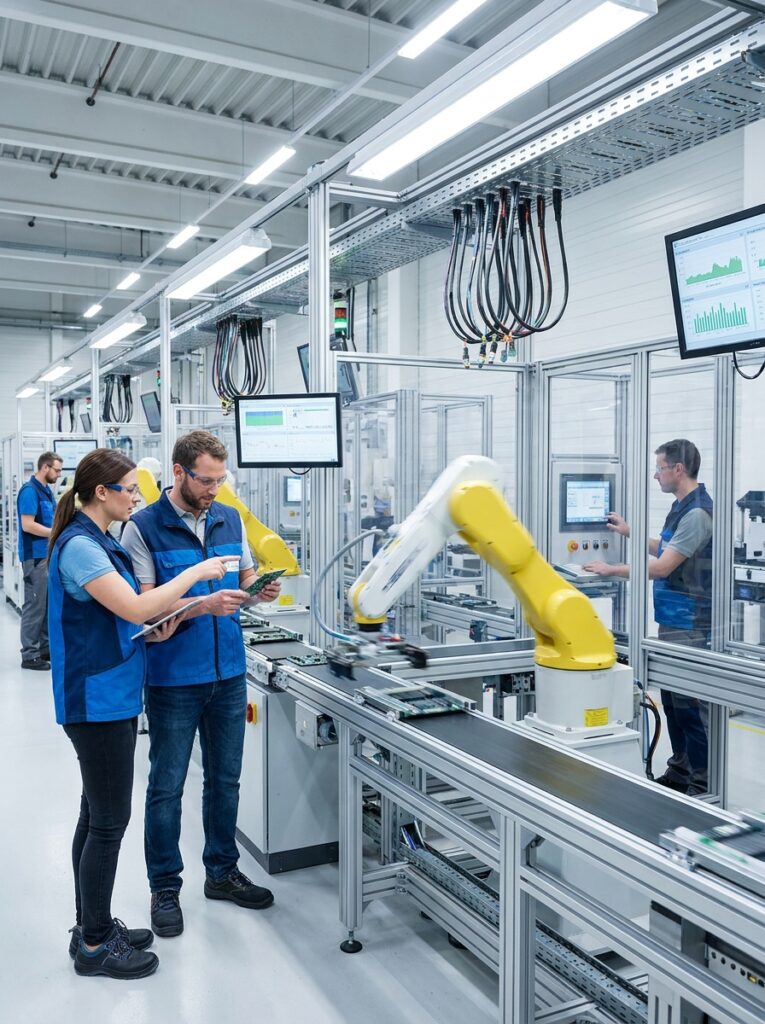
From factories and hospitals to restaurants and family homes, robots are taking on more tasks, but the future is likely to be defined by cooperation as much as replacement.
The fear that robots will replace humans has followed every major wave of automation. When machines entered factories, workers feared the loss of craft. When computers entered offices, clerks and administrators worried about disappearing roles. Today, robots powered by artificial intelligence, sensors, cameras and advanced software have brought that anxiety into more places: production lines, operating rooms, restaurant kitchens, warehouses and even private homes.
The question is not simple. Robots can already perform many tasks faster, more precisely and more continuously than humans. They do not get tired, do not need breaks in the human sense and can operate in dangerous environments. In some jobs, they clearly reduce the need for human labor. But replacing tasks is not always the same as replacing people. Many jobs are made of several activities, and only some of those activities are easy to automate.
Factories show the most advanced example of this transformation. Industrial robots have become common in automotive plants, electronics production, logistics centers and food processing. They weld, lift, sort, paint, inspect, package and move materials with high consistency. In environments where the same action is repeated thousands of times, robots are often more efficient than humans.
This does not mean the factory becomes empty. Automation changes the kind of human work required. Fewer workers may be needed for repetitive manual tasks, but more technicians, engineers, maintenance specialists, programmers and safety supervisors may be needed to manage automated systems. A robot arm may assemble a component, but humans still design the process, monitor quality, solve unexpected failures and decide how production should change.
The biggest risk in factories is not that every worker disappears, but that workers without new skills may be left behind. A production worker who once operated a machine manually may need to learn how to supervise automated equipment. A warehouse worker may need to work alongside mobile robots that move goods. Training becomes essential. Without it, automation can increase inequality between those who can adapt and those who cannot.
Hospitals reveal a different side of robotics. In medicine, robots are not simply labor-saving devices. They can support precision, safety and access. Surgical robots can help doctors perform delicate procedures through smaller movements. Rehabilitation robots can assist patients recovering mobility. Delivery robots can carry medicines, linens or laboratory samples through hospital corridors, freeing nurses and staff from routine transport work.
Yet hospitals also show the limits of replacement. A robot can assist a surgeon, but it does not carry the full moral responsibility of medical judgment. A machine can monitor vital signs, but it cannot comfort a frightened patient in the same way a nurse can. It can deliver medicine to a room, but it cannot fully understand the emotional meaning of illness, pain or family anxiety. Health care depends not only on accuracy, but also on trust, empathy and human presence.
This is why robots in hospitals are more likely to become partners than substitutes for medical professionals. They can reduce physical burden, improve consistency and support overstretched staff. In aging societies, where demand for care is rising, robots may help fill gaps. But the most valuable health systems will likely use technology to give human caregivers more time for the parts of care that only humans can provide.
Restaurants are another testing ground. Robots now appear in kitchens, dining rooms and delivery services. Some prepare food, fry ingredients, make drinks, carry dishes, clear tables or deliver orders. For restaurant operators facing labor shortages, rising wages and pressure for speed, automation can be attractive. A robot server can move plates from the kitchen to tables. A robotic kitchen system can prepare repetitive menu items with consistency.
But restaurants are not factories. Food service is also about hospitality, atmosphere and human interaction. A customer may enjoy the novelty of a robot delivering noodles or coffee, but the experience of being welcomed, understood and served with warmth remains deeply human. A waiter can read frustration, answer unusual questions, make recommendations and recover a bad experience through judgment and charm. Robots may handle routine tasks, but the emotional labor of hospitality remains difficult to automate.
In family homes, robots are already more common than many people realize. Robot vacuum cleaners, lawn mowers and smart home devices perform small domestic tasks. Future home robots may help older adults move safely, remind people to take medicine, monitor falls, carry objects or support people with disabilities. In this setting, robots may become tools for independence rather than symbols of replacement.
The home, however, is one of the most complex environments for a robot. Unlike factories, homes are messy, unpredictable and personal. Furniture moves, children drop toys, pets interrupt paths and people expect privacy. A domestic robot must not only move safely but also understand human habits and boundaries. The more intimate the environment, the more important trust becomes.
This raises ethical questions. A robot in the home may collect data about movement, speech, routines and health. Who owns that data? How securely is it stored? Can families control what is recorded? If a care robot helps an elderly person, who is responsible when it fails? These questions show that the future of robotics is not only technical. It is legal, social and moral.
The idea of total replacement also underestimates human adaptability. When technology removes one type of work, it often creates new needs. Robots must be designed, built, installed, repaired, trained, cleaned, regulated and integrated into human systems. New jobs may emerge in robot maintenance, human-machine interface design, safety inspection, AI supervision and ethics compliance. The challenge is whether societies can prepare workers for these roles quickly and fairly.
There will still be displacement. It would be dishonest to suggest that every worker will benefit automatically. Jobs built mainly around routine, predictable physical tasks are more exposed. Some restaurant, warehouse, manufacturing and delivery roles may shrink as machines improve. Companies under cost pressure may adopt robots to reduce labor expenses. Workers in those sectors need protection, retraining and realistic pathways to new employment.
At the same time, many human abilities remain hard to replace. People are better at handling ambiguity, building trust, making moral decisions, caring for others, leading teams, improvising in unusual situations and understanding cultural context. Robots can calculate, lift and repeat. Humans can interpret, persuade, comfort, imagine and take responsibility.
The most likely future is not a world where robots replace all humans, but one where robots reshape human work. In factories, humans may become supervisors of automated systems. In hospitals, robots may support doctors and nurses rather than remove them. In restaurants, robots may carry food while people focus on service and experience. In homes, robots may handle chores while families decide how much technology they want inside private life.
Whether this future is positive depends on choices made now. Businesses must not treat automation only as a way to cut jobs. Governments must update education, labor policy and safety rules. Schools must teach digital and technical skills alongside creativity, communication and ethics. Workers must be given opportunities to learn before their jobs disappear, not after.
Robots can make society more productive, safer and more convenient. They can take on dangerous work, support aging populations, reduce repetitive strain and improve precision. But they can also deepen inequality, weaken job security and make human relationships feel more mechanical if adopted without care.
The real question, then, is not whether robots can replace humans. In some tasks, they already can. The deeper question is what kind of future humans want to build with them. If robots are used only to reduce costs, many people will experience them as a threat. If they are used to remove dangerous tasks, support care, improve quality and give people time for more meaningful work, they can become partners in progress.
Robots may become stronger, faster and smarter. But the future should not be measured only by what machines can do. It should be measured by whether technology helps human beings live with more dignity, safety and opportunity. Machines can perform tasks. Humans must still decide the purpose.”””
