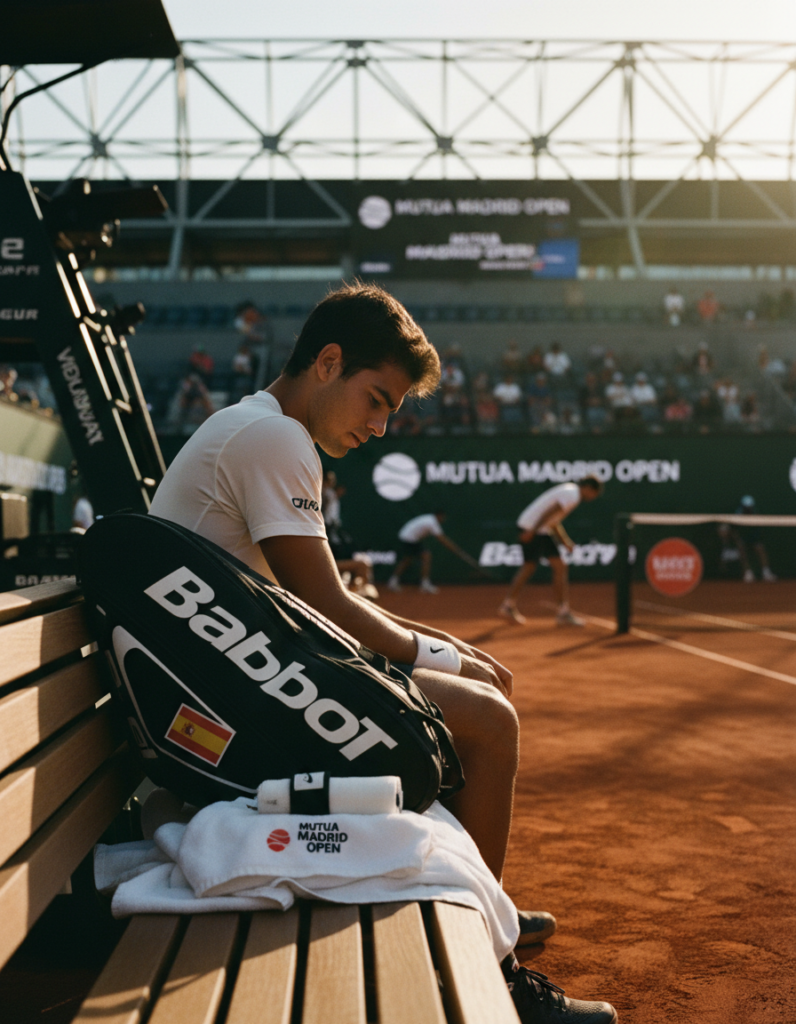
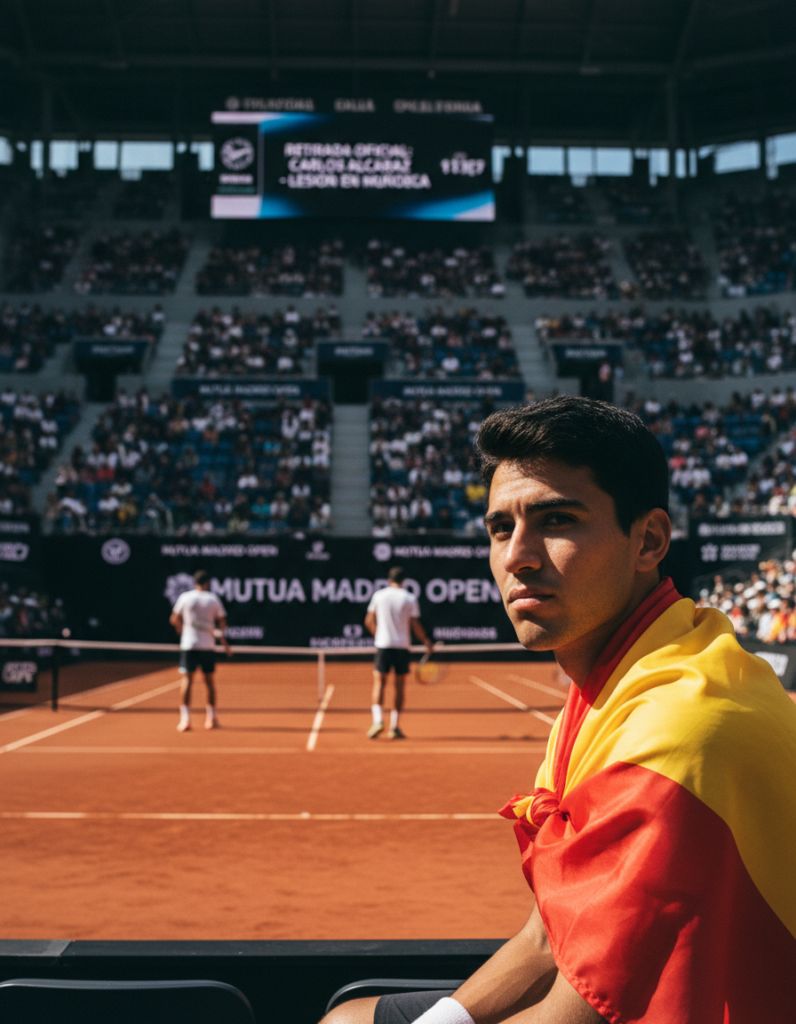
Carlos Alcaraz’s withdrawal with a wrist injury has stripped the Madrid Open of its biggest home attraction, leaving Spain’s flagship ATP Masters 1000 event to begin on April 22 without the player many fans had most wanted to see.
The Mutua Madrid Open opened on April 22 in the Spanish capital with the familiar scale and ceremony of one of the clay season’s premier events, but with an unmistakable absence hanging over the tournament. Carlos Alcaraz, Spain’s leading men’s player and one of the sport’s strongest box-office draws, pulled out days before the event because of a wrist injury, depriving the tournament of its home favorite and altering the emotional balance of the opening week.
For Madrid, the loss is sporting, commercial and symbolic all at once. Alcaraz is not simply another top seed on the entry list. He is the most magnetic figure in Spanish men’s tennis of his generation, a player whose popularity bridges hardcore tennis audiences and more casual local fans. In a tournament that depends on atmosphere as much as elite competition, his absence changes the texture of the event before a ball is struck in the main draw.
The ATP Tour confirmed that Alcaraz withdrew from the tournament because of a wrist problem, ruling him out of his home ATP Masters 1000 stop for the second straight year. His decision came after he had already pulled out of Barcelona, a sign that the injury was serious enough to force caution rather than risk an already crowded clay-court schedule. For a player whose game depends heavily on explosive acceleration, violent racket-head speed and physical improvisation, even a manageable wrist issue can quickly become a larger concern.
That made Madrid a difficult call. The tournament is among the most important on the clay calendar outside Roland Garros and Rome, and for a Spanish player it carries a significance that goes beyond ranking points. Yet elite tennis players and their teams have become increasingly cautious when injuries threaten to spill from one event into the next. With the Italian Open and then the French Open approaching, Alcaraz appears to have prioritized recovery over sentiment, even if it meant missing the home event where he would have been the central attraction.
His withdrawal leaves a visible void in a week that should have been built partly around him. The Madrid Open remains rich in talent and prestige, and the field still includes major contenders, but tournaments are not shaped only by the rankings. They are shaped by local narratives, by ticket demand, by crowd identity, and by the players who make an arena feel as though it belongs to the city hosting it. In Madrid, Alcaraz is one of the few athletes capable of doing that almost instantly.
The timing also sharpens questions about his physical condition heading into the rest of the European clay swing. Injury management in tennis is always partly opaque, because teams rarely reveal every medical detail in real time, but the public facts are enough to raise concern. A withdrawal from Barcelona can sometimes be presented as precaution. Missing Madrid as well suggests the issue has had more persistence than his camp would have hoped. That does not automatically make it a long-term problem, but it does shift the conversation from scheduling choice to competitive uncertainty.
For the tournament itself, the challenge is to move forward without appearing diminished. Madrid remains one of the sport’s marquee combined events, staged at Caja Magica and spread across a long fortnight that blends ATP and WTA narratives. The men’s main-draw first round began on April 22, according to official tournament scheduling, and the event still offers the speed, altitude and high-stakes clay-court tennis that often make it distinct from other stops in the European spring. But opening day inevitably became as much about who was not there as about who was.
That is the burden of modern tennis events built around star power. The calendar is dense, the injury load is constant and fan expectations are increasingly attached to a small cluster of headline names. When one of them disappears from the draw, especially in his home country, the entire tournament must recalibrate its storytelling. Organizers can spotlight the depth of the field, emerging names and title contenders. They can market the unpredictability created by a major withdrawal. What they cannot do is fully replace the player who was meant to be the emotional center of the week.
The broader competitive effect is also significant. Alcaraz’s absence removes one of the most dangerous clay-court players in the men’s game and opens space in the draw for rivals who might otherwise have had to plan around him. In recent seasons, he has become one of the defining presences of the surface, combining defense, improvisation and explosive offense in a way that few opponents can comfortably handle. Without him, the title picture feels wider and, for some contenders, more navigable.
That does not guarantee easier tennis. Madrid’s conditions can be tricky, and the tournament often produces matches of unusual rhythm because of the altitude and the speed with which the ball moves through the air. Players who thrive elsewhere on clay do not always dominate here in the same way. But removing Alcaraz from the bracket changes how the week is read from the outset. It takes away a likely focal point for night sessions, a source of partisan energy in the stands, and one of the few players capable of making every round feel like a local occasion.
His absence is also a reminder of how fragile momentum can be, even for the game’s brightest stars. Tennis rewards continuity, but the schedule punishes bodies relentlessly. A minor issue can quickly become a strategic concern when events stack on top of one another. For elite players, especially those with ambitions for the biggest titles, the hardest decision is often not whether they can compete, but whether they should. In Alcaraz’s case, the answer appears to have been no, however painful that may have been for the player and for the tournament.
For Spanish fans, that leaves a familiar disappointment. They are still getting a major international event on home soil, but not the version they most wanted. The hope now shifts away from Madrid itself and toward what comes next: whether the rest period is enough, whether Rome becomes realistic, and whether Alcaraz can arrive at Roland Garros healthy enough to contend. Until then, every update about his wrist will carry more importance than any early-round score in Madrid.
The tournament, meanwhile, proceeds as top events always do. Matches begin, contenders adapt, promoters pivot and the draw develops its own logic. Someone will seize the opening created by his withdrawal. New storylines will emerge. Madrid will still produce winners and losers, tension and spectacle. Yet the first days of the 2026 edition will still be defined by the same fact: one of the sport’s most electric players, and the city’s biggest tennis attraction, is watching from the outside instead of playing on center court.
In that sense, the Madrid Open has already begun with a contradiction. It remains one of the most important stops of the spring, but it starts under the shadow of an absence that everyone can feel. For the tournament, the job now is to prove that the show remains compelling without its hometown star. For Alcaraz, the more urgent task is simpler and far more important: heal, recover, and make sure one missed week in Madrid does not become something much larger.