Jeep is pausing the Wagoneer S for the 2026 model year and planning a 2027 return with upgrades to battery performance, software and drivability, a move that underscores the growing pressure on automakers to refine electric vehicles faster as competition intensifies.
Jeep is taking the unusual step of skipping an entire model year for one of its most important electric vehicles, temporarily pulling the Wagoneer S from the calendar as the brand works to improve the SUV before reintroducing it in 2027.
According to Car and Driver, the Jeep Wagoneer S will not be offered as a 2026 model and is expected to return for the 2027 model year after the company pauses production to focus on battery performance, software and overall capability. When it comes back, the electric SUV is also expected to adopt the North American Charging Standard, or NACS, allowing access to Tesla’s Supercharger network. The decision amounts to more than a product update. It is a public acknowledgment that in the current EV market, launching a vehicle is no longer enough; manufacturers also have to show they can adapt quickly when early execution falls short.
The Wagoneer S was supposed to help define Jeep’s electric future. Built on Stellantis’ STLA Large platform, it represented a high-profile attempt to translate the Jeep name into a premium battery-electric format without abandoning the brand’s performance image. In specification terms, the formula was ambitious. Car and Driver says the 2027 version will continue to offer dual motors, all-wheel drive and as much as 600 horsepower with the optional Propulsion Boost package, placing it firmly in the high-output electric SUV conversation. Yet the same publication’s assessment of the vehicle points to why Jeep may have decided a reset was necessary.
In its review of the returning 2027 Wagoneer S, Car and Driver says the model is quick but compromised by a choppy ride, grabby regenerative braking and long stopping distances. Those are not small defects in an EV positioned as both premium and modern. Range and acceleration can attract attention, but daily drivability, brake feel, ride quality and software polish are what determine whether a customer experiences an EV as advanced or unfinished. In a market where buyers are increasingly comparing not only horsepower and battery size but also interface smoothness and charging convenience, those shortcomings can become decisive.
The pause therefore looks less like a cancellation than a controlled retreat. Car and Driver, citing Automotive News and a Jeep spokesperson, reports that production is being halted so the company can work on future improvements in battery performance, software and capabilities. That wording is revealing. Battery performance speaks to the most fundamental question in EV ownership: confidence in usable range, charging behavior and efficiency. Software points to another modern battleground, where customers now expect seamless infotainment, reliable updates, intuitive energy management and fewer digital frustrations. “Capabilities” is broader, but in Jeep’s context it likely gestures toward the brand’s attempt to ensure that an electric SUV still feels aligned with the promise of toughness, confidence and real-world usability.
Jeep’s choice also reflects a larger shift in how the industry is handling electric transitions. In the first phase of the EV race, simply arriving with a credible battery-electric product could generate momentum. Now the field is maturing. Buyers have more options, expectations are higher and tolerance for half-finished execution is lower. That puts legacy automakers under a particular strain. They are not only competing against one another but also against the benchmark-setting experiences created by Tesla and, increasingly, against a market in which Chinese brands and software-centric newcomers are shaping expectations around speed of iteration.
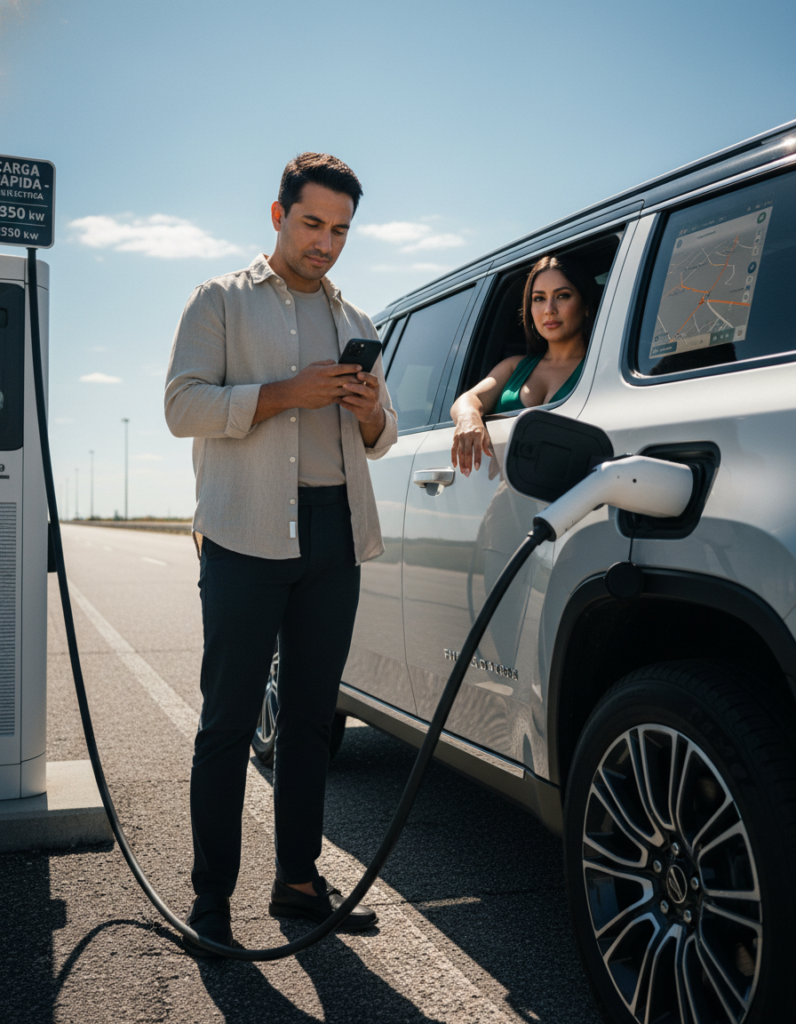
That is why the move to NACS matters almost as much as the mechanical revisions. Car and Driver reports that the Wagoneer S will return with NACS compatibility, enabling access to Tesla’s Supercharger network. In North America, charging access has become one of the most commercially important features an EV can gain, because it affects not just convenience but buyer psychology. Consumers may accept compromises in styling or even range if they believe charging will be easy, visible and dependable. Supercharger access has become, for many non-Tesla brands, a way of narrowing the gap between technical EV ownership and comfortable EV ownership.
For Jeep, this is especially important because its customer base has long been associated with freedom, distance travel and capability. An electric Jeep that raises doubts about road-trip usability or charging confidence risks clashing with the very emotional identity the brand sells. NACS adoption therefore does more than expand plug options. It helps reconnect the product to the brand story.
The timing of the pause is also telling. Car and Driver says Jeep sold 10,426 Wagoneer S models in the first nine months of 2025, but fewer than 1,000 in the next six months. Those figures suggest a sharp cooling in momentum. Sales numbers alone never tell the whole story; launch cadence, dealer inventory, incentives and production timing all matter. But such a drop is difficult to ignore. It implies that whatever initial curiosity the vehicle generated was not sustained at the same pace, which in turn strengthens the case for a mid-course correction rather than simply pushing ahead unchanged.
That creates an awkward but increasingly familiar moment for established carmakers. EVs are not refreshed like smartphones, yet the market is beginning to expect something closer to software-era responsiveness. A vehicle that feels slightly behind on software, charging standards or calibration can quickly look dated, even if its core hardware remains competitive. Skipping a model year is one of the clearest signals a manufacturer can send that it believes the existing product needs more than a light update.
There is, however, risk in that strategy. A pause can create room for improvement, but it can also create uncertainty. Dealers must keep selling the 2025 model even as the company implicitly tells the market that a better version is coming later. Customers considering a purchase may hesitate, especially if they believe the 2027 version will solve some of the current model’s weaknesses. Car and Driver notes that 2025 inventory remains available at dealerships, though it is unclear how long stock will last. That leaves Jeep in a transitional period where the outgoing version remains on sale while the brand asks consumers to trust in a future, more polished return.
The broader strategic question is what this says about Jeep’s EV roadmap. The Wagoneer S was unveiled as part of an electrified push meant to show that the brand could extend beyond internal-combustion icons like the Wrangler and Grand Cherokee. But EV transitions rarely move in straight lines, and Stellantis has already shown a willingness to adjust plans elsewhere in its North American portfolio. In that context, pausing the Wagoneer S can be read as a pragmatic response to reality rather than a reversal of ambition. The company appears to be acknowledging that if an EV is to carry a major legacy badge, it must meet a higher standard than mere compliance with the electrification trend.
That may ultimately prove healthier for the vehicle. A 2027 Wagoneer S with better battery behavior, improved software, stronger ride and brake tuning, and NACS access would likely be easier to position as a true premium electric SUV rather than as a first attempt still learning its market. The question is whether the improvements will arrive quickly and convincingly enough to matter in a segment that keeps moving.
For now, the clearest conclusion is that Jeep has chosen refinement over continuity. The Wagoneer S is not disappearing, but it is stepping back. In an industry that often prefers to frame every EV program as inevitable forward progress, that kind of pause is unusually candid. It suggests Jeep understands that the next stage of EV competition will not be won just by launching electric models under famous badges. It will be won by making them good enough, seamless enough and useful enough that buyers see no reason to wait.
Ironically, that is exactly what Jeep is now asking the market to do: wait until 2027.