
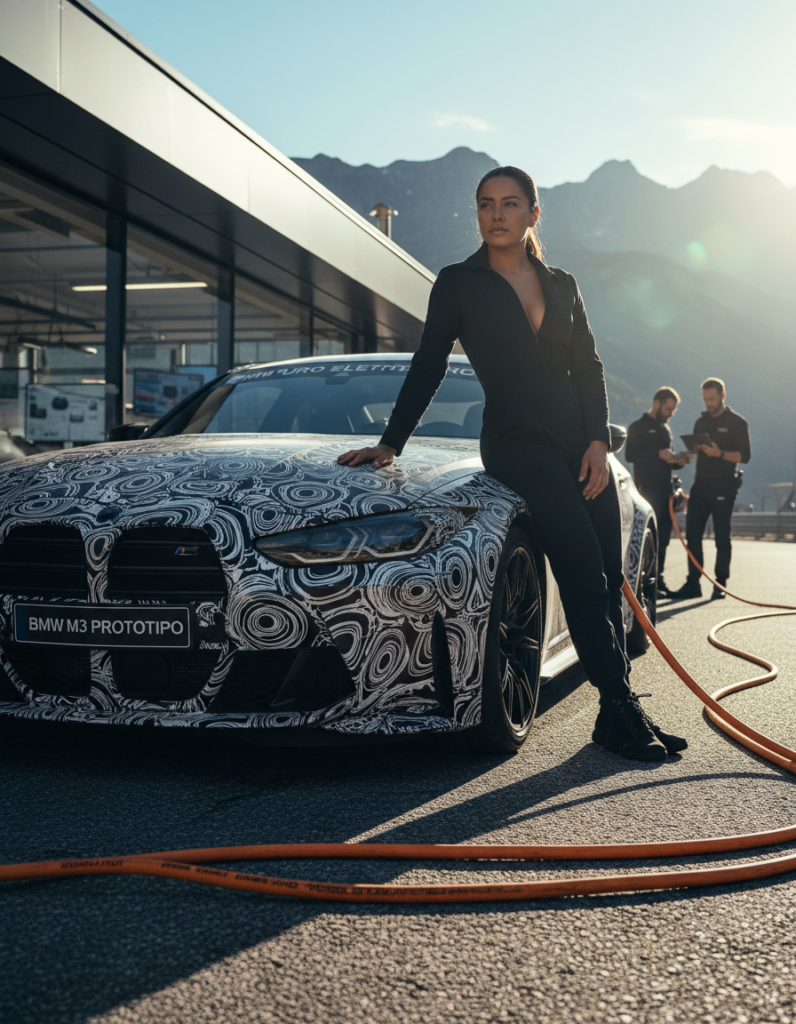
The expected 2028 launch of BMW’s first purpose-built electric M car suggests the brand is no longer experimenting at the edges of electrification, but preparing to redefine what high-performance means under the M badge.
For years, the question hanging over BMW M was not whether electrification would come, but how far the division could go before its identity began to blur.
BMW has sold fast electrified cars before. It has used plug-in hybrid technology, launched powerful battery-electric models, and openly discussed the role of software, torque vectoring and high-voltage systems in the future of driving dynamics. But the iM3, as described by Car and Driver, represents something different. It is expected to be the first fully electric M model engineered from the ground up rather than adapted from an existing combustion-era formula. That distinction matters because it marks the moment BMW M appears ready to stop treating electrification as an adjacent project and start treating it as a core chapter of the brand’s history.
According to Car and Driver’s report, the 2028 BMW iM3 will ride on BMW’s forthcoming dedicated EV architecture, use an 800-volt electrical system and likely produce more than 600 horsepower in base form. The publication also says the car may eventually use as many as four electric motors, a setup that would push the car far beyond the logic of simply building an electric replacement for the current M3. Instead, the iM3 is shaping up as a technical reset: a performance sedan designed around the possibilities of electric propulsion from the first sketch onward.
BMW’s own statements support that broader reading, even if the company has not yet released final production specifications for the iM3 itself. In January, BMW Group said the electric future of BMW M would be powered by Neue Klasse technologies, including four electric motors, an intelligent driving dynamics control system and a performance-optimized high-voltage battery. Earlier, BMW also detailed sixth-generation eDrive hardware for Neue Klasse vehicles, including 800-volt technology and cylindrical battery cells with 20% greater energy density, as part of a package aimed at improving charging speed, efficiency and range by about 30%. Those are not minor engineering updates. They are the ingredients of an entirely new performance architecture.
What makes the iM3 especially important is not simply that it will be quick. Nearly every serious electric performance car is quick. The larger issue is whether BMW can translate the specific character of an M car into an EV without reducing the experience to brute-force acceleration numbers.
That challenge has defined the early electric era for enthusiast brands. Electric vehicles have already won the horsepower war in a narrow sense. Instant torque, precise motor control and all-wheel-drive software logic allow them to deliver explosive straight-line performance almost by default. But M has never built its identity on raw speed alone. The badge means steering feel, balance, composure, repeatability, road-car usability and a certain kind of mechanical conversation between driver and chassis. It means a car that feels disciplined rather than merely violent. If the iM3 succeeds, it will not be because it is the fastest electric sedan on paper. It will be because it convinces skeptical drivers that a software-defined performance car can still feel like a BMW M
BMW appears to understand that this is the real test. The company has emphasized that its new “Heart of Joy” control unit will integrate drivetrain and driving-dynamics functions in a single high-speed computer, coordinating propulsion, braking, recuperation and steering behavior far more tightly than in previous generations. BMW says the system processes information ten times faster than earlier architectures and is designed to make the vehicle more precise, more efficient and more stable through corners and braking zones. In ordinary corporate language, those claims could sound abstract. In the context of an M car, they point to something more concrete: BMW is trying to replace part of the old emotional logic of combustion performance with a new digital logic of responsiveness and control.
That is why the iM3 is more consequential than another premium EV launch. It is a referendum on whether legacy performance brands can carry their mythology across a technological rupture. Porsche is already wrestling with that question. Mercedes-AMG is wrestling with it. Audi Sport is wrestling with it. BMW M now seems ready to answer in a serious way, and the M3 is the right battleground. Within BMW’s lineup, the M3 has long been more than a fast sedan. It is the ideological center of the brand’s performance identity: practical enough for daily use, disciplined enough for track work, and iconic enough that any major change to it reads as a statement about the future of driving itself.
Car and Driver notes that the iM3 is expected to be sold alongside a new gasoline-powered M3 rather than replacing it outright. That detail is crucial. BMW is not forcing an immediate binary choice between the old religion and the new one. Instead, it appears to be pursuing a dual-track strategy: keep combustion alive for enthusiasts who still want it, while using the iM3 to prove that electric performance can stand on its own merits. This is a commercially cautious move, but also a smart one culturally. Enthusiast loyalty is rarely won by declaring the past obsolete. It is won by building something new that earns respect gradually.
The likely specification profile strengthens the sense that BMW is thinking beyond symbolic compliance. An 800-volt system matters not just for engineering prestige but for everyday credibility. Higher-voltage architectures typically allow faster charging, better thermal efficiency and more consistent performance under repeated use, especially in demanding conditions. In the world of performance EVs, that consistency is critical. A car that produces headline numbers once and then fades under heat stress does not really satisfy the M tradition. The same is true of battery and software integration. BMW has said its next-generation EV technology will seek gains in charging speed, efficiency and range, which suggests the iM3 is being built to function as a real car, not just a showroom statement.
There is also a broader brand implication. The electric iM3 is arriving as BMW’s Neue Klasse program becomes the company’s main architectural bridge into its next era. That means the car will likely carry more symbolic burden than a niche halo model would. It will not just show what BMW M can do. It will help define what BMW believes an electric sport sedan should be in design, software, charging behavior and driver interaction. If it lands well, it could shape expectations far beyond M. If it misfires, the backlash will not be confined to one model line.
That is what makes the iM3 one of the most closely watched EV projects in the performance world right now. Not because BMW is the first automaker to build a fast electric sedan. It is not. Not because 600-plus horsepower is shocking. It no longer is. The story matters because the iM3 appears to be BMW M’s first full attempt to treat electric performance as a native language instead of a translated one.
For the wider industry, that shift carries meaning. The first wave of electric performance cars often fell into two traps: they were either technically impressive but emotionally distant, or exciting in short bursts but compromised by weight, heat or inconsistency. The next wave needs to do more. It needs to make electrification feel not like a sacrifice dressed up as progress, but like a legitimate expansion of what a performance car can be. BMW’s public focus on motor control, integrated chassis software, high-voltage hardware and purpose-built EV packaging suggests it knows this
That is why the iM3 deserves attention even before full production details arrive. It is not merely another future BMW. It is a test of whether one of the most important performance badges in modern automotive history can survive electrification without becoming generic. The numbers will matter. The lap times will matter. But the deeper question will be harder and more interesting: can an electric M3 still feel like an M3?
By 2028, BMW intends to offer its answer. And for the first time, it looks ready to answer without compromise.

