
The race for cheaper, faster and cleaner batteries is deciding which companies and countries will lead the next era of cars.
For more than a century, the engine was the heart of the car. It shaped performance, identity and industrial power. In the electric age, that role is moving to the battery.
Battery technology now sits at the center of the automotive world. It determines how far an electric car can travel, how quickly it can charge, how much it costs and how sustainable it really is. It also shapes global supply chains that stretch from mines to refineries, cell factories and recycling plants.
The rapid rise of electric vehicles has created enormous demand for battery materials. Lithium, nickel, cobalt, manganese and graphite have become strategically important resources. Countries that once focused on oil security now worry about mineral security. Governments in North America, Europe and Asia are investing in domestic supply chains, hoping to reduce dependence on concentrated processing hubs.
China currently holds a dominant position in battery manufacturing and processing. Its companies have built scale, technical expertise and close relationships with automakers. Battery giants are competing to improve energy density, reduce cost and shorten charging times. At major auto shows, charging speed has become a headline feature, with companies promising that drivers can add significant range in minutes rather than hours.
For consumers, these improvements matter because they address the most persistent concerns about electric vehicles. Range anxiety has declined as newer models travel farther on a charge, but charging time remains a barrier for drivers used to gasoline refueling. If fast-charging batteries become cheaper and widely available, one of the strongest arguments against EVs will weaken.
Cost is equally important. Batteries are the most expensive component in many electric cars. Lower battery prices can make EVs more affordable and allow automakers to compete without large subsidies. That is why companies are exploring different chemistries, including lithium iron phosphate batteries that reduce reliance on nickel and cobalt. Some are studying sodium-ion batteries, which could use more abundant materials, though their performance characteristics differ.
Solid-state batteries remain one of the industry’s most anticipated technologies. They promise higher energy density and improved safety, but mass production has proven difficult. Automakers and battery firms continue to invest heavily, yet timelines remain uncertain. The history of battery development suggests that breakthroughs are possible, but scaling them safely and cheaply is the hardest part.
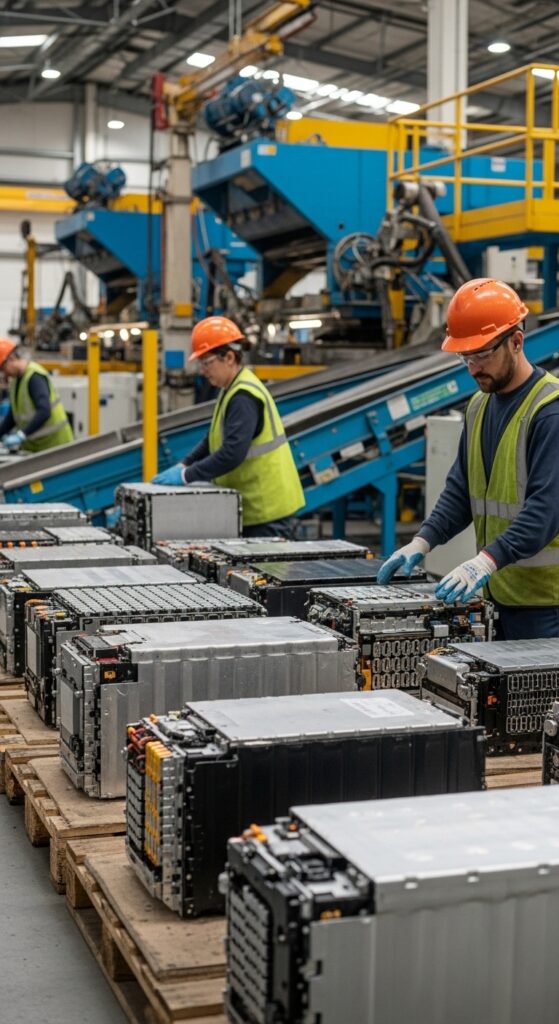
Environmental questions remain. Electric cars do not emit exhaust, but battery production can be energy-intensive. Mining can damage landscapes and communities if poorly regulated. Cobalt supply chains have faced scrutiny over labor conditions. Recycling is expected to reduce future pressure on mining, but the industry is still developing the systems needed to process batteries at large scale.
The battery race is also a labor story. New factories can bring thousands of jobs, but they may be located far from traditional engine plants. Workers trained for combustion powertrains may need new skills. Communities that depended on engine and transmission production are watching closely to see whether battery investment will replace lost employment or move it elsewhere.
Automakers that master batteries will control more of their destiny. Those that rely too heavily on outside suppliers may face cost disadvantages or shortages. Some companies are forming joint ventures with battery producers. Others are building in-house expertise. The old competition over engines has become a competition over cells, software and supply chains.
The future car may be judged by design, comfort and brand, but its success will depend heavily on the battery hidden beneath the floor. In the electric era, the battery is not merely a component. It is the new engine of industrial power.”””
