
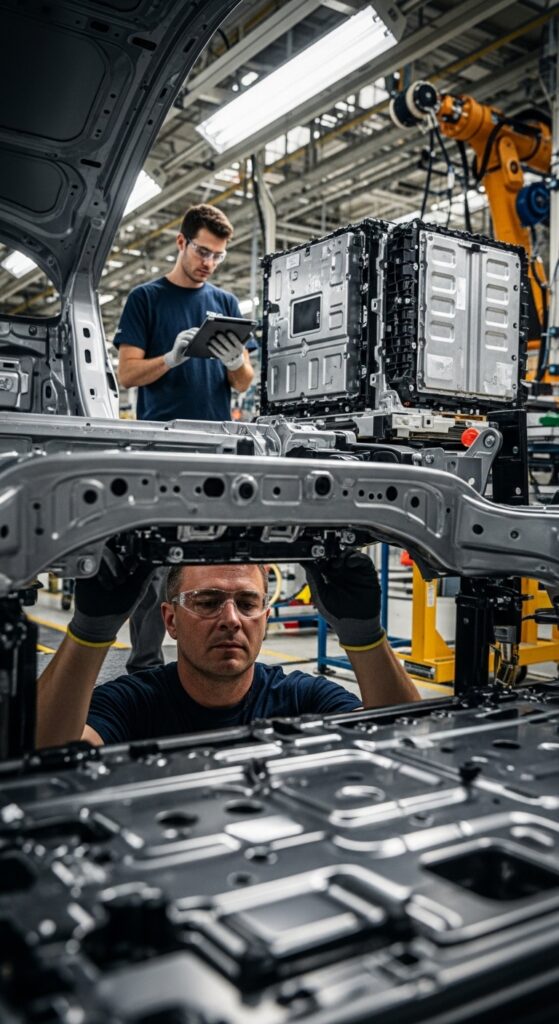
As cars shift from engines to batteries and software, workers and communities built around traditional manufacturing confront an uncertain future.
The transformation of the automobile is not only technological. It is human. Behind every electric car, hybrid system and software-defined dashboard is a workforce being asked to adapt to one of the largest industrial shifts in modern manufacturing.
For generations, auto jobs were built around engines, transmissions, exhaust systems and the complex mechanical architecture of gasoline and diesel vehicles. Electric cars change that equation. They have fewer moving parts, different supply chains and a greater need for battery, electronics and software expertise. The result is both opportunity and anxiety.
New battery plants are rising in several countries, supported by government incentives and automaker investment. These factories can create thousands of jobs and help regions compete in the clean-technology economy. But they do not always appear in the same places as old engine plants, and the jobs may require different skills. For workers in traditional powertrain facilities, the transition can feel less like progress than displacement.
Labor unions have warned that the electric shift must not become a race to lower wages. In the United States and Europe, unions have pushed automakers and governments to ensure that battery jobs provide stable pay, safety protections and long-term security. The argument is simple: if public money supports the electric transition, workers should share in the benefits.
Automakers face their own pressure. They must invest heavily in new technology while maintaining profits in a competitive market. Electric vehicles can be expensive to develop, and price wars have reduced margins in some regions. Companies are looking for efficiency wherever they can find it. That can mean automation, restructuring and job cuts, even as new plants open elsewhere.
The skills required in the auto industry are changing quickly. Mechanical expertise remains important, but software, data analysis, battery chemistry and power electronics are becoming central. Training programs are trying to prepare workers for the new environment. The challenge is speed. Industrial communities cannot be rebuilt overnight, and older workers may not find it easy to move into new roles.
The shift also affects suppliers. Thousands of smaller companies produce components for combustion vehicles. Some can adapt to electric platforms; others may lose business as parts become unnecessary. Exhaust systems, fuel injection components and certain transmission parts face long-term decline. Suppliers that move into thermal management, battery housings, sensors and electronics may find new growth.
Governments are increasingly involved. Industrial policy has returned to the center of automotive strategy. Subsidies, tax credits and local-content rules are being used to attract factories and secure supply chains. Policymakers want cleaner transport, but they also want domestic jobs and strategic independence. Cars have become tools of economic policy as much as consumer products.
For workers, uncertainty is the defining emotion. Many understand that the industry must change. They also want assurance that the future will include them. A cleaner car market built on insecure work would carry political risks. Communities that feel abandoned can resist environmental policies, even when they support cleaner air and lower fuel costs.
The auto industry has survived major transformations before: mass production, globalization, robotics and digital design. Each wave created winners and losers. The electric and software revolution may be just as disruptive. Its success will not be measured only in battery range or sales charts. It will also be measured in whether workers can move with the industry rather than be left behind by it.”””
