
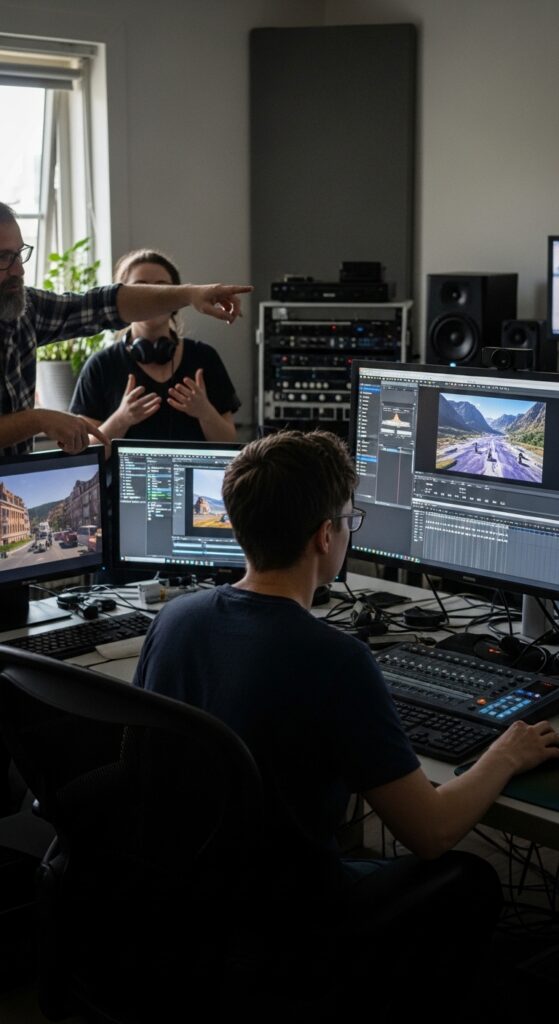
From script development to music generation and visual effects, AI is becoming a powerful tool while raising urgent questions about ownership, labor and authenticity.
Artificial intelligence has entered the entertainment industry with the force of a new production system. It can generate images, imitate voices, assist editing, translate dialogue, summarize scripts and create music-like compositions. For executives, it promises speed and efficiency. For artists, it brings both opportunity and fear.
The entertainment business has always adopted new tools. Sound changed cinema. Digital editing changed postproduction. Streaming changed distribution. AI may prove just as significant because it reaches into the creative process itself. It does not merely deliver entertainment; it can help make it.
Studios are exploring AI for development and production. The technology can analyze audience trends, generate concept art, assist visual effects and localize content for international markets. Smaller creators can use AI to produce material that once required large teams. A filmmaker with limited resources may now create storyboards, rough effects or translated versions faster than before.
The music industry faces a particularly urgent challenge. AI systems can generate vocals and instrumentals that resemble existing artists. Some fans see novelty. Rights holders see a threat to identity and copyright. The central question is whether an artist’s voice, style or past recordings can be used to train or create new material without permission.
Actors have similar concerns. Digital replicas could allow studios to reuse a performer’s likeness or voice beyond the original work. Background performers have warned that scans of their bodies could reduce future employment. Contracts increasingly need to define how digital images may be used, stored and compensated.
Writers are also watching closely. AI can produce outlines, dialogue and summaries, but it lacks lived experience, moral judgment and genuine intention. Still, companies under financial pressure may be tempted to use AI to reduce development costs. Writers argue that technology should assist human creativity, not replace it or weaken credit.
The public may become more skeptical as synthetic entertainment spreads. If a song, actor, video or interview can be generated, audiences will need ways to know what is real. Authenticity may become more valuable, not less. Live performance, behind-the-scenes transparency and trusted creators could gain importance in a world of easy imitation.
At the same time, AI can expand access. Independent artists, small studios and creators in countries with fewer production resources may use the tools to compete globally. Translation and dubbing can help stories cross borders. Accessibility features can improve entertainment for viewers with disabilities. The technology’s impact will depend heavily on rules, ethics and market power.
Regulation is still catching up. Copyright law was not designed for systems trained on massive datasets of text, music, images and video. Courts and lawmakers are being asked to decide how existing creative works can be used and what rights apply to synthetic outputs. The answers will shape entertainment for decades.
The industry’s challenge is to avoid a false choice between innovation and protection. AI can be useful without being uncontrolled. It can reduce repetitive work while preserving human authorship. It can help creators reach audiences without turning creativity into a machine-led race to the cheapest product.
Entertainment depends on emotion, memory, identity and surprise. AI can imitate patterns, but the value of art is not only in pattern. It is in the human meaning audiences attach to it. The future will not be decided by whether AI enters entertainment. It already has. The question is whether human creativity remains at the center.”””
