
Artificial intelligence is becoming a powerful creative assistant, but its rise is forcing artists, studios, platforms and regulators to redefine authorship, ownership and trust.
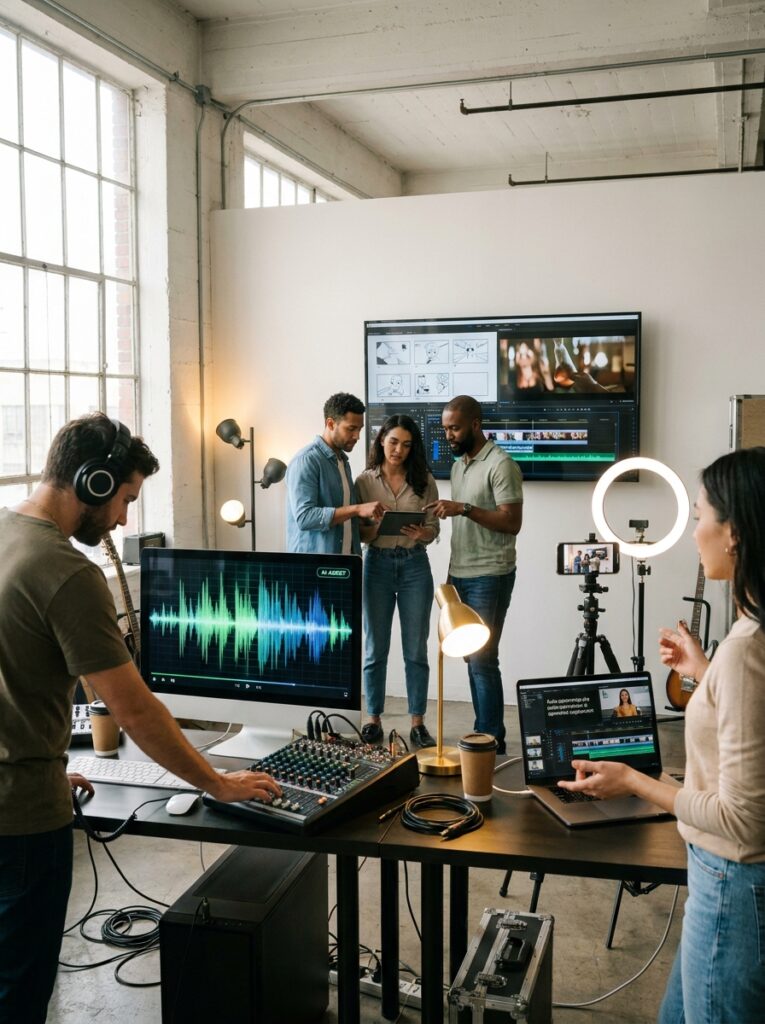
Artificial intelligence has entered the creative industries not as a distant experiment, but as a daily working tool. In music studios, it can suggest melodies, clean recordings, separate vocals from instruments and imitate voices. In film production, it can help generate storyboards, build visual effects, translate dialogue, de-age actors and organize vast amounts of footage. For online creators, it can write captions, cut videos, produce thumbnails, translate scripts, generate images and analyze audience behavior. The result is a creative economy moving faster than its legal, ethical and cultural rules.
The most important fact about AI in entertainment is that it is not one technology. It is a collection of tools that affect different stages of creation. Some AI systems assist with routine tasks, such as noise reduction, color correction, transcription or editing. Others generate new material, including songs, voices, images, video sequences and scripts. The difference matters. A tool that helps a composer mix a track raises fewer concerns than a system trained on millions of songs that can produce music in the style of living artists. A translation system that helps a filmmaker reach a wider audience is different from a digital replica that uses an actor’s face or voice without meaningful consent.
In music, AI has already become both useful and disruptive. Producers use machine-learning tools to master tracks, isolate stems, correct pitch, search sound libraries and test arrangements. Independent musicians can now access capabilities that once required expensive studios. A songwriter can create a demo faster, experiment with genres and distribute work globally with fewer intermediaries. For artists outside major music centers, this can be empowering. AI can reduce technical barriers and allow more people to participate in professional-sounding production.
But music also shows the sharpest risks. Voice cloning can imitate singers with disturbing accuracy. Generative systems can produce tracks that resemble existing styles, raising questions about whether the underlying training data was licensed and whether artists should be paid when their work helps build commercial models. The problem is not simply that AI can make songs. The problem is that music depends on identity, emotion, memory and reputation. A voice is not just sound. It is a performer’s signature, labor and commercial value.
Streaming platforms face another challenge: volume. AI can produce enormous amounts of music quickly, creating opportunities for experimentation but also for spam, fraud and royalty manipulation. If platforms are flooded with low-quality or fake tracks, human artists may find it harder to be discovered and fairly compensated. The future of AI music will therefore depend on licensing, labeling and enforcement. Listeners may accept AI-assisted music, but they are likely to demand transparency when a voice, song or artist identity is synthetic.
In film, AI is changing production from development to distribution. Writers and producers can use AI to summarize research, compare script drafts or visualize scenes before filming. Directors can generate concept art and previsualization at lower cost. Editors can search footage more efficiently, synchronize sound, remove unwanted objects and create rough cuts. Visual effects teams can use AI to accelerate rotoscoping, background generation, facial adjustments and crowd scenes. Dubbing and subtitling can also become faster and more natural, helping films travel across languages and markets.
These uses may make filmmaking more accessible. A small team can now attempt work that previously required a large studio pipeline. Independent creators can make pitch materials, short films and visual worlds with limited budgets. For documentary filmmakers, AI tools can restore old footage, improve audio and analyze archives. For animation and genre cinema, they can reduce some production bottlenecks. In that sense, AI may expand who gets to tell stories.
At the same time, the film industry is built on human performance, writing, directing, design and craft. That is why AI became a major issue in Hollywood labor negotiations. Writers worry that studios may use AI-generated material to reduce human employment or weaken credit and compensation. Actors worry that digital replicas may allow their likeness, body or voice to be reused without proper consent or payment. Editors, illustrators, voice actors, animators and visual effects workers face similar concerns. The question is not whether AI should exist in film. It is who controls it and who benefits from the productivity it creates.
The most responsible studios are likely to treat AI as a supervised production tool rather than a replacement for creative judgment. An AI-generated storyboard does not know whether a scene is emotionally honest. A synthetic background does not understand a director’s intention. A generated performance may imitate expression, but it does not carry lived experience. Film audiences respond not only to image and sound, but to the belief that a human story is being communicated. If AI becomes too invisible or too exploitative, it may damage the trust that entertainment depends on.
For content creators, AI is already transforming daily workflow. A solo creator can use AI to brainstorm video ideas, draft scripts, create captions, translate clips, generate background music, design thumbnails and repurpose one long video into multiple short posts. This helps creators publish more frequently and reach audiences across languages and platforms. It also allows small businesses, educators and journalists to produce professional-looking media without large teams.
The danger is that AI may intensify the pressure to produce constantly. Social platforms already reward speed, volume and trend awareness. Generative tools can make that cycle even faster. When every creator can generate more content, audiences may face more noise, not more meaning. The value of human judgment, taste and authenticity may rise precisely because synthetic content becomes abundant. In the creator economy, trust may become the rarest commodity.
AI also changes how audiences discover entertainment. Recommendation systems decide what songs appear in playlists, what videos appear in feeds and what films are promoted on streaming platforms. These systems shape culture by directing attention. They can help niche artists find audiences, but they can also narrow taste, reinforce trends and make creators dependent on opaque algorithms. In the digital entertainment economy, AI is not only making content. It is deciding which content becomes visible.
Copyright remains the unresolved center of the debate. Creative industries argue that AI companies should not train commercial systems on protected works without permission, transparency or compensation. AI developers often argue that training models is a form of learning or analysis and that strict licensing could slow innovation. Courts and lawmakers are still working through these questions. What is already clear is that creators want control over how their work, voice, image and style are used. Without that control, AI may be seen less as innovation and more as extraction.
The law is also drawing a line around authorship. In many jurisdictions, copyright protection depends on human creativity. Fully machine-generated work may receive little or no protection, while AI-assisted work can be protected when a human contributes meaningful selection, arrangement, editing or expression. This distinction will become increasingly important. Future creative credits may include not only writers, directors, musicians and editors, but also AI supervisors, dataset licensors, prompt designers and synthetic media coordinators.
The economic impact will be uneven. AI may lower costs for small creators, but it may also allow large companies to scale content production more aggressively. It may create new jobs in AI supervision, rights management, synthetic performance, model auditing and content verification. It may also reduce demand for some entry-level creative tasks that once helped young workers learn their craft. The entertainment industry must be careful not to automate away the apprenticeship paths that create future artists.
Audiences will ultimately decide how much AI they accept. Some will embrace AI-generated music, virtual actors and synthetic influencers. Others will prefer clearly human-made work, live performance and authentic voices. Many will accept a hybrid model: AI for tools, humans for meaning. The market may divide not between AI and non-AI entertainment, but between transparent and deceptive uses of AI.
The future of AI in music, film and content creation will not be defined by technology alone. It will be defined by consent, compensation, disclosure and artistic purpose. Used responsibly, AI can help musicians experiment, filmmakers visualize and creators reach global audiences. Used carelessly, it can flood platforms with imitation, weaken labor rights and erode trust in what people see and hear.
The creative industries have survived every major technological disruption by absorbing the tool and defending the value of human imagination. AI will likely follow the same pattern. It will become part of the studio, the editing room, the writer’s desk and the creator’s phone. But the most valuable work will still come from people who know what they want to say, why it matters and how to make an audience feel that it was made for them.
“””
