
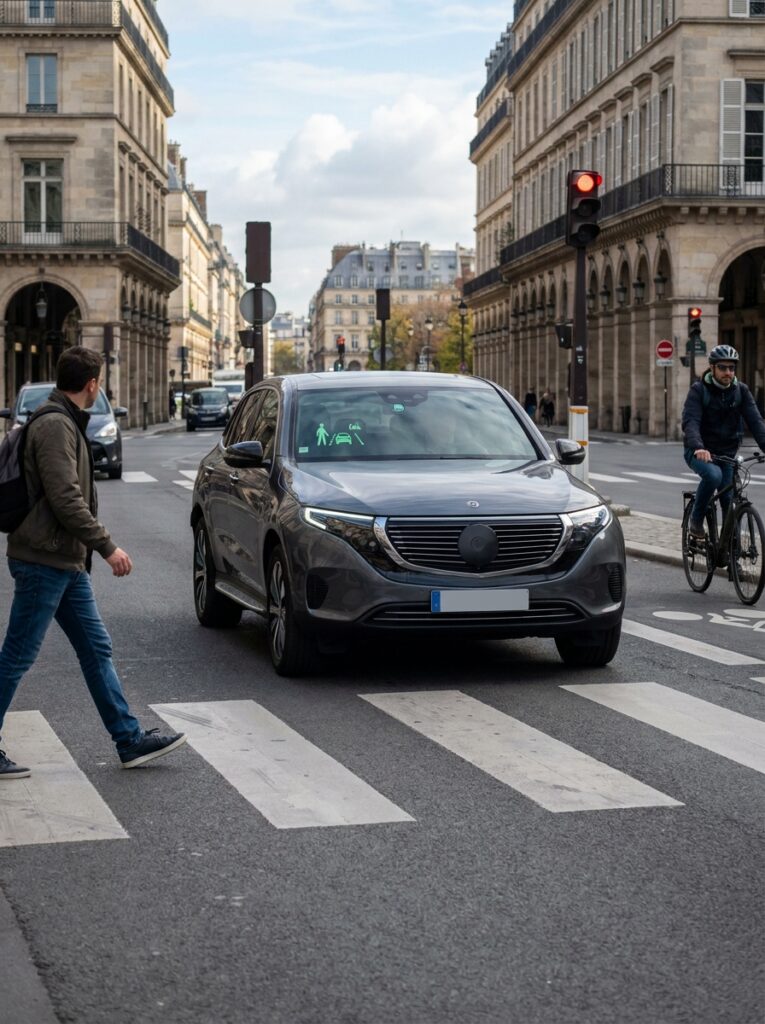
From automatic braking to driver monitoring, a new generation of safety systems is moving the automobile from passive protection toward active crash prevention.
For decades, car safety was measured mainly by what happened after a crash. Stronger structures, airbags, crumple zones and seat belts saved lives by protecting occupants when impact was unavoidable. That era is not over. The basic physics of a collision still matter, and a well-engineered body shell remains essential. But the most important shift in modern automotive safety is happening before the crash. Today’s safest cars are increasingly designed not only to survive collisions, but to predict, warn, intervene and sometimes prevent them altogether.
The central technology in this transformation is automatic emergency braking, often called AEB. Using cameras, radar or a combination of sensors, the system monitors the road ahead and looks for a vehicle, pedestrian or obstacle in the car’s path. If the driver fails to respond quickly enough, the car can warn the driver and then apply the brakes automatically. In some cases, AEB may avoid a crash entirely. In others, it may reduce the speed of impact, which can make the difference between a minor collision and a life-threatening one.
Pedestrian automatic emergency braking has become especially important as road deaths involving people outside vehicles remain a major concern in many countries. A pedestrian is far more vulnerable than someone protected by a vehicle cabin, airbags and seat belts. Modern pedestrian AEB systems are designed to recognize people crossing or walking near the road and brake if the driver does not act. The technology is not perfect. Darkness, rain, unusual clothing, complex intersections and high speeds can still challenge sensors. But its growing presence shows how safety engineering is expanding beyond occupants to include everyone sharing the street.
Blind-spot warning is another technology that has moved from luxury models to mainstream vehicles. The system uses rear-facing sensors to detect vehicles traveling in areas that may be difficult for the driver to see. A light in the side mirror, a sound or a steering-wheel vibration can alert the driver before a lane change. More advanced blind-spot intervention systems go further. If the driver begins to move toward a vehicle in the blind spot, the car can provide steering assistance or braking pressure to help prevent a side collision.
Lane-departure warning and lane-keeping assist address one of the most common causes of serious crashes: drifting out of a lane. A lane-departure system warns the driver when the car begins to leave its lane without a turn signal. Lane-keeping assist can gently steer the vehicle back toward the center of the lane. Lane-centering systems, often paired with adaptive cruise control, can provide more continuous assistance on highways. These technologies can reduce fatigue on long drives, but they are not substitutes for attention. Poor lane markings, construction zones, snow, heavy rain and sharp curves can limit their effectiveness.
Adaptive cruise control has also changed highway driving. Traditional cruise control maintained a set speed. Adaptive cruise control adjusts speed automatically to keep a safe distance from the vehicle ahead. In traffic, some systems can slow the car to a stop and then resume movement when traffic clears. The safety benefit is not only convenience. By smoothing speed changes and reducing tailgating, adaptive cruise control can help lower the risk of rear-end crashes. Still, the driver must understand how the system reacts and must be ready to brake or steer at any moment.
Rear cross-traffic warning and rear automatic braking are particularly useful in parking lots, driveways and crowded urban spaces. Rear cross-traffic warning alerts a driver when another vehicle, cyclist or pedestrian approaches from the side while the car is reversing. Rear automatic braking can stop the vehicle if the system detects an imminent collision behind it. These features may appear minor compared with high-speed crash prevention, but many injuries and property-damage incidents happen at low speeds in places where visibility is poor.
Driver monitoring is becoming one of the most consequential safety developments in modern vehicles. As cars gain more automated assistance, the risk of driver overconfidence rises. A camera-based driver monitoring system can detect whether the driver is looking at the road, showing signs of distraction or possibly becoming drowsy. Some systems issue warnings. Others may slow the vehicle or limit the use of advanced assistance if the driver is not paying attention. This technology reflects a hard truth: the safest vehicle is not only the one that watches the road, but also the one that knows whether the human driver is still engaged.
The latest safety conversation also includes occupant monitoring. Sensors inside the cabin can detect whether passengers are seated correctly, whether a child may have been left in the vehicle, or whether airbags and seat-belt tensioners should respond differently based on occupant size and position. In the future, interior monitoring could help protect children, elderly passengers and people who may be more vulnerable in a crash. It also raises privacy questions, because cameras and sensors inside the cabin collect sensitive data. Automakers will need clear rules on what is recorded, stored and shared.
Headlights remain one of the most underrated safety technologies. Advanced LED headlights, adaptive beams and automatic high-beam systems can dramatically improve nighttime visibility. Poor headlights can limit even the best driver’s reaction time. Adaptive systems can direct light into curves, reduce glare for oncoming traffic and illuminate pedestrians or obstacles sooner. Safety organizations have increasingly emphasized headlight performance because many serious crashes occur at night, when visibility is limited and reaction windows are shorter.
Vehicle-to-vehicle and vehicle-to-infrastructure communication may become the next major leap. These systems allow cars to exchange information with other vehicles, traffic lights, road signs or emergency services. A vehicle could warn another car about sudden braking ahead, black ice around a curve or an approaching emergency vehicle before the driver can see it. The promise is significant, but the challenge is coordination. Communication standards, cybersecurity, infrastructure investment and broad adoption are all necessary before this technology can deliver its full safety value.
Modern safety also depends on software. Cars are now updated much like smartphones, with manufacturers able to improve braking logic, driver-assistance behavior or sensor calibration after the vehicle has been sold. This creates a powerful opportunity to fix problems and refine performance quickly. It also creates responsibility. Software errors in a safety-critical system can have real-world consequences. Automakers must test updates carefully, communicate changes clearly and make sure drivers understand when a vehicle’s behavior has changed.
The limits of these technologies must be stated plainly. Advanced driver-assistance systems are not self-driving systems. They assist the driver; they do not remove the driver’s responsibility. Marketing terms can confuse consumers, especially when systems control steering and speed under certain conditions. A car that can follow a lane on a highway is not a car that can handle every road, weather condition or emergency. The most dangerous safety technology is one that encourages the driver to trust it more than it deserves.
For buyers, the safest approach is to look beyond feature names. Different manufacturers use different terms for similar systems, and performance can vary widely. A vehicle may advertise automatic braking, but buyers should ask whether it detects pedestrians at night, whether blind-spot intervention is included or only a warning, whether lane keeping works reliably, and whether driver monitoring is camera-based or only dependent on steering-wheel input. Independent crash tests and safety ratings are often more useful than brochures.
The most advanced safety package is not necessarily found only in expensive cars. As regulations and rating programs become tougher, technologies once reserved for premium models are appearing in compact cars, family sedans and mainstream SUVs. That democratization matters. Safety has the greatest social benefit when it is standard, not optional. A feature that saves lives should not be hidden in a costly luxury package.
The future of automotive safety will be defined by prevention, cooperation and accountability. Cars will continue to become stronger, but they will also become more aware. They will watch traffic, read lanes, monitor drivers, protect pedestrians, warn cyclists, communicate with infrastructure and adapt through software. The result could be roads where fewer mistakes become tragedies. But technology alone will not deliver that future. Drivers must understand the systems, automakers must design them responsibly, regulators must test them rigorously, and safety must remain a public priority rather than a marketing slogan.
“””
