
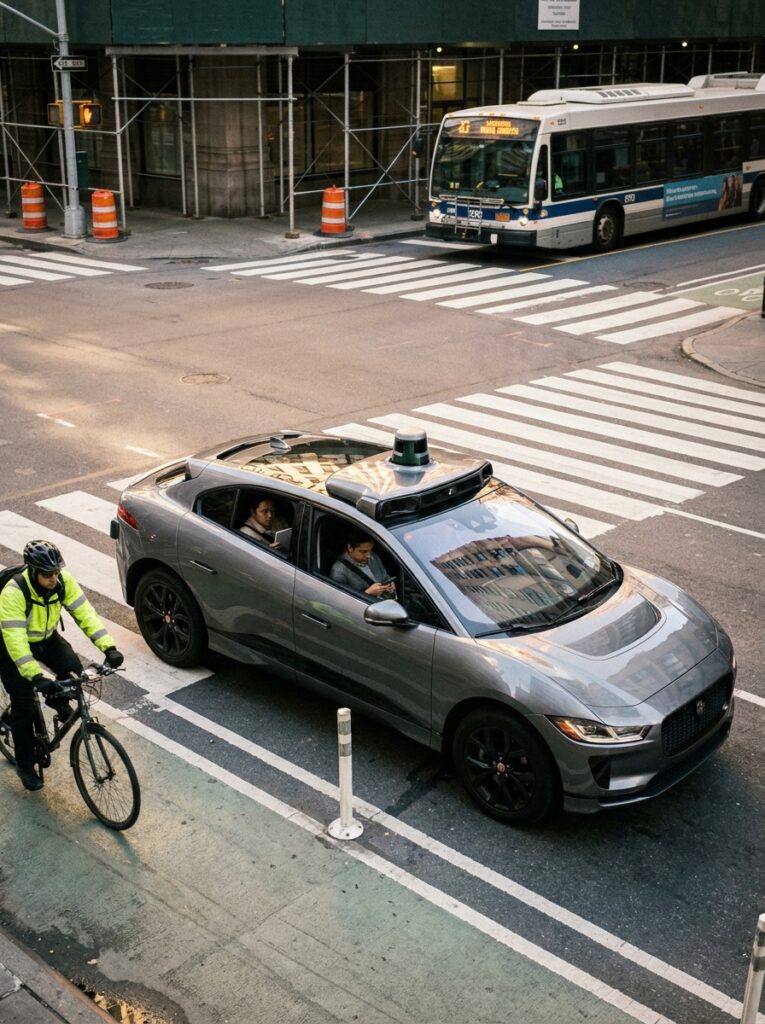
Autonomous driving is moving from promise to deployment, but the next decade will be defined as much by regulation, trust and software discipline as by artificial intelligence itself.
The future of the automobile is no longer being shaped only by engines, batteries and sheet metal. It is increasingly being written in code. Artificial intelligence is changing how vehicles see the road, how they respond to danger, how they communicate with drivers and how automakers think about the business of transportation. The self-driving car, once treated as a futuristic symbol, is now becoming a practical test of whether AI can safely operate in the messy, unpredictable world of public streets.
Yet the transition is uneven. In a few cities, robotaxis already carry passengers without a human driver behind the wheel. In most of the world, however, the cars sold to consumers remain far from fully autonomous. They can steer within a lane, adjust speed, brake in emergencies, monitor blind spots and help with parking. They cannot broadly replace an alert human driver. That distinction will define the industry’s next phase.
The most important change is that self-driving technology is becoming operationally real before it becomes universally available. Robotaxis are likely to advance faster than privately owned fully autonomous cars because they can be deployed inside mapped, monitored and restricted areas. A company can limit where the vehicle operates, control maintenance, update software centrally, collect performance data and pause service during extreme weather or unusual road conditions. A privately owned autonomous car must handle a much wider range of roads, weather, driver behavior and maintenance quality.
This is why the first large-scale future of autonomy may look less like a person buying a car that drives anywhere and more like a city resident ordering a driverless ride. The robotaxi model fits the current limits of technology. It allows companies to focus on dense urban and suburban zones where demand is high and conditions can be studied in detail. It also gives regulators a clearer target: fleets, operators, service areas and crash data, rather than millions of individual owners using automated systems in unpredictable ways.
Artificial intelligence is the engine behind that shift. Modern autonomous systems use AI to interpret camera images, radar returns, lidar point clouds, maps and vehicle data. They must identify pedestrians, cyclists, traffic lights, construction zones, emergency vehicles, lane markings, animals, debris and human gestures. They must predict what other road users might do next, then choose a safe path in fractions of a second. The technical challenge is not simply driving in normal traffic. It is handling the rare events that human drivers may see only a few times in a lifetime.
The industry is also moving toward more integrated AI models. Earlier systems often separated perception, prediction and planning into distinct software layers. Newer approaches increasingly use large neural networks and end-to-end learning to connect raw sensor inputs more directly to driving decisions. Supporters argue that this can make vehicles more adaptable and less dependent on hand-coded rules. Critics warn that complex AI models can be difficult to explain, validate and audit. In safety-critical transportation, performance is not enough. Regulators and the public will also demand evidence that the system behaves reliably under stress.
Inside the vehicle, AI is advancing even faster than full autonomy. Driver monitoring cameras, voice assistants, cabin sensors and predictive maintenance systems are becoming standard elements of the modern car. A vehicle can now detect whether a driver is distracted, drowsy or looking away from the road. It can adjust climate settings, recommend charging stops, warn about mechanical issues and personalize navigation. The car is becoming a software-defined environment, not merely a machine that moves people from one place to another.
This trend will reshape the relationship between automakers and customers. In the past, a car was largely finished when it left the factory. In the AI era, it can change through software updates. Features may improve, interfaces may be redesigned and driver-assistance functions may be refined after purchase. That creates opportunity, but it also creates tension. Consumers will ask who owns the data, who controls the software, how long updates will be provided and whether essential features should depend on subscriptions.
Safety remains the central issue. Human driving causes enormous harm worldwide, and automated systems could eventually reduce crashes linked to distraction, fatigue, speeding and impaired driving. But autonomous systems introduce different risks: sensor failures, software errors, confusing handoff between machine and human, cyberattacks and unexpected behavior in unusual conditions. A self-driving car does not need to be perfect to be valuable, but it must be demonstrably safer than the alternative in the places and conditions where it operates.
The handoff problem is especially important for consumer vehicles. Partial automation can make driving feel easier, but it can also encourage overconfidence. If a system controls steering and speed, some drivers may stop paying close attention even when they remain legally and practically responsible. That is why driver monitoring is becoming a major safety battleground. The future car will not only watch the road. It will watch the person who is supposed to be supervising it.
Regulation will determine how quickly the industry moves. Governments face a difficult balance. If rules are too restrictive, they may slow technologies that could save lives. If rules are too permissive, they may allow immature systems onto public roads and damage public trust after preventable failures. The most effective approach is likely to be staged: clear reporting requirements, independent safety assessment, defined operating domains, cybersecurity standards and transparent communication about what a system can and cannot do.
Public trust may be harder to win than technical progress. A human driver can make a terrible mistake and still be seen as part of an accepted risk. An autonomous vehicle that makes a similar mistake may trigger national attention and political backlash. That asymmetry means self-driving companies must meet a higher standard of explanation. They will need to show not only that their vehicles work, but that failures are investigated, lessons are shared and improvements are made.
The economic impact could be profound. Robotaxis could reduce the cost of ride-hailing if companies can remove the human driver while maintaining safety and service quality. Logistics companies may use autonomous trucks on specific highway corridors. Automakers may earn more from software, data services and fleet operations. At the same time, professional drivers, repair shops, insurers and city planners will face disruption. The shift will not arrive all at once, but it will force many industries to adapt.
There are also urban questions. If robotaxis become cheap and convenient, they could reduce private car ownership in some cities. They could also increase traffic if empty vehicles circulate while waiting for passengers. Cities will need to decide where driverless vehicles can stop, how they interact with buses and cyclists, how data is shared and whether autonomous mobility supports public transportation or competes with it. The technology alone will not guarantee better cities.
For private buyers, the near-term advice is simple: treat AI driving features as assistance, not replacement. Shoppers should ask whether a vehicle has strong driver monitoring, clear alerts, reliable emergency braking and transparent limitations. They should be skeptical of marketing that suggests a car can drive itself everywhere unless the system is legally and technically designed for that role. The safest AI feature is one that helps the driver understand its limits.
Over the next decade, the winners in automotive AI will not necessarily be the companies with the boldest promises. They will be the ones that combine strong software, reliable hardware, high-quality data, disciplined safety culture and public accountability. The self-driving car is not a single invention waiting for a launch date. It is a system of sensors, chips, maps, laws, insurance, infrastructure and human behavior.
The future of the automobile will therefore be hybrid in more ways than one. Roads will contain human-driven cars, assisted cars, supervised automated cars and fully driverless fleets at the same time. AI will first become common as a co-pilot, then as a fleet operator in defined areas, and only later as a universal private chauffeur. The destination is clear: cars will become smarter, more connected and increasingly capable of driving themselves. The route there will be gradual, contested and measured in trust as much as in miles.
“””
