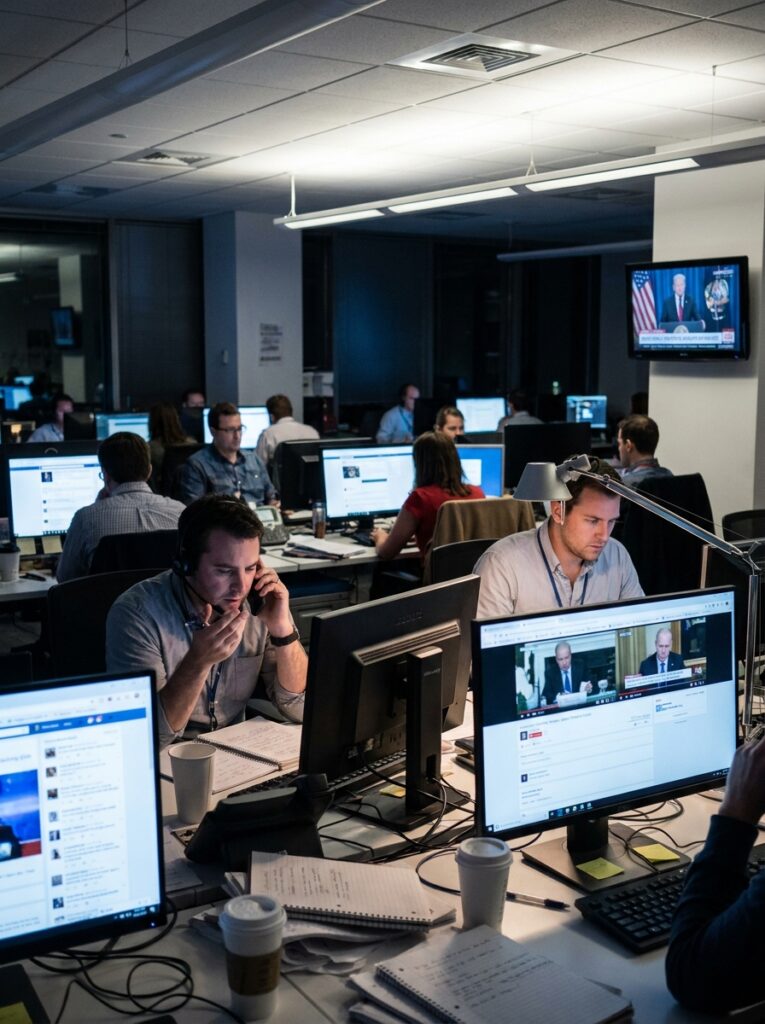

Reporters are being pushed to publish faster, verify harder and compete with social media platforms that can spread information before newsrooms have confirmed what is true.
The old newsroom deadline used to arrive with the printing press, the evening bulletin or the top of the hour. Today, for many journalists, the deadline never fully arrives because it never fully ends. News breaks on phones, circulates through social media within seconds and demands updates before reporters have reached a scene, checked a document or spoken to a source. The result is a profession caught between two imperatives that often collide: be first and be right.
The pressure is especially intense during wars, elections, natural disasters, public health emergencies, financial shocks and major crimes. Audiences expect instant information. Editors expect live updates. Platforms reward speed, emotion and visual material. Rumors can travel faster than police statements, court filings or official briefings. In that environment, the modern reporter is not only a writer or broadcaster. The job now includes verification specialist, live blogger, video producer, social media monitor, safety planner and, increasingly, target of public anger.
The rise of social media has changed the starting point of many stories. A fire, protest or explosion may first appear as a shaky video uploaded by a witness. A politician’s statement may break through a livestream. A rumor may begin in a private messaging group and reach millions before any newsroom can trace its origin. Reporters must decide whether the material is real, where it was filmed, when it was recorded, who posted it and whether sharing it could cause harm. These judgments often happen under extreme time pressure.
Speed is not new to journalism. Wire services, radio stations and television news have always valued fast reporting. What is different now is the scale and visibility of the competition. A journalist is no longer competing only with rival newspapers or broadcasters. They are competing with influencers, anonymous accounts, official agencies, activists, public relations teams, bots and ordinary users who can publish directly to the same audiences. Some are careful. Many are not bound by editorial standards. The reporter must move quickly while carrying a heavier burden of proof.
That burden can be difficult to explain to audiences. When a false claim is already trending, people may ask why reputable news organizations have not reported it. The answer is often simple: they have not confirmed it. But restraint can look like delay, bias or irrelevance in a media culture trained to expect immediate reaction. Responsible silence is one of the hardest things for a newsroom to defend when misinformation is loud.
Verification has become one of the central skills of the profession. Reporters and editors examine metadata, satellite imagery, weather conditions, shadows, landmarks, accents, uniforms, license plates and posting histories. They contact eyewitnesses, compare videos from different angles and seek independent confirmation. In conflict zones or authoritarian environments, they may have to verify events from far away because physical access is restricted or dangerous. The work is painstaking, but the public often sees only the final sentence: “Reuters could not independently verify the claim,” or “The video’s authenticity has not been confirmed.”
The emotional strain of this work is substantial. Journalists covering breaking news often watch graphic footage before it is edited or withheld from the public. They speak with grieving families, survivors and officials under pressure. They absorb criticism from audiences who accuse them of being too slow, too fast, too cautious or too intrusive. Social media has made that criticism immediate and personal. A reporter’s name, face and contact details can become part of the story.
Women journalists and journalists from minority communities often face additional abuse, including sexualized threats, racist attacks and coordinated harassment campaigns. Online hostility is not merely background noise. It can affect mental health, reporting choices and physical safety. Some reporters avoid certain topics, reduce their public presence or leave the profession entirely. When intimidation succeeds, the cost is paid not only by journalists but by the public, which loses information on issues powerful groups may prefer to keep hidden.
The business pressures are also severe. Many newsrooms have fewer reporters than they did a generation ago, even as they must publish across more formats. A single story may require a written article, live updates, social posts, a short video, a podcast segment and a newsletter entry. Journalists are asked to be accurate, fast and multimedia-ready while working with shrinking time and support. The public sees constant output, but not the labor behind it.
Social platforms have also changed how success is measured. Page views, watch time, shares, comments, subscriptions and search visibility can influence editorial decisions. Metrics can help journalists understand audiences, but they can also distort priorities. Stories that are important may not perform well. Stories that provoke outrage may spread widely. Reporters can feel pressure to package complex events in ways that fit platform logic: shorter, sharper, more emotional and more visual.
This does not mean social media is only a threat. It has given journalists new tools, new sources and new ways to reach audiences directly. Reporters can find eyewitnesses, identify trends, correct mistakes quickly and distribute urgent public information. Local journalists can build loyal communities. Investigative reporters can ask for tips. International correspondents can show scenes from the field without waiting for a full broadcast slot. Social media has widened the public square, but it has also made that square louder, less predictable and easier to manipulate.
The arrival of generative artificial intelligence adds another layer of complexity. AI tools can help transcribe interviews, translate documents, summarize long reports and detect patterns in large datasets. They can also generate convincing fake images, fabricated audio and misleading text at scale. For journalists, the challenge is double: using new tools responsibly while investigating how those same tools may be used to deceive the public. The verification race is becoming more technical.
Accuracy remains the profession’s strongest defense. A newsroom cannot always beat social media on speed, but it can offer confirmation, context and accountability. That value becomes clearer during crises. A false evacuation warning, a misidentified suspect or an inaccurate death toll can cause real damage. The discipline of waiting for confirmation may seem slow online, but it is often what separates journalism from rumor.
Editors play a crucial role in protecting that standard. They must create systems that reward careful reporting, not only rapid publishing. Breaking news desks need clear rules for sourcing, headlines, corrections and use of user-generated content. Reporters need training in digital verification and safety. Newsrooms need mental health support for journalists exposed to traumatic material. They also need the authority to say, even in a competitive moment, that some information is not ready to publish.
Audiences also have responsibilities. The public can slow the spread of falsehoods by checking sources before sharing, reading beyond headlines and understanding that reliable reporting often evolves as facts become clearer. Early reports may change not because journalists are hiding the truth, but because the truth is still being established. In breaking news, uncertainty is not a flaw when it is clearly labeled. It is a form of honesty.
The future of journalism will likely remain fast, fragmented and contested. Social platforms will continue to shape what people see first. AI will make false material easier to produce. Newsrooms will keep fighting for attention in crowded information markets. But the central mission of reporting has not changed. Journalists still go where events happen, ask questions, test claims and produce a record that can be challenged and corrected.
The 24/7 news cycle has made the work more exhausting and more visible. It has compressed time, raised expectations and exposed reporters to new forms of pressure. Yet it has also clarified why journalism matters. In a world where everyone can publish, the value of the reporter lies not in publishing something, but in finding out whether it is true.
“””