
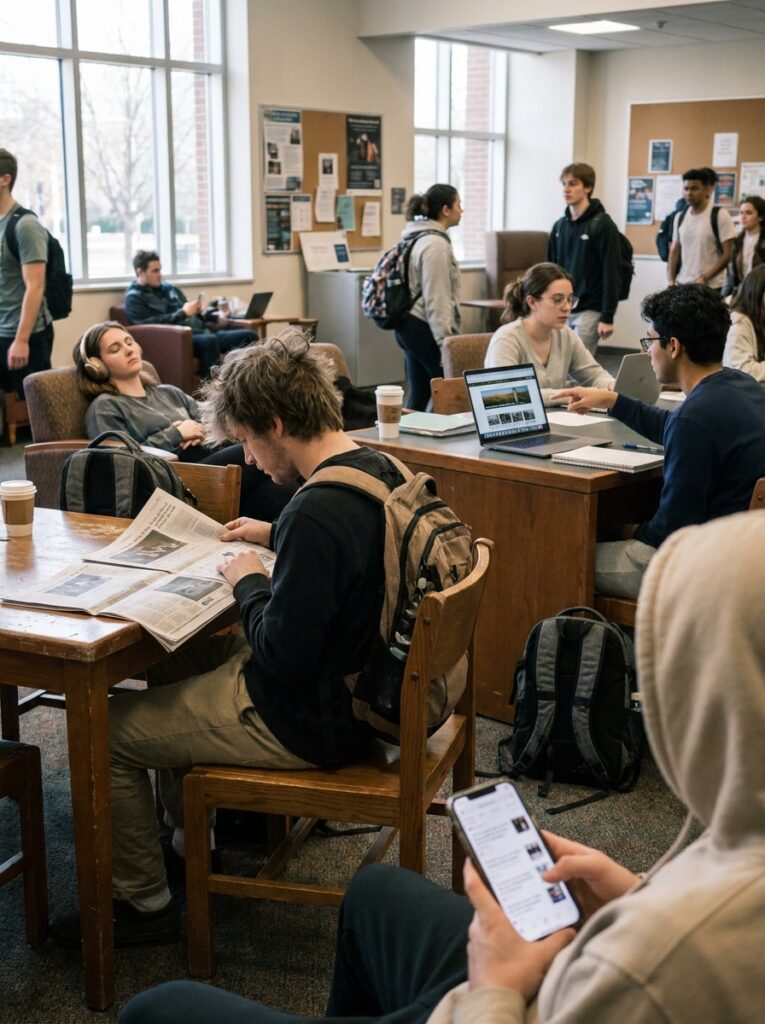
Students are not abandoning news entirely, but they are changing where, how and why they encounter it, forcing journalism to reinvent itself for a generation raised on phones, feeds and video.
The question is often asked with anxiety in newsrooms, classrooms and family conversations: do young people still read newspapers? The answer is yes, but not in the way older generations understand the habit. Many students no longer begin the morning with a printed front page or wait for an evening television bulletin. They encounter news through smartphones, social media feeds, short videos, podcasts, newsletters, search engines, campus groups, messaging apps and conversations with friends and family. News has not disappeared from young lives. It has become less formal, less scheduled and far more fragmented.
For high school students, news often arrives incidentally. A political development may appear between entertainment clips. A climate story may be shared by a creator. A local incident may circulate in a class group chat before a newspaper publishes a full report. A major international event may first be understood through a short video, a meme, a live update or a screenshot. This does not mean students are uninterested in the world. It means the path from event to audience has changed.
University students show a similar pattern, though with more variation. Some follow major newspapers, public broadcasters, newsletters and podcasts closely, especially if they study politics, economics, health, technology or international relations. Others rely heavily on social media and only seek out traditional outlets when a story becomes important to their lives: tuition fees, job markets, housing, elections, war, climate disasters, public health rules or campus protests. News consumption has become situational. Young people may ignore routine politics for weeks, then follow a crisis intensely across multiple platforms.
The decline of print is real. For many students, a printed newspaper feels less like a daily necessity and more like an object from another media age. It is slower, less interactive and less convenient than a phone. But equating the decline of print with the death of news reading is misleading. Young audiences still read, but much of that reading happens inside digital environments: article links, explainers, live blogs, captions, newsletters, social posts and search results. The form has changed from a single package to a stream of pieces.
This shift has weakened the old authority of newspapers. In the past, editors decided what appeared on the front page, and that page helped organize public attention. Today, algorithms, influencers, peer networks and search engines share that power. A student may trust a journalist, a professor, a YouTuber, a podcaster, a classmate or a subject expert depending on the issue. The news brand still matters, but it is no longer the only gateway to credibility.
For journalism, this is both a threat and an opportunity. The threat is that professional reporting can be lost in a crowded feed where rumors, commentary, advertising and entertainment compete on equal visual terms. A carefully verified investigation may appear beside an unverified claim that is more emotional and easier to share. The opportunity is that news organizations can reach students directly in formats they actually use. A strong explainer video, a clear visual timeline, a campus-focused newsletter or a well-produced podcast can bring journalism to people who may never visit a newspaper homepage.
Students tend to reward clarity. They often want context, not only headlines. Many say they avoid news because it feels overwhelming, negative or difficult to trust. This does not mean journalism should become simplistic. It means news organizations must explain why a story matters, what is known, what remains uncertain and how the issue affects ordinary people. The old assumption that audiences arrive with background knowledge is less reliable. Modern journalism must often provide the background first.
Short-form video has become one of the defining formats of youth news consumption. It can make complex subjects accessible quickly, especially when it uses strong visuals and plain language. But it also creates risks. A one-minute clip can introduce a topic, but it cannot always capture uncertainty, evidence or competing perspectives. The best journalism uses short video as an entry point, not as a substitute for full reporting. The challenge is to turn attention into understanding.
Podcasts and newsletters have become important in a different way. They serve young people who want depth but dislike traditional newspaper routines. A student can listen to a news podcast while commuting, exercising or cooking. A newsletter can summarize the day’s major stories without requiring constant scrolling. These formats feel personal and manageable. They also allow journalists to build a direct relationship with readers and listeners outside platform algorithms.
The role of campus journalism remains significant. Student newspapers, radio stations, newsletters and online magazines often cover issues that national outlets ignore: housing conditions, tuition disputes, student elections, safety concerns, academic policy and local culture. For many young people, campus media is the first place where news feels directly connected to their own lives. It is also a training ground for future journalists. In an era of declining local news, student journalism can help preserve the habit of civic attention.
Trust is the central problem. Many students have grown up seeing institutions criticized from every direction. They are aware of bias, commercial pressure, political polarization and misinformation. Some respond with healthy skepticism. Others respond with cynicism, assuming all news is manipulated. Journalism must distinguish itself not by demanding trust, but by showing its work. Sources, documents, corrections, data methods and editorial standards should be visible. Transparency is no longer optional. It is part of the product.
The rise of misinformation makes news literacy essential. Students need to know how to check sources, identify manipulated images, compare independent reports and recognize emotional manipulation. But news literacy should not be framed only as a warning against fake news. It should also teach students how journalism works: how reporters verify, why corrections matter, how headlines are written, how opinion differs from reporting and why local information is vital to democracy. Understanding journalism makes young people better critics of journalism, not passive consumers.
News organizations also need to reconsider tone. Younger audiences often respond to journalism that acknowledges uncertainty and human impact. They may be more comfortable with journalists who explain their process, appear on camera, answer questions and engage with communities. This does not mean abandoning independence or turning reporters into activists. It means recognizing that distance alone no longer guarantees authority. Credibility can come from fairness, evidence, humility and accountability.
Paywalls create another barrier. Many students cannot afford multiple subscriptions, even when they value professional reporting. This pushes them toward free content on platforms, where quality varies widely. Some publishers are responding with student discounts, campus access, nonprofit models, public-service funding and free explainers. The future of youth news may depend partly on whether serious journalism remains accessible to people before they become paying professionals.
Artificial intelligence is adding a new layer of change. Students may use AI chatbots to summarize news, explain unfamiliar topics or compare viewpoints. This can be useful, but it also raises concerns about accuracy, sourcing and the loss of traffic to original reporting. If young people receive news through summaries that hide the work of reporters, journalism’s economic foundation may weaken further. Newsrooms will need to use AI carefully while defending the value of original reporting, eyewitness evidence and human judgment.
The most successful modern news organizations will not ask young people to return to the habits of the past. They will meet them where they are without surrendering journalistic standards. That means mobile-first design, clear writing, strong visuals, responsible social media use, newsletters, podcasts, video explainers, fact-checking and active engagement. It also means resisting the temptation to chase every trend at the expense of accuracy.
Young people still read the news, but they read it differently. They read across platforms, in fragments, through recommendations, in moments of urgency and often through voices that blend journalism with personality. The newspaper is no longer the central object. The public need for reliable information remains as strong as ever.
The future of journalism will depend on whether news organizations can transform without losing their purpose. Students do not need journalism to look like the past. They need it to be trustworthy, accessible, relevant and honest about complexity. If journalism can meet that test, the next generation will not abandon the news. It will redefine what reading the news means.
“””
