
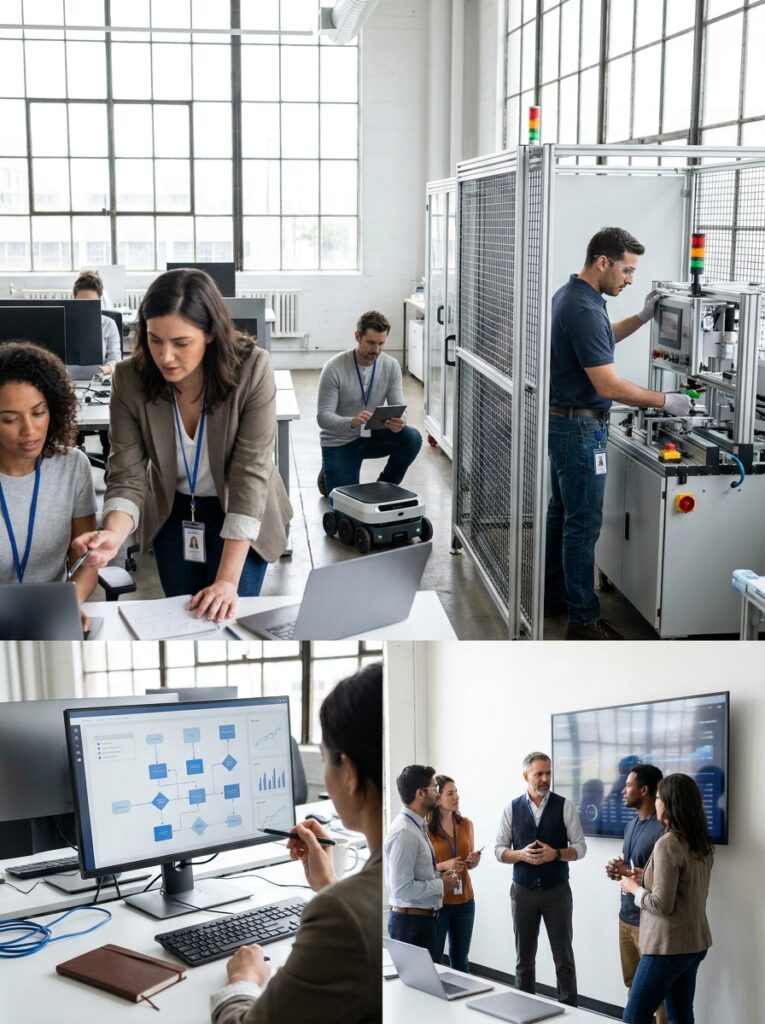
Artificial intelligence, automation and digital tools are transforming jobs across offices, factories and services, forcing workers to learn new skills while societies confront a changing labor market.
The future of work is no longer a distant forecast. It is arriving inside offices where artificial intelligence drafts emails, factories where robots inspect products, warehouses where algorithms route orders, hospitals where software helps read scans, farms where sensors monitor crops and classrooms where digital platforms track learning. Technology is not only creating new industries. It is changing the tasks inside old ones.
For workers, the question is no longer whether technology will affect their jobs. The question is how deeply, how quickly and under whose control. Some jobs will disappear. Many more will be reorganized. New roles will emerge around data, cybersecurity, clean energy, robotics, AI operations and human-centered services. The central challenge for the next decade is not simply to protect jobs from machines. It is to help people move with the work as the work changes.
Artificial intelligence has made the issue more urgent because it reaches beyond manual labor. Earlier waves of automation were often associated with factory floors, assembly lines and physical repetition. Generative AI now affects writing, coding, design, customer service, legal research, marketing, accounting, translation, education and administration. It can summarize documents, generate images, answer routine questions, analyze large datasets and produce software code. White-collar work, once considered safer from automation, is now directly exposed.
That does not mean every exposed job will vanish. In many workplaces, AI is more likely to remove tasks than eliminate entire occupations. A lawyer may use AI to search documents but still need judgment, strategy and ethics. A doctor may receive diagnostic support from software but remain responsible for patient care. A journalist may use transcription tools but still must verify facts and make editorial decisions. A teacher may use an app to track progress but still must motivate students, manage classrooms and understand children as individuals.
The difference between task replacement and job replacement is important. A job is a bundle of activities. Technology often takes over the predictable parts first: scheduling, sorting, counting, drafting, checking, monitoring and moving information from one system to another. What remains may become more human, more complex or more demanding. Workers who once spent hours on routine processing may be expected to interpret results, manage exceptions, communicate with clients and supervise AI systems.
This shift is already visible in clerical and administrative work. Data entry, basic bookkeeping, document preparation, call-center scripts and appointment scheduling are among the areas most vulnerable to automation. These roles have provided stable employment for millions of people, especially women in many economies. When technology changes them, the impact is not abstract. It affects household income, career paths and social mobility.
Manufacturing and logistics are changing in a different way. Robots can weld, lift, pack, sort and inspect with speed and consistency. Automated warehouses can operate around the clock. Drones and autonomous vehicles are being tested for delivery, agriculture, mining and infrastructure inspection. These systems can reduce injuries and increase output, but they also change demand for labor. Some workers may move from physical handling to machine maintenance, quality control, safety monitoring and system management. Others may be displaced if training and transition support are weak.
Service work is also being redesigned. Restaurants use ordering kiosks. Banks move customers to apps. Hotels automate check-in. Retailers use inventory software and self-checkout systems. Customer service increasingly begins with chatbots before a human agent enters the conversation. For consumers, these changes may bring speed and convenience. For workers, they can mean fewer entry-level roles, more monitoring and higher expectations when human help is needed.
Technology is creating jobs as well. AI specialists, data analysts, cybersecurity experts, robotics technicians, cloud engineers, digital product managers, renewable energy engineers and user-experience designers are in growing demand. So are roles that combine technical understanding with human trust: AI trainers, ethics officers, digital health coordinators, online learning designers and automation supervisors. The labor market is not shrinking in a simple way. It is being rearranged.
The rearrangement creates a skills race. Workers will need technological literacy, but not everyone must become a software engineer. Basic AI literacy may become as common as spreadsheet knowledge once was. Employees will need to know how to use AI tools, check their outputs, protect data, recognize errors and understand when human judgment is required. In many fields, the valuable worker will not be the person who competes against AI, but the person who knows how to direct it responsibly.
Human skills are becoming more important, not less. Analytical thinking, communication, creativity, leadership, emotional intelligence, collaboration and adaptability are difficult to automate fully. A machine can generate a report, but it cannot easily build trust with a worried patient, calm an angry customer, mentor a young employee, negotiate a sensitive deal or understand the cultural meaning of a decision. The more technology handles routine work, the more human workers may be judged by the quality of their judgment.
This creates pressure on education systems. Schools and universities cannot prepare students only for fixed professions if professions keep changing. They must teach digital fluency, problem-solving, ethics, communication and the ability to keep learning. Vocational training also needs modernization. A mechanic may need to understand electric vehicles and diagnostic software. A farmer may need to interpret sensor data. A nurse may work with digital records and AI-supported triage systems. The boundary between technical and nontechnical work is fading.
Companies also carry responsibility. It is not enough to buy AI tools and tell workers to adapt. Employers must invest in training, redesign jobs carefully and involve employees in decisions about technology. Poorly implemented automation can create anxiety, surveillance and resentment. Well-designed technology can remove drudgery, improve safety and give workers more time for meaningful tasks. The difference often depends on management choices.
Governments will have to respond as well. Labor markets do not adjust automatically or fairly. Workers displaced by automation may not live in the places where new technology jobs are created. They may lack the money, time or confidence to retrain. Older workers may face age discrimination. Young workers may struggle to enter professions where entry-level tasks have been automated. Policies on lifelong learning, unemployment support, portable benefits, labor rights and digital infrastructure will shape whether the transition is inclusive or divisive.
There are also ethical risks. AI systems can make biased decisions if trained on biased data. Algorithmic management can monitor workers too closely, assign tasks without explanation or penalize people through opaque systems. Productivity tools can become surveillance tools. If workers do not know how decisions are made, they lose agency. The future of work must therefore include rules about transparency, privacy, accountability and the right to challenge automated decisions.
The fear of replacement is real, but fear alone is not a strategy. Workers need practical adaptation. That means learning to use digital tools, building transferable skills, understanding one’s industry, following technological trends and seeking training before a crisis arrives. It also means developing the capacities that machines lack: empathy, ethics, curiosity, context and the ability to work with other people.
The most resilient careers may be those built around learning rather than a single job title. A person may begin as an administrative assistant, learn data tools, move into operations coordination and later supervise automated workflows. A factory worker may become a robotics technician. A teacher may become a blended-learning designer. A nurse may specialize in digital health. The path will not be easy for everyone, but movement will become a normal part of working life.
Technology will not end work. It will change what society values in work. Routine execution will be cheaper. Judgment, trust, creativity, care and responsibility may become more important. The risk is that the benefits of automation flow mainly to companies and highly skilled workers while others face insecurity. The opportunity is that technology can remove dangerous, repetitive and exhausting tasks while opening new forms of employment.
The future of employment will be neither fully human nor fully automated. It will be hybrid. Machines will calculate, monitor, generate and optimize. Humans will guide, question, care, persuade and decide. The workers who thrive will not be those who know everything today, but those who can keep learning tomorrow. The societies that thrive will be those that treat technological change not as an excuse to abandon workers, but as a reason to prepare them.
“””
