Vogue is bringing its café concept to New York for the first time, turning a corner of Manhattan into a three-day branded space that blends coffee service, fashion programming, shopping and live events in a format that increasingly defines how media and luxury-adjacent brands want to meet consumers in person.
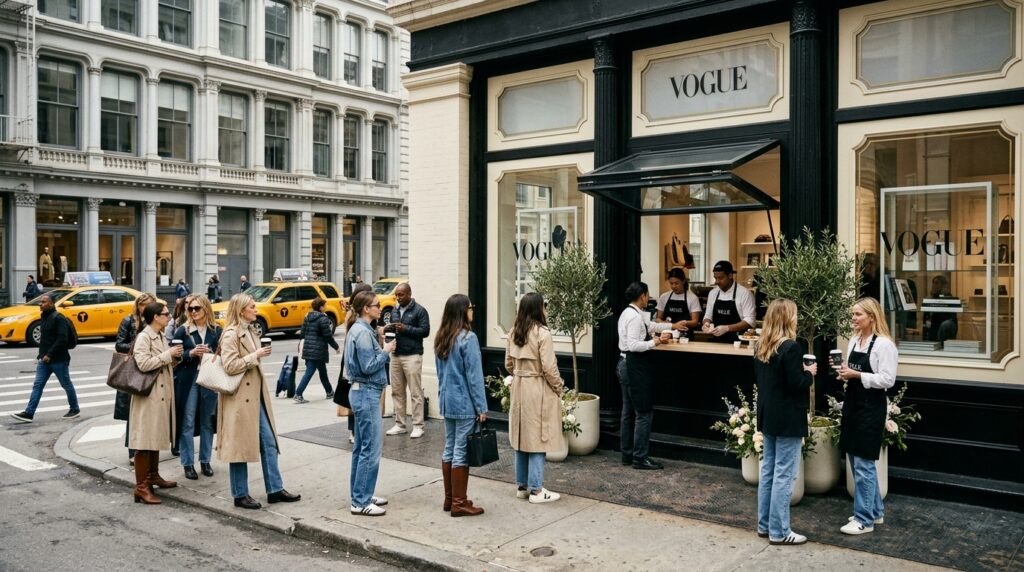
The pop-up, called Vogue Café and presented by Chase Sapphire Reserve, will run from May 2 through May 4, 2026, at the corner of Spring Street and Sixth Avenue in SoHo, according to Vogue. The event marks the concept’s Manhattan debut after earlier editions in London, Milan and Paris during fashion month, and it arrives at a moment when the line between editorial brand, retail environment and live cultural activation has become increasingly porous.
On the surface, the concept is straightforward: a temporary café serving drinks and food in a Vogue-designed setting, with a tightly curated menu and a schedule of events meant to draw visitors deeper into the brand’s world. But in industry terms, the significance runs beyond the beverages. The New York edition reflects the continued rise of what marketers and retail strategists often describe as experiential or “IRL” brand building — physical spaces designed not just to sell items, but to stage identity, community and shareable participation.
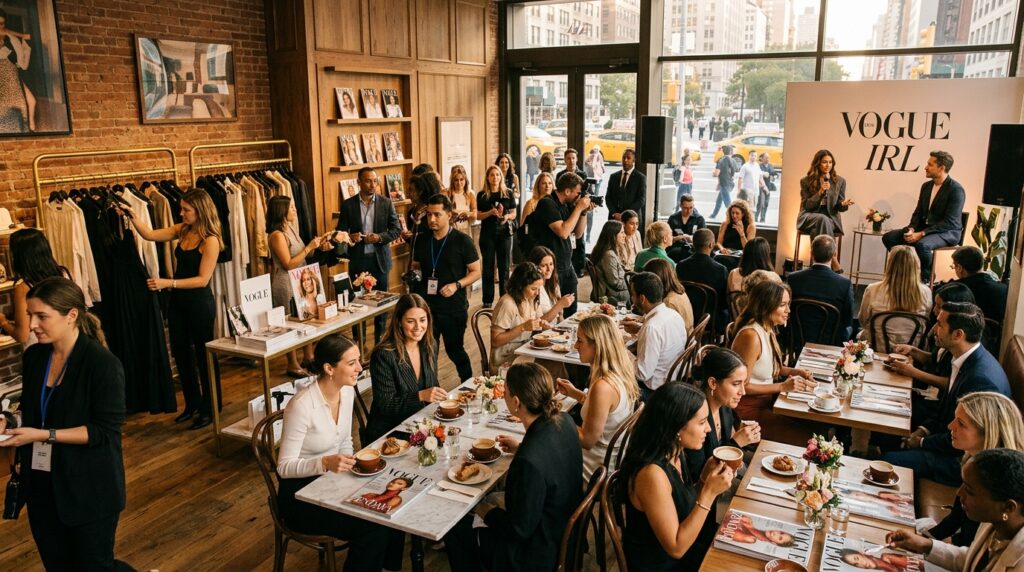
Vogue’s own description of the New York café makes that strategy unusually explicit. The publication says visitors can expect a lineup that includes coffee service, themed drinks, photo opportunities, a floral cart, merchandise and special programming throughout the weekend. The event is also tied to a broader calendar of fashion and entertainment moments. Vogue says cardholders of Chase Sapphire Reserve will gain access to exclusive perks including a cocktail soirée, a screening marking the 10th anniversary of “The First Monday in May,” and a dinner party timed to the Met Gala red-carpet livestream on May 4.
That linkage is central to why the event matters. The café is not being launched as a standalone hospitality venture in the traditional sense. It is closer to a temporary physical extension of Vogue’s editorial ecosystem, activated at a moment when New York’s fashion audience is already focused on the city because of the Met Gala. In other words, the café functions as content, social venue, consumer touchpoint and brand theater at once.
This is increasingly how premium consumer-facing brands operate in physical space. In a retail climate where online discovery is saturated and conventional storefront economics remain challenging, short-term activations offer a different kind of return. They can create urgency through scarcity, generate social media visibility through design and programming, test merchandise and partnerships in real time, and bring audiences into direct contact with a brand without the commitments of a permanent location.
For Vogue, the move is also notable because it extends a magazine brand into a more immersive lifestyle environment without requiring a full reinvention of its identity. Fashion media has long influenced where consumers shop, what they wear and which labels they follow. What has changed is the willingness of those media brands to become the setting itself. A café allows Vogue to translate editorial sensibility into texture, menu, décor, event curation and in-person interaction. It gives the brand a place, not just a point of view.
The details announced so far reinforce that positioning. Vogue says the New York pop-up will include a live taping of “The Run-Through with Vogue,” a figure-drawing session hosted by Happy Medium, exclusive pre-orders of Alex Mill monogram totes, and a charm bar by Don’t Let Disco. Food will come from Hani’s Bakery and Altro Paradiso, while merchandise will include custom aprons by Tanner Fletcher. These elements matter because they show the project is designed less as a conventional café and more as a layered cultural collaboration. Each partner adds another touchpoint: fashion, craft, food, conversation, personalization and collectability.
That mix aligns with where much of fashion and luxury retail has been heading. Analysts and industry observers have argued that physical commerce is becoming more experience-led, with brands using stores, pop-ups and hospitality-inspired spaces as stages for emotional connection rather than purely transactional visits. McKinsey’s “State of Fashion 2026” notes that fashion brands are navigating a low-growth and volatile environment in which sharper consumer engagement and more adaptable formats matter increasingly. Forbes, writing about immersive retail in 2025, described how brands are expanding beyond stores into pop-ups and branded hospitality formats because experience itself has become a strategic asset.
The Vogue Café sits squarely in that logic. It is temporary, curated and likely highly photogenic. It combines hospitality with event programming and product discovery. It also benefits from timing: the weekend culminates on Met Gala day, when Vogue’s authority in fashion media reaches one of its annual peaks. The café therefore becomes a real-world portal into a digital and editorial event that already commands global attention.
There is also a geographic logic to the choice of SoHo. Manhattan’s downtown shopping districts remain among the most visible laboratories for brand experimentation in New York, especially for labels and cultural properties looking to capture a style-conscious, social-media-active crowd. A temporary installation in SoHo can operate simultaneously as neighborhood destination, tourist draw and industry stop. It is the kind of location where the audience is not merely passing through but primed to document, browse and linger.
Still, the event’s value will depend on execution. Experiential retail has become so common that novelty alone is no longer enough. Consumers have learned to distinguish between a meaningful activation and a branded backdrop designed mainly for photos. To break through, these spaces usually need some combination of utility, exclusivity and narrative coherence. Vogue appears to be aiming for that balance by connecting food and drink with editorial talent, shopping opportunities, special-access moments and a recognizable fashion calendar anchor.
The sponsorship structure is important too. Chase Sapphire Reserve’s role points to how these events increasingly sit at the intersection of media, commerce and loyalty ecosystems. Premium card partnerships allow brands to layer access and exclusivity into the experience while giving financial-services companies a lifestyle platform that feels more aspirational than a typical promotion. For attendees, this can create a two-tier event model: open enough to generate buzz, selective enough to preserve desirability.
More broadly, the Vogue Café illustrates how “IRL brand experience” has evolved from marketing add-on to strategic format. A decade ago, a magazine-branded café pop-up might have seemed like a novelty. In 2026, it fits a larger pattern. Brands want physical environments that can be visited, filmed, posted, shopped and remembered. Consumers, meanwhile, continue to show that even in a digital-first market, they still value spaces that feel social, immersive and finite.
That may be especially true in fashion, where image and atmosphere are not secondary to the product but part of the product’s meaning. A pop-up café tied to Vogue is not merely selling coffee. It is selling proximity to a world — a world of fashion week energy, insider programming, aesthetic polish and cultural timing. The drinks, merchandise and events are the tools. The real product is affiliation.
For New York, the opening is modest in duration but significant in symbolism. It suggests that legacy media brands still see room to expand physically, and that the future of lifestyle marketing may belong as much to hybrid spaces as to conventional stores or editorial pages. Vogue is not opening a permanent restaurant. It is doing something more contemporary: creating a temporary environment built to compress media, hospitality, commerce and event culture into one weekend.
Whether the pop-up becomes an annual fixture or remains a one-off experiment, its arrival says something about the current state of branding in fashion and lifestyle. The most effective brands are no longer satisfied with being seen. They want to be entered, inhabited and experienced. For three days in early May, Vogue is betting that Manhattan is the right place to do exactly that.”””