With autonomous Volkswagen ID. Buzz vehicles now undergoing road validation in Los Angeles under Uber’s platform strategy, the race to turn robotaxis from controlled demonstrations into large-scale urban transportation services has entered a more operational phase.
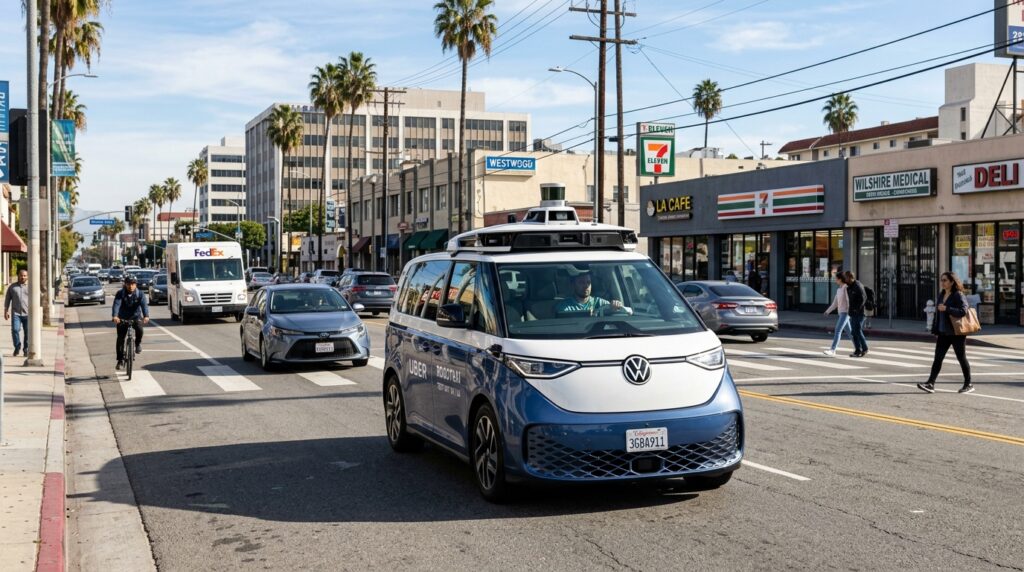
Uber and Volkswagen have moved one step closer to making robotaxis part of everyday city transport, launching on-road testing of autonomous Volkswagen ID. Buzz vehicles in Los Angeles in what both companies describe as the next phase of their partnership.
The trial is significant not simply because another self-driving vehicle has appeared on American streets, but because it reflects a broader shift underway in the autonomous mobility business. For years, robotaxis were often viewed as ambitious pilot programs, carefully staged demos, or expensive technical experiments confined to narrow geographies. What is happening now in Los Angeles suggests something more concrete: companies are trying to turn autonomy into a repeatable urban service model, integrated with consumer platforms that already operate at scale.
That distinction matters. The path from autonomous technology showcase to commercially viable transportation network has been much harder than early advocates predicted. Companies in the sector have had to contend with technical setbacks, regulatory caution, public skepticism, high operating costs, and the challenge of proving that autonomous systems can perform reliably in dense, unpredictable city environments. Against that backdrop, Uber and Volkswagen’s latest testing program is being watched not only as a local mobility development but as a marker of how mature the robotaxi sector may be becoming.
According to the companies, the testing now underway in Los Angeles involves purpose-built autonomous versions of the all-electric Volkswagen ID. Buzz. The vehicle itself is part of what gives the project outsized visibility. Unlike some other autonomous test vehicles that appear retrofitted or anonymous, the ID. Buzz carries a recognizable design lineage, echoing Volkswagen’s classic microbus while serving as a modern electric platform. In commercial terms, that gives the deployment a degree of brand clarity that many autonomous vehicle programs have lacked.
For now, however, this remains a supervised test. Human safety drivers are still in the vehicles, an important reminder that the program has not yet reached a fully driverless public-service phase. The presence of safety operators is standard for this stage of deployment, but it also speaks to the industry’s current reality. Robotaxi companies may market autonomy as the destination, yet the road to that destination still depends heavily on layered oversight, real-world validation and regulatory trust-building.
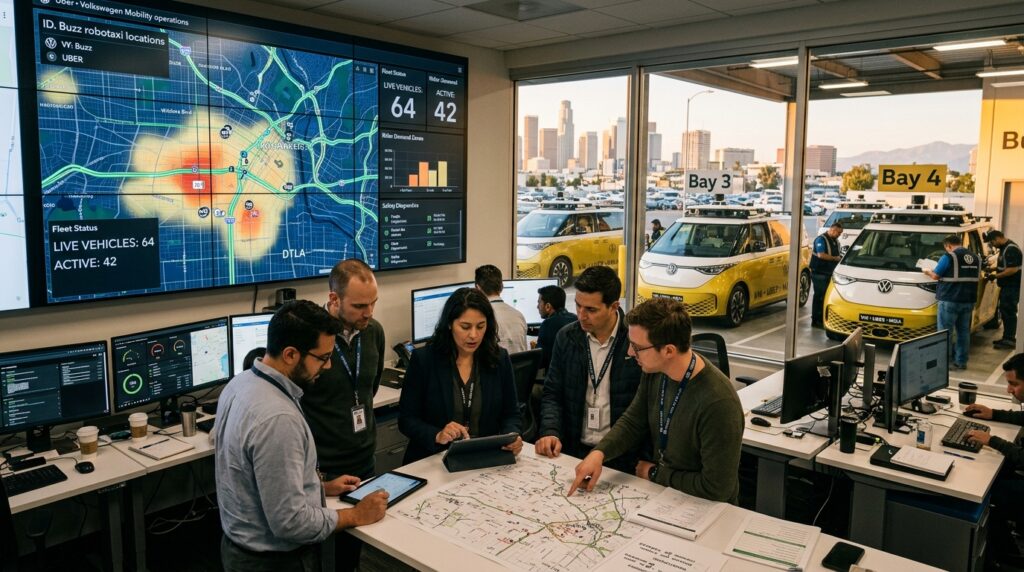
Uber and Volkswagen have said the Los Angeles test fleet will expand to more than 100 vehicles during the testing phase. That scale is notable because it moves beyond a token handful of vehicles and into a range that can begin to generate more meaningful operational data. A larger fleet allows companies to evaluate not just isolated vehicle performance, but routing behavior, maintenance cycles, dispatch logic, rider interface issues, traffic interaction patterns and the economics of managing autonomous assets in a real city.
Los Angeles is also a deliberate proving ground. It is a city defined by driving culture, complex traffic flows, broad geographic spread and a mix of arterial roads, dense neighborhoods and commercially important corridors. In other words, it is not an easy environment. A robotaxi system that can operate credibly in Los Angeles gains a stronger case for future expansion than one tested only in simpler or more tightly controlled settings. The city’s prominence also ensures that every success or failure will be visible to regulators, competitors and consumers alike.
The strategic logic behind the partnership is equally important. Uber, after years of recalibrating its approach to autonomy, has increasingly positioned itself as a platform rather than a singular robotaxi developer. Instead of betting exclusively on one in-house technical path, it has moved toward integrating autonomous vehicle partners into the Uber ecosystem. That approach allows Uber to benefit from the growth of autonomous mobility without bearing all of the development risk itself. For Volkswagen, the arrangement offers something just as valuable: access to an existing ride-hailing platform with a large user base, market familiarity and a ready-made demand interface.
That platform-plus-manufacturer model may prove central to the next phase of autonomous transport. Building a capable self-driving system is only part of the challenge. Companies must also solve fleet operations, customer acquisition, app integration, pricing, support, maintenance and city-by-city rollout. In practical terms, a robotaxi service is not just a vehicle problem. It is a network problem. Uber’s strength lies in networks. Volkswagen’s strength lies in vehicle production and industrial scale. The Los Angeles testing program is therefore not only about technology, but about whether those complementary strengths can produce a workable business model.
Volkswagen’s autonomous effort is being advanced through MOIA America, previously known as Volkswagen ADMT, which has been tasked with bringing the group’s autonomous mobility ambitions closer to public operation. This matters because legacy automakers have often been seen as slower or more cautious than pure-play technology companies in the robotaxi space. Yet they also possess advantages that startups do not: manufacturing experience, supply-chain depth, compliance knowledge and the ability to think in terms of fleet durability rather than prototype novelty.
That industrial dimension is likely to become more important as robotaxis move toward wider deployment. It is one thing to demonstrate autonomy with a small number of highly managed vehicles. It is another to build, maintain and refresh a fleet that can survive the wear and tear of commercial urban service. In that respect, Volkswagen’s involvement makes this effort more than a software experiment. It ties autonomous driving to a mass-manufacturing mindset, something investors and city planners are increasingly treating as essential.
Still, the obstacles remain substantial. Safety is the most obvious. Every on-road validation program must prove not merely that the vehicles can navigate roads under ideal conditions, but that they can respond correctly to edge cases, construction zones, emergency vehicles, aggressive drivers, pedestrians and the innumerable irregularities of city life. Regulatory acceptance is another hurdle. Public rollout timelines depend not only on technical confidence but on whether state and local authorities are satisfied with oversight, reporting and operational safeguards.
Public trust may be the hardest variable of all. Consumers are more familiar with autonomous vehicles than they were a few years ago, but familiarity is not the same as confidence. A robotaxi service can look compelling in a press release while still leaving many riders uncertain about getting into a vehicle without a human driver. That is one reason the transition from safety-driver testing to genuine public robotaxi operations is such an important threshold. It is the point at which the industry must stop speaking mainly to investors and engineers and start persuading ordinary passengers.
Even so, the timing of the Los Angeles test suggests the sector is entering a more consequential chapter. The autonomous vehicle industry no longer revolves only around who can make the boldest future-facing claim. Increasingly, it revolves around who can secure permits, operate safely, scale economically and deliver real rides in real cities. The most meaningful progress is now operational rather than rhetorical.
In that sense, Uber and Volkswagen’s Los Angeles program captures the current state of the robotaxi business better than any flashy unveiling could. The vehicles are real. The city is real. The test conditions are real. The safety driver remains in place, showing the industry is not yet at the endpoint. But the ambition is also real: to move from experimental autonomy to urban service infrastructure.
That is why this development stands out in 2026. Robotaxis are no longer only symbols of a possible future. In places like Los Angeles, they are becoming part of an incremental, highly scrutinized attempt to build that future in public. The distance between demonstration and operation has not disappeared. But it is narrowing, one supervised mile at a time.