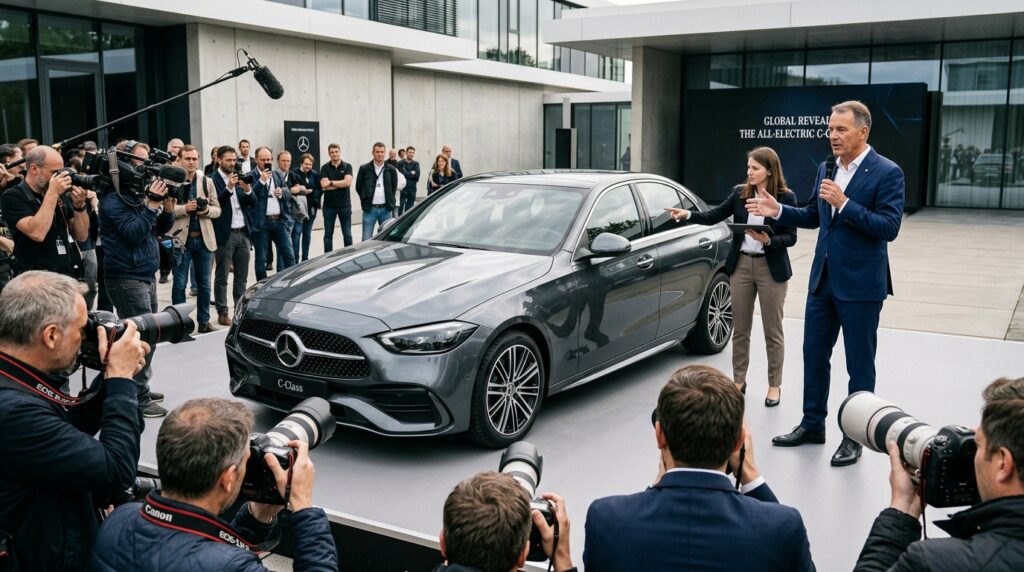
Mercedes-Benz has unveiled the first fully electric C-Class, bringing one of its most important global nameplates into the battery-electric era and delivering what could become one of the most consequential premium car launches of the week.
The new electric C-Class arrives with the kind of specifications designed to send a clear message about intent. Mercedes says the sedan is built around an 800-volt architecture and can deliver up to 762 kilometers of driving range under the WLTP test cycle, positioning it as a serious entrant in the increasingly contested luxury electric sedan market. That matters not only because of the headline numbers, but because of the badge attached to them. The C-Class is not a niche model inside Mercedes-Benz. It sits in the company’s core portfolio, which the automaker itself describes as the heart of the brand.
For years, Mercedes used the EQ sub-brand to mark out its battery-electric ambitions, separating many of its EVs visually and commercially from the company’s conventional sedans. The electric C-Class feels different. Rather than standing apart as an experiment in EV branding, it brings electrification directly into one of Mercedes’ most established and widely recognized product lines. That makes the launch symbolically larger than a normal model debut. It suggests Mercedes now sees the electric transition not as an adjacent project, but as something that must be embedded inside its most important mainstream luxury offerings.
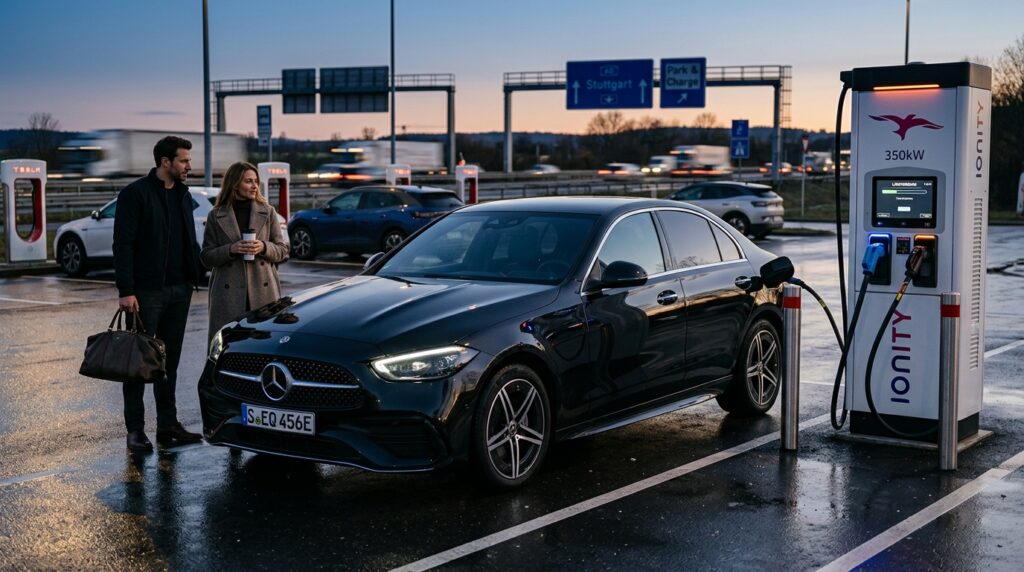
The specifications underline that repositioning. On its consumer site, Mercedes describes the all-new electric C-Class as using a powerful 800V architecture and being capable of up to 762 km on a single charge. Additional launch coverage says the first version revealed is the C 400 4MATIC, with around 360 kW of output, rapid DC charging of up to 330 kW, and the ability to add roughly 325 km of range in 10 minutes under ideal conditions. In market terms, those figures place the car directly into the conversation with the most serious next-generation EVs rather than older electric luxury sedans built around slower 400V systems.
That 800V foundation is especially important. In the EV market, range still captures consumer attention, but charging speed increasingly determines whether a car feels future-ready. A long-range electric sedan that recharges slowly can still feel compromised, particularly for drivers accustomed to the convenience of combustion models. By moving the C-Class EV to an 800V setup, Mercedes is aligning one of its key sedan lines with the faster-charging electrical architecture now associated with higher-end or more advanced EV platforms. It is a technical signal as much as a product feature: Mercedes wants this car to be read as part of the next wave, not the previous one.
The launch also reflects a broader recalibration in Mercedes’ EV strategy. In recent years, the company moderated earlier rhetoric around going all-electric by the end of the decade, instead emphasizing that the pace of transition would depend on market conditions, charging infrastructure and customer demand. But that has not meant retreat. Official Mercedes material says electrification remains central to the company’s “Ambition 2039” strategy and to a larger product and technology offensive running through 2027. In that context, the electric C-Class is not an isolated release. It is part of a larger attempt to make Mercedes’ battery-electric offerings more competitive, more desirable and more directly integrated into the segments that matter most commercially.
That is why the model’s category matters so much. Luxury electric SUVs have attracted much of the industry’s attention because they align with consumer demand in many markets. Sedans, by contrast, carry a different strategic burden. They are still vital in the premium sector as brand-defining products, especially in Europe and parts of Asia, and they remain one of the clearest tests of efficiency, packaging and aerodynamic performance. A compelling electric sedan says something profound about an automaker’s engineering confidence. If Mercedes can make the C-Class EV desirable at scale, it will have shown that electrification is no longer limited to halo vehicles or specialized body styles.
There is also the competitive angle. The premium midsize sedan segment has become one of the most closely watched battlegrounds of the EV transition, with established brands trying to defend their legacy customer bases while also attracting buyers who might otherwise look to Tesla, BMW, Polestar or future Audi electric sedans. The electric C-Class gives Mercedes a more direct answer in a space where simply offering an EV is no longer enough. Buyers increasingly expect long range, fast charging, advanced software, refined interior packaging and a design language that feels modern without losing brand identity.
Mercedes appears to understand that. Early coverage of the vehicle has highlighted not just the powertrain, but the car’s broader luxury-tech proposition: a large digital display setup, AI-enhanced infotainment features, a more spacious cabin than the current combustion C-Class, and premium ride and comfort systems designed to preserve the model line’s traditional executive-sedan feel. In other words, Mercedes is not selling the C-Class EV as a science project. It is trying to sell it as a proper Mercedes first and an electric car at the same time.
That balance may prove crucial. One of the central tensions of the luxury EV market is that buyers want novelty, but not alienation. They want advanced software, faster charging and stronger efficiency, yet they also want familiarity in quality, comfort and status. Mercedes has sometimes been criticized for allowing its early EQ designs to drift too far into a separate visual and conceptual universe. The electric C-Class suggests a more integrated approach, one that uses the credibility of a known nameplate to lower the psychological barrier to EV adoption for traditional premium buyers.
The timing of the launch is notable as well. Global automakers are under pressure from several directions at once: slowing EV demand growth in some regions, continued regulatory pressure on emissions, intense competition from Chinese manufacturers, and rising consumer expectations for software-defined vehicles. In that environment, launching an all-electric version of a core sedan is a statement of confidence. It says Mercedes believes there is still room to shape demand rather than merely react to it.
For Mercedes-Benz, the C-Class EV is therefore more than just another addition to the lineup. It is a referendum on how the company wants its electrified future to look. If the EQ era represented a phase of experimentation and separation, the electric C-Class looks more like a phase of convergence: fewer conceptual detours, more direct integration of electric technology into the brand’s central product architecture.
That could make this one of the more important luxury-car debuts of the season. The C-Class has long served as an entry point to Mercedes sedan ownership for many customers and as a backbone product in the brand’s global portfolio. Bringing that model into the EV era with headline range, 800V charging and a premium-tech package sends a message far beyond a single product cycle. It signals that Mercedes is now betting the future of luxury electrification not only on flagship EQ models or SUVs, but on the enduring strength of one of its most recognizable sedans.
Whether the market embraces the car will depend on pricing, real-world efficiency, charging access and regional rollout. But the strategic meaning is already clear. Mercedes did not choose a fringe model to make this statement. It chose the C-Class. And in doing so, it turned a familiar luxury sedan into one of the clearest signals yet that the premium electric transition is moving decisively into the industry’s core.”””