
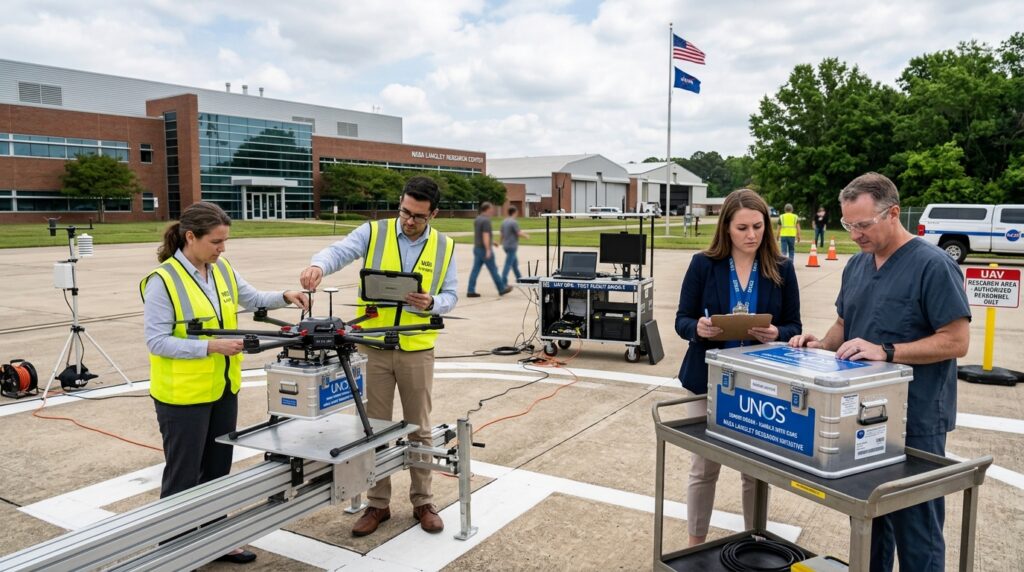
The partnership between NASA’s Langley Research Center and the U.S. organ-sharing network UNOS highlights how aerospace technology is being applied directly to one of medicine’s most time-sensitive logistical challenges on Earth.
NASA is teaming up with the United Network for Organ Sharing, or UNOS, to study whether advanced aviation technologies, including drones and flight research systems, can move donated organs faster and more reliably through the transplant system, in a collaboration that underscores how aerospace innovation is increasingly finding practical use far beyond space missions.
The agreement, announced on April 21, pairs NASA Langley Research Center in Hampton, Virginia, with the nonprofit organization that sits at the center of the U.S. transplant network. At its core is a simple but urgent problem: in organ transplantation, time is not just money or efficiency. It is viability.
Every donated organ moves against the clock. Hearts, lungs, livers and kidneys must be recovered, preserved, matched, transported and transplanted within narrow windows. Even when organs are moved by plane between cities, delays on the ground, traffic congestion, airport bottlenecks, handoff problems and uncertainty in final-mile delivery can erode that precious margin. The result can be higher costs, more stress for transplant teams and, in the worst cases, organs that arrive too late or in compromised condition.
That is where NASA believes its expertise can help.
In its announcement, NASA said Langley would work with UNOS under a Space Act Agreement to explore faster, more dependable ways to transport donor organs using advanced aviation technologies. The agency said the project will draw on Langley’s aeronautics research strengths in advanced modeling, flight planning, sensing technologies and safety systems to identify how aircraft systems developed for aviation research could address key weaknesses in transplant logistics. NASA said the work would begin with drone testing and route evaluation, particularly in the first-mile and last-mile portions of transport where delays can be especially costly.
The first phase of the effort is deliberately technical and cautious. UNOS said researchers will develop and test instrumentation to measure how environmental factors such as temperature, vibration and altitude affect organs during unmanned aerial vehicle flights carrying research or animal organs. NASA, for its part, said the initial flight evaluations would be followed by an assessment of whether an animal test organ remained viable for transplant, including whether tissue damage or temperature instability occurred during transport.
That attention to biological integrity is essential. Moving an organ faster is useful only if the journey does not degrade the organ itself. In other words, the project is not merely a test of flight speed. It is a study of whether advanced air mobility can meet the exacting medical standards required for transplantation.
NASA said early testing would make use of Langley’s City Environment Range Testing for Autonomous Integrated Navigation, or CERTAIN, a platform that allows drones to fly beyond visual line of sight in realistic conditions without ground-based spotters. That capability matters because it allows researchers to simulate delivery scenarios closer to the messy realities of real medical logistics rather than idealized short-range demonstration flights. UNOS said future phases could examine scalability, longer-range operations and regulatory requirements if early results are promising.
The partnership is notable partly because of what it says about NASA’s role. The space agency is more often associated with rockets, planetary science and human exploration, but Langley has long been one of NASA’s core aeronautics centers. Its work spans future airspace systems, advanced air mobility, aviation safety and autonomous operations. NASA says its Advanced Air Mobility program is helping the Federal Aviation Administration and industry prepare for a future transportation system that includes low-altitude passenger transport, cargo delivery and public-service uses such as emergency response. Organ delivery fits naturally into that framework: it is time-critical, high-value and potentially well suited to specialized drone routes.
For UNOS, the partnership arrives at a moment when transportation reliability has become an increasingly visible issue in transplantation. The organization said drone-based delivery could reduce costs, increase route flexibility and cut transport times by avoiding traffic and other scheduling constraints. UNOS already operates tools such as a real-time Organ Tracking Service designed to improve visibility while organs are in transit, and it has supported broader reforms intended to strengthen the logistics chain. In 2025, the Federal Aviation Administration delivered a report to the U.S. transportation secretary on improving human organ transport on commercial airlines, after a working group of regulators, airlines, procurement organizations, hospitals and labor representatives proposed 20 recommendations to improve the process.
That broader policy backdrop is important. The NASA-UNOS collaboration is not emerging in a vacuum or as a futuristic side project. It is part of a growing recognition across the U.S. transplant system that logistics are inseparable from medical outcomes. Advances in surgery, matching algorithms and preservation technology lose some of their impact if transport remains vulnerable to avoidable delays and poor handoffs.
The tone of the two organizations’ statements reflects that practical ambition. John Koelling, director of the Aeronautics Research Directorate at NASA Langley, said the partnership was a chance to apply NASA technology to a real-world problem that could save the lives of people waiting for transplants. UNOS interim chief executive Mark Johnson said combining NASA’s aeronautics capabilities with UNOS’ transplant expertise could help explore approaches that may reduce transport time and cost, improve efficiency and ultimately save more lives.
The language is measured, and for good reason. No one involved is claiming that drone organ delivery is ready for immediate nationwide use. There are obvious constraints. Airspace regulation, weather, distance, payload limits, hospital integration, chain-of-custody requirements and biological safety all stand between a research agreement and a routine medical service. Drones might prove useful in some parts of the network and not in others. They may be best suited for short, high-priority segments rather than replacing existing air and ground transport entirely.
But even within those limits, the potential is significant.
In transplantation, incremental reductions in delay can matter enormously. A more reliable first-mile movement from donor hospital to airport, or a faster last-mile transfer from landing site to transplant center, could improve scheduling certainty for surgical teams and reduce the risk of missed opportunities. In areas where highway traffic is unpredictable or access is difficult, direct aerial routing could offer a margin that conventional courier systems cannot easily match. And because organs are among the most time-sensitive cargoes in any transportation network, success here could also provide a model for other urgent medical deliveries.
There is also symbolic weight in the project. Governments and research institutions are under pressure to show how advanced technology can deliver public benefits in daily life, not just in distant or abstract domains. This partnership gives NASA a vivid example of that argument: a space and aviation agency using its engineering knowledge not for spectacle, but for a problem rooted in hospital corridors, transplant centers and patients waiting for a call that can mean survival.
That helps explain why the announcement has drawn attention beyond the transplant community. It suggests that technologies often discussed in the context of future mobility, autonomous flight or commercial drone development may find some of their most persuasive early uses in public-service missions where speed, precision and reliability are not luxuries but necessities.
The work remains at an early stage, and much will depend on the results of the first tests. Yet the direction is clear. NASA and UNOS are trying to determine whether tools built for the future of aviation can solve one of medicine’s oldest and hardest logistical problems: getting a donated organ from one human being to another before time runs out.
If the answer is yes, the implications could reach well beyond one research center or one transplant network. It would show that aerospace innovation, often measured in altitude and distance, can also be measured in something more immediate and human: the number of lives preserved because an organ arrived in time.

