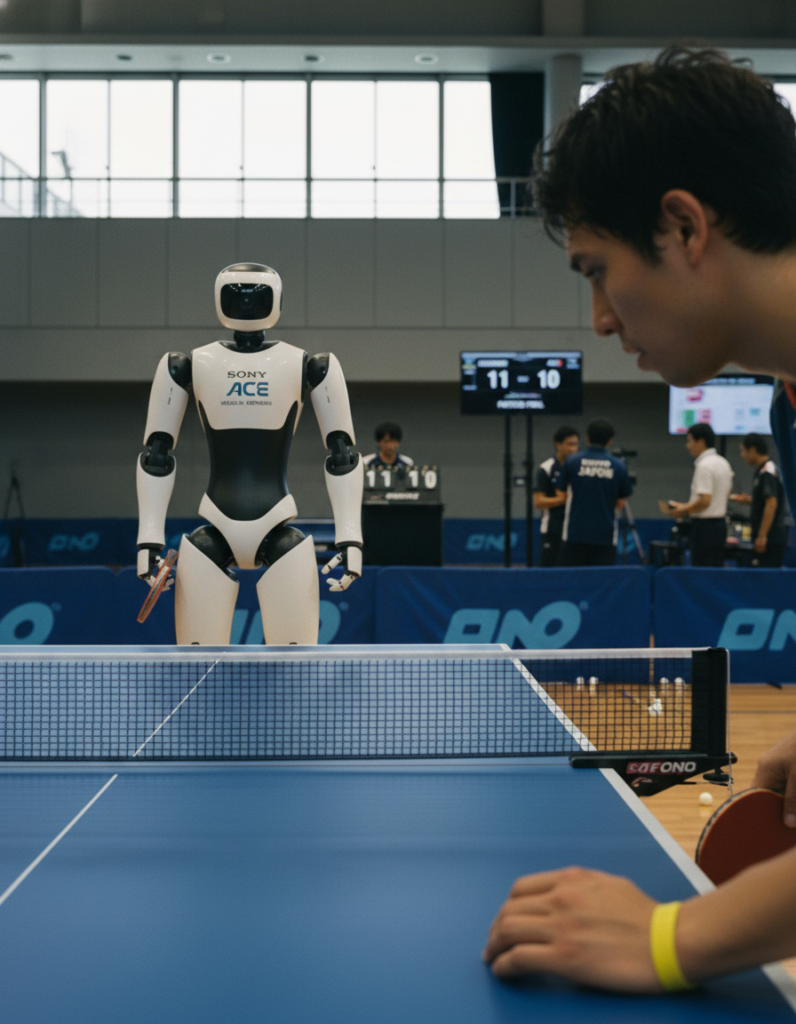
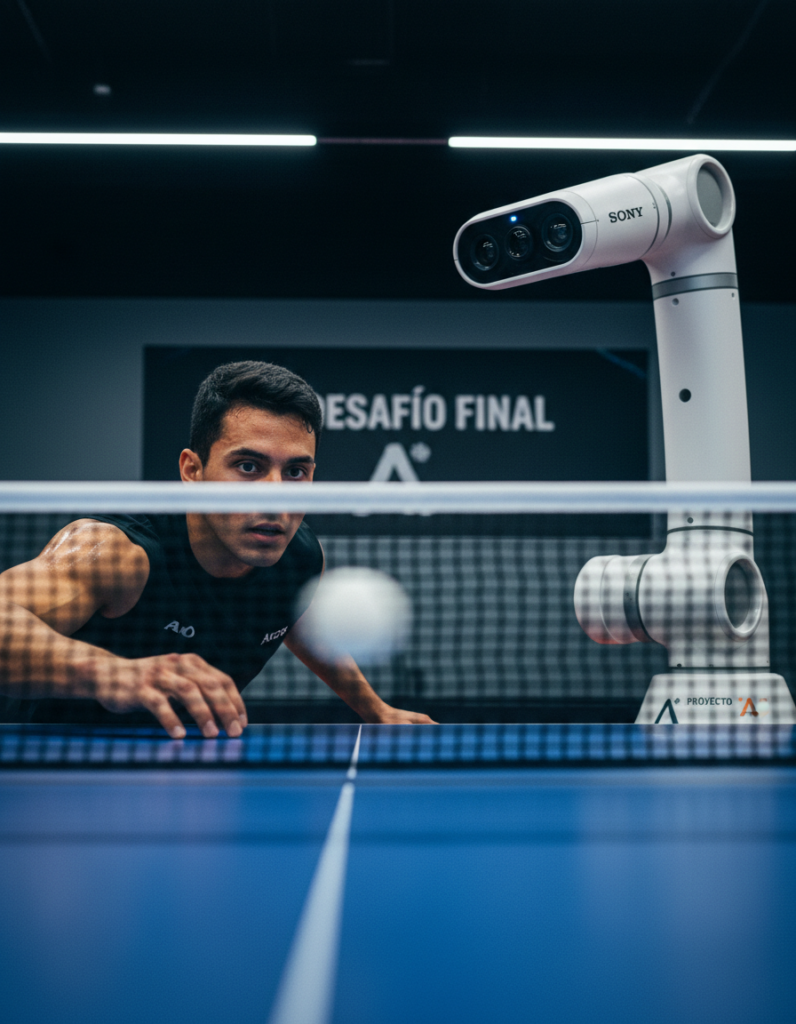
Sony’s Ace robot is drawing attention far beyond the lab, as its ability to rally with — and at times outplay — elite human table tennis players sharpens a debate over how quickly artificial intelligence is moving from digital mastery into the messy demands of physical reality.
TOKYO — For years, the most dramatic victories in artificial intelligence came on screens.
Machines conquered chess, then Go, then a widening range of video games and simulations, often in carefully controlled environments where the rules were fixed, the playing field was perfectly known and the body was irrelevant. What made those advances historic was the quality of decision-making. What they did not have to confront, at least not in the same way, was the friction, uncertainty and timing of the real world.
That is why Sony’s table tennis robot, Ace, is generating such interest across both the technology and sports communities.
According to reporting by The Associated Press on April 22, 2026, Ace can push elite human players into difficult exchanges and, on some occasions, beat them. Sony has framed the achievement as a milestone not simply because a robot can hit a ball back over a net, but because table tennis is one of the fastest, most reactive and least forgiving tests of machine perception and control.
The distinction matters. A game in software can be reset, abstracted and accelerated. A rally in table tennis unfolds in fractions of a second, with a small ball whose speed, angle and spin change continuously. The machine must see, predict and move almost instantly. It must convert vision into action under pressure, then adjust again on the next shot. There is no pause button, and no clean separation between “thinking” and “doing.”
That challenge has made table tennis a long-standing benchmark in robotics. Researchers have often viewed the sport as a compact version of a much bigger problem: how to build machines that can act intelligently in dynamic human environments. A robot that can read a spinning ball, position itself correctly and return it with purpose is demonstrating more than athletic novelty. It is showing a growing ability to handle uncertainty in motion.
Sony’s Ace appears to embody that shift. AP reported that the robot was able to challenge high-level human opponents and occasionally surpass them, an outcome that would have sounded like science fiction not long ago. The symbolism is powerful because the arena is physical, shared and visible. This is not a machine scoring points in a virtual contest. It is operating across a table from a person, under the same basic conditions of play.
That does not mean the robot has “solved” sport, or robotics more broadly. Even when a machine reaches startling performance in a narrow task, the gap between excellence in one setting and broad usefulness in everyday life remains wide. But the significance of Ace lies in what it suggests about the direction of travel. More capable perception, better control systems and more advanced learning methods are beginning to combine in ways that make robots less brittle and more adaptable.
The sports world is watching for a different reason. Elite athletes and coaches understand that table tennis is not merely about reflexes. It is about spin, disguise, rhythm, anticipation and psychological pressure. A machine that can survive in that environment is doing more than reproducing forehand drills. It is interacting with one of the most subtle racket sports in the world.
There is also an irony here. For decades, robots in sport were largely training tools — ball launchers, tracking systems, replay machines, devices built to help humans improve. Ace hints at a role reversal. The robot is no longer just the assistant feeding repetitions; it is becoming a credible opponent. That possibility raises intriguing questions. Could advanced robots become sparring partners tailored to a player’s weaknesses? Could they accelerate training by producing precise, repeatable but still adaptive challenges? Could they even help reveal tactics or shot patterns that human competitors have not yet explored?
Those possibilities extend beyond sport. Robotics researchers have long argued that progress in high-speed manipulation has implications for warehouses, factories, logistics, health care and disaster response. The same fundamental capabilities — sensing fast-changing conditions, predicting motion and executing precise actions — matter in many industries. A robot playing table tennis is, in one sense, entertainment. In another, it is a public demonstration of a deeper technological capability.
The broader history of AI gives this moment added weight. Previous headline-grabbing breakthroughs often involved systems that excelled in domains where the world could be represented as data. Robotics has always been harder because the world refuses to stay still. Sensors are noisy. Objects move unpredictably. Tiny errors in timing or position can cascade into failure. In that sense, physical intelligence has been a more stubborn frontier than digital intelligence.
That is why even partial success stands out. Earlier high-profile work in robot table tennis showed that machines could reach respectable levels against beginners and intermediate players while still struggling against stronger opponents. The latest attention around Sony’s Ace suggests the frontier is moving again, toward competition that looks less like a controlled demonstration and more like genuine athletic exchange.
Still, restraint is important. A robot that plays one sport well is not a general-purpose athlete, much less a general-purpose worker. Public fascination with spectacular demonstrations can blur the difference between narrow mastery and broad intelligence. A machine engineered for a specific challenge may perform brilliantly there and poorly elsewhere. Real-world success, in robotics, is often highly local.
Yet even with that caveat, Ace lands as a meaningful moment. It shows that progress in robotics is no longer confined to carefully staged pick-and-place tasks or slow-moving industrial routines. The new generation of systems is beginning to manage speed, adaptation and unpredictability in a way that ordinary people can immediately recognize. A table tennis rally needs no translation. Anyone watching can grasp the difficulty.
That accessibility may help explain why the story has resonated so strongly. Technology often becomes real to the public not when a paper is published, but when a machine does something physical, visible and slightly unsettling. A robot returning a vicious topspin shot carries that effect. It compresses years of research into a single image: silicon, metal and code meeting human skill at the table.
For Sony, a company with a long history in consumer technology and robotics, Ace also carries branding significance. It aligns the company with a vision of AI that is embodied rather than purely computational — technology that acts in the world, not just analyzes it. For the sports community, it offers a glimpse of training and competition that may increasingly involve intelligent machines. For robotics researchers, it provides another sign that the field is edging toward systems that can operate with speed and competence in human spaces.
The deeper question now is not whether robots can produce isolated physical feats. They can. The question is how far those capabilities can scale: from table tennis to homes, hospitals, streets and workplaces; from specialized excellence to dependable versatility; from a dazzling rally to a useful, trusted partner in daily life.
Ace does not answer all of that. But it sharpens the point of the conversation.
The age of AI was once defined by victories in games we played on machines. More and more, it is being defined by machines entering the games — and the world — we inhabit ourselves.