
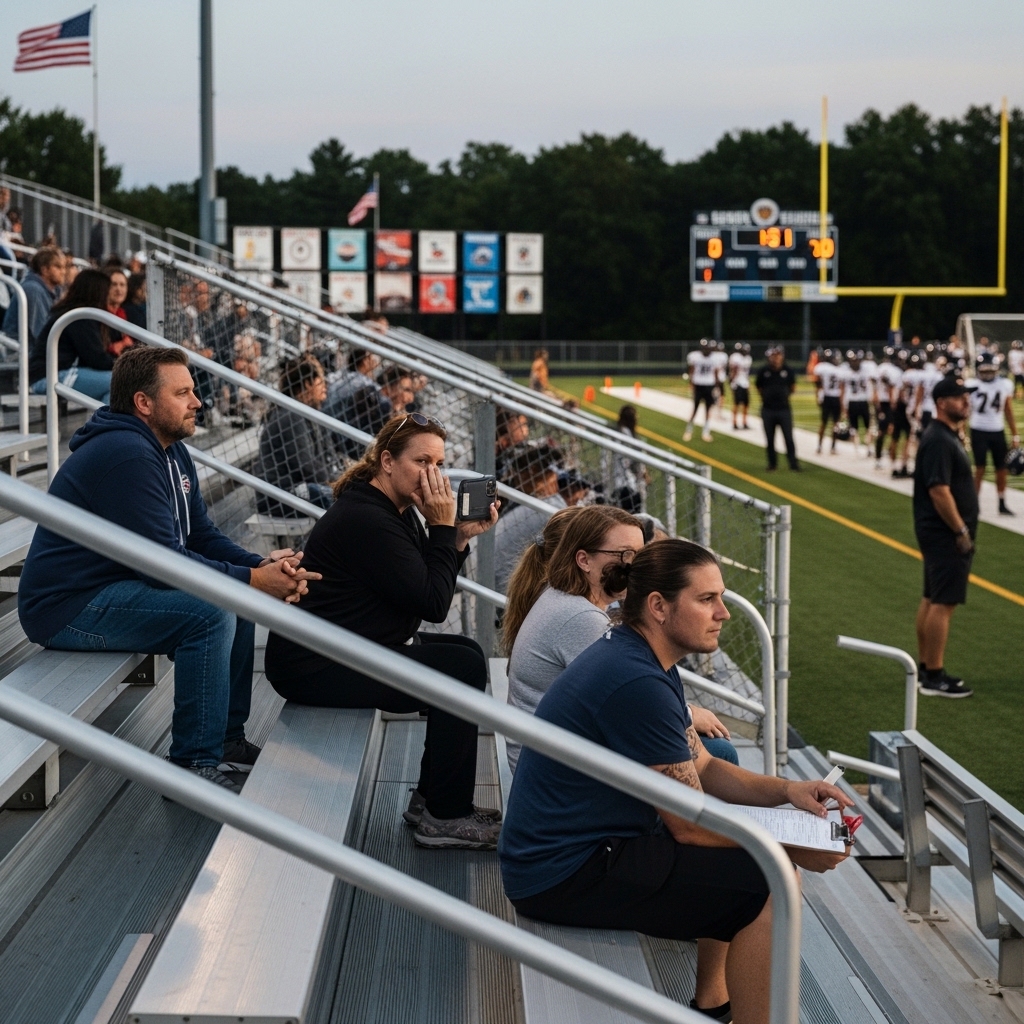
Across the United States, high school athletics remains a source of pride, discipline and opportunity, but for many families the pursuit of a college scholarship has become an emotional and financial gamble.
On a Friday night in many American towns, the brightest lights are not in shopping centers or office parks, but above school stadiums. Teenagers run onto football fields, basketball courts, soccer pitches and running tracks wearing uniforms that carry the name of a school, a neighborhood and often a family’s hopes. Parents sit in bleachers with phones raised, coaches shout instructions, and college dreams can feel close enough to touch.
High school sports occupy a powerful place in American culture. They are celebrated as a path to teamwork, discipline, leadership and community identity. For millions of students, athletics can offer structure after school, friendships across social groups and a reason to stay engaged with academics. At their best, school teams teach teenagers how to lose, recover, sacrifice and belong.
But beneath the applause, another reality has grown more visible. For many families, youth and school sports have become tied to the hope of a college athletic scholarship. That hope can inspire students to train harder and aim higher. It can also become a source of pressure that reshapes family life, household spending and a teenager’s sense of self-worth.
The scale of high school sports in the United States is enormous. The National Federation of State High School Associations reported that participation exceeded eight million in the 2023-24 school year, an all-time high and the first time the total had passed that mark. The NCAA has also emphasized that only a fraction of high school athletes go on to compete at the college level, and an even smaller share receive athletic scholarships. Recruiting services and college athletics experts often warn families that “full ride” scholarships are far less common than many parents imagine.
Yet the scholarship dream remains powerful because the cost of American higher education is so high. For middle-class families worried about tuition, housing and debt, athletic talent can appear to offer a rare route through an expensive system. A child who can run faster, shoot more accurately, throw harder or swim a fraction of a second quicker may seem to hold not only personal promise but financial relief for the entire household.
That belief can begin early. Children may join travel teams in elementary school, attend private coaching sessions before sunrise and spend weekends driving across states for tournaments. Families pay for club fees, equipment, camps, strength training, recruiting videos and showcases designed to put athletes in front of college coaches. What was once a seasonal school activity can become a year-round project.
The financial burden is uneven. Wealthier families can afford specialized training and exposure events. Lower-income families may depend on school programs, community coaches or fundraising. In some sports, especially those with expensive equipment or travel circuits, access to recruitment pathways can reflect a family’s resources as much as a student’s talent. The result is a system that often speaks the language of merit while quietly rewarding money, time and parental flexibility.
For parents, the pressure is complicated. Many begin with good intentions. They want to support a child’s passion, reward hard work and open doors. They drive long distances, rearrange work schedules and celebrate every improvement. But the line between support and expectation can blur. A missed shot, poor race or injury may feel not only disappointing but costly. The teenager stops playing only for a team and begins carrying the weight of an investment.
Coaches and athletic directors often see this tension up close. A student may love the sport but dread the car ride home after a loss. A parent may question playing time, demand more exposure or compare one child’s progress with another’s. A coach may be praised when college recruiters show interest and blamed when they do not. In the most stressful cases, the athletic field becomes an extension of family anxiety.
The students themselves are left to manage conflicting identities. They are children, classmates, athletes and potential scholarship candidates all at once. Their grades matter, but so do statistics. Their friendships matter, but so do tournament schedules. Their bodies are still developing, but they are often asked to train like professionals. When performance becomes central to family hope, an injury or slump can feel like personal failure.
Sports specialization has intensified the pressure. Many young athletes now focus on one sport for most of the year, believing that constant practice is necessary to stand out. Some may benefit from disciplined training, especially in highly technical sports. But medical professionals and youth sports advocates have warned that early specialization can increase the risk of overuse injuries, burnout and emotional fatigue. A teenager who never has an offseason may not have the space to recover, explore other interests or simply be young.
The mental health dimension is increasingly difficult to ignore. Student-athletes often learn to project confidence and toughness. They may be reluctant to tell parents or coaches that they feel anxious, exhausted or no longer enjoy the sport. In competitive environments, admitting fear can be mistaken for weakness. The same culture that teaches resilience can sometimes discourage vulnerability.
The pressure is not limited to elite prospects. Even students with little chance of a scholarship may absorb the message that athletics must produce a measurable return. A season becomes valuable only if it leads to recruitment. A sport becomes worth playing only if it helps with college admissions. That mindset can strip school athletics of one of its most important functions: giving young people a healthy place to grow, compete and connect.
College coaches also operate within a demanding system. They seek athletes who can succeed academically, physically and emotionally at the next level. But recruiting is competitive, and communication with families can be uneven. A teenager may interpret a message from a coach as a firm opportunity when it is only early interest. Families may spend thousands of dollars chasing visibility without understanding how limited roster spots and scholarships can be.
The scholarship itself is often misunderstood. Not all college athletic aid covers the full cost of attendance. Many scholarships are partial, divided across teams and renewed according to institutional rules. Division III schools, for example, do not award athletic scholarships, though students may receive academic or need-based aid. Even when athletic aid is offered, families may still face significant expenses.
This gap between perception and reality fuels disappointment. Parents may believe that years of spending on youth sports will eventually be recovered through college aid. But the math rarely works that neatly. For some families, the total cost of travel teams, camps and private coaching can exceed the value of any scholarship eventually offered. The emotional cost can be harder to measure.
None of this means the scholarship dream is false. For some students, athletics genuinely opens doors that might otherwise remain closed. A scholarship can change the course of a young person’s education. A coach’s belief can help a teenager leave home, earn a degree and build a future. School sports can still be one of the most constructive institutions in American youth life.
The challenge is to keep ambition from becoming a burden. Experts in youth development often urge families to ask different questions. Is the child still enjoying the sport? Is the schedule leaving time for rest, schoolwork and friendships? Is the family’s financial commitment sustainable? Would the student still want to play if no scholarship were possible? These questions can help separate a young athlete’s dream from adult fear.
Schools can also play a stronger role. Athletic departments can educate parents about recruiting realities, scholarship limits and academic eligibility. Coaches can encourage multi-sport participation and protect rest periods. Counselors can help student-athletes plan for college in ways that do not depend entirely on sports. Communities can celebrate effort, character and improvement, not only recruitment announcements.
For families, the healthiest approach may be to treat sports as part of education rather than a financial strategy. The lessons of athletics are real even when no scholarship arrives. A student who learns discipline, cooperation, courage and time management has gained something valuable. A family that cheers without turning every game into an audition may preserve what first made the sport meaningful.
In American school sports, the dream of a scholarship will not disappear. It is tied too deeply to college costs, national sports culture and the belief that talent can change destiny. But the dream needs perspective. Teenagers are not investment portfolios. They are young people still discovering who they are. The best outcome may not always be a signed letter of intent, but a child who leaves the field healthy, supported and still able to love the game.