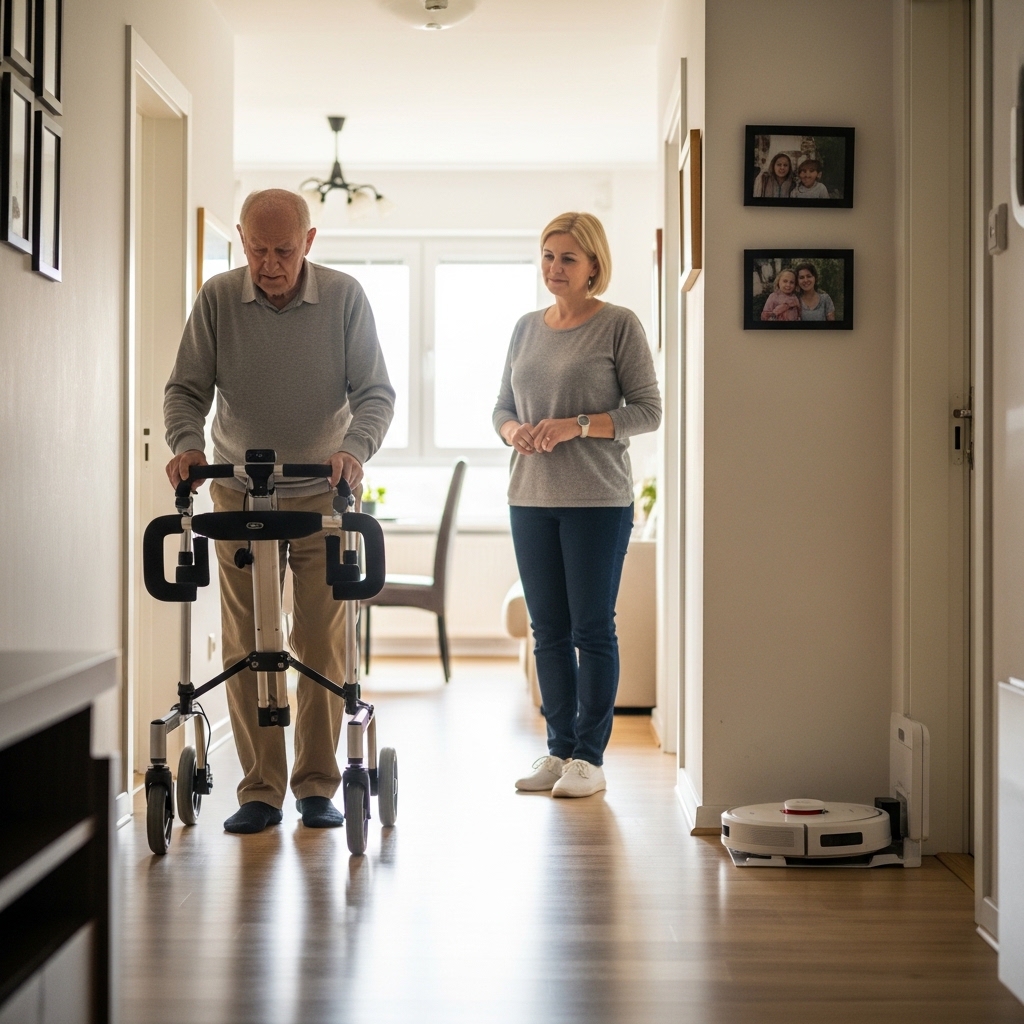
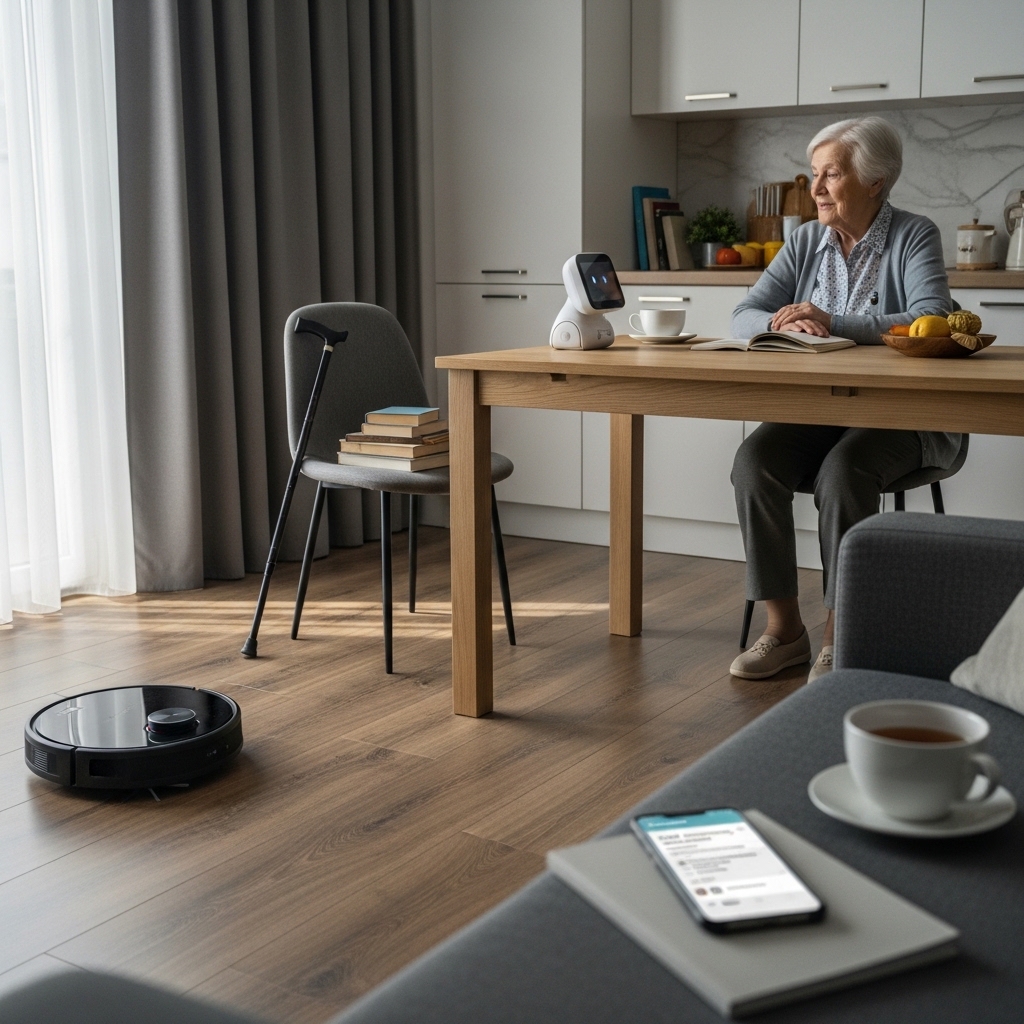
As artificial intelligence, sensors and aging populations converge, the domestic robot is beginning to shift from a cleaning appliance into a practical assistant for daily life.
For years, the household robot was defined by a familiar circular machine sliding under sofas, bumping lightly against chair legs and returning to its charging dock with a bin full of dust. The robot vacuum did not look like science fiction. It did not speak, lift objects or understand the emotional tone of a room. But it did something far more important for the robotics industry: it entered ordinary homes, earned a place in daily routines and taught consumers that a machine could quietly perform a domestic task without constant supervision.
That modest beginning is now giving way to a broader transformation. Around the world, companies, universities and public agencies are testing a new generation of home robots designed not only to clean floors but also to monitor health, support mobility, remind people to take medication, reduce loneliness and help older adults live independently for longer. The future of home robotics is no longer confined to convenience. It is increasingly tied to one of the most urgent demographic challenges of the century: how to care for aging societies with too few caregivers.
The shift is being driven by three forces arriving at once. Artificial intelligence has made machines better at recognizing speech, objects and human behavior. Sensors have become cheaper and more capable, allowing robots to map rooms, detect falls, avoid pets and navigate cluttered apartments. At the same time, many countries are facing rising numbers of older adults and persistent shortages of health and social-care workers. Together, these pressures are pushing domestic robots from luxury gadgets toward tools that may become part of basic home infrastructure.
The robot vacuum remains the clearest proof of consumer acceptance. Its success came from a narrow but valuable promise: automate a repetitive chore in a contained environment. Newer models use cameras, lidar, voice assistants and machine-learning software to avoid cables, identify rooms and adjust cleaning routines. Some can mop, empty their own dustbins and integrate with smart-home systems. These advances may appear incremental, but they have created the technical and commercial base for more ambitious household machines.
The next step is already visible in companion robots. Devices such as ElliQ, developed for older adults, are designed to initiate conversations, suggest exercises, offer reminders and encourage social connection. In New York State, officials have used companion robots and robotic pets as part of programs aimed at reducing isolation among older residents. Supporters say these systems are not meant to replace family members, nurses or community workers. Their purpose is to fill gaps between human visits, especially for people who live alone or have limited mobility.
That distinction matters. Elder-care robots raise immediate ethical questions because care is not merely a list of tasks. It involves trust, judgment, intimacy and dignity. A robot can remind a person to drink water, but it cannot fully understand grief. It can detect inactivity, but it cannot replace the reassurance of a familiar human voice. Researchers and care providers increasingly describe the most realistic role for robots as supportive rather than substitutive: machines that handle routine monitoring, reminders and physical assistance while humans remain responsible for emotional care and medical decisions.
Physical assistance is one of the most difficult frontiers. Helping an older person stand, walk, bathe or recover from a fall requires strength, balance and safety far beyond what is needed to clean a floor. Engineers at the Massachusetts Institute of Technology have tested the Elderly Bodily Assistance Robot, or E-BAR, a mobile system designed to support users as they sit, stand and move around the home. The concept reflects a major direction in robotics research: building machines that work in human environments without forcing people to redesign their lives around the robot.
That is a central challenge. Homes are messy, personal and unpredictable. A hospital corridor is easier for a robot to navigate than a living room with rugs, pets, toys, narrow doorways and moving people. A kitchen can contain hundreds of objects with different shapes, weights and risks. A cup, a pill bottle and a hot pan each require different handling. For a robot to become a true home assistant, it must not only move accurately but also understand context. It must know when to act, when to ask permission and when to stay out of the way.
The technology is improving, but expectations still need restraint. Humanoid robots attract attention at trade shows because they resemble the general-purpose helpers imagined in films. In practice, many near-term home robots will be less dramatic: mobile screens, smart walkers, fall-detection devices, robotic pets, automated medication dispensers and cleaning machines that coordinate with voice assistants. Their value will come from reliability, not spectacle. A robot that prevents one fall, alerts a caregiver at the right moment or helps a person maintain a routine may be more transformative than a machine that can briefly fold a shirt on camera.
Cost will determine how widely these systems spread. Robot vacuums became common only after prices fell and reliability improved. Elder-care robots face a harder path because they may require subscriptions, secure data services, maintenance and integration with health providers or public agencies. Wealthier households may adopt advanced systems first, while lower-income older adults could be left behind unless insurers, governments or community organizations help fund access. If robots become part of care, affordability will be as important as innovation.
Privacy is another barrier. A useful home-care robot may need to process voice commands, movement patterns, medication schedules and emergency events. In some cases, it may use cameras or microphones in deeply private spaces. That creates risks of data misuse, hacking, surveillance and unclear consent, especially for people with cognitive decline. Regulators and manufacturers will need clear standards on what data is collected, where it is stored, who can access it and how users can disable monitoring without losing essential support.
There are also cultural differences. Japan, with one of the world’s oldest populations, has long explored robots as part of elder care, partly because of labor shortages and a strong robotics industry. In parts of Europe, care homes have tested social robots to encourage conversation and entertainment. In the United States, some public programs have focused on loneliness and independent living. Acceptance varies by family structure, religion, income, trust in technology and the meaning people attach to care. A robot welcomed as helpful companionship in one home may feel intrusive or undignified in another.
Still, the direction of travel is clear. Domestic robotics is moving from single-purpose machines toward connected systems that combine cleaning, monitoring, communication and assistance. The home robot of the near future may not be a single humanoid servant. It may be an ecosystem: a vacuum that maps the apartment, a companion device that checks in each morning, a wearable that detects changes in movement, a robotic support frame that helps prevent falls and a remote-care platform that alerts relatives or professionals when something seems wrong.
The most successful robots will likely be those that disappear into routine. They will not demand that older adults become technology experts. They will speak clearly, move safely, respect privacy and perform specific tasks well. They will support caregivers rather than compete with them. They will be judged not by whether they look human, but by whether they help people remain safer, more independent and more connected.
The journey from vacuuming floors to caring for the elderly shows how technological revolutions often begin quietly. The first domestic robots did not transform the household overnight. They cleaned small areas, learned the geometry of rooms and gained trust one completed task at a time. Now, as societies age and care systems strain, that trust is being extended to more sensitive parts of life. The future has not fully arrived, and it will need careful regulation, honest marketing and human oversight. But it is no longer distant. It is already moving through the hallway, learning the shape of the home.