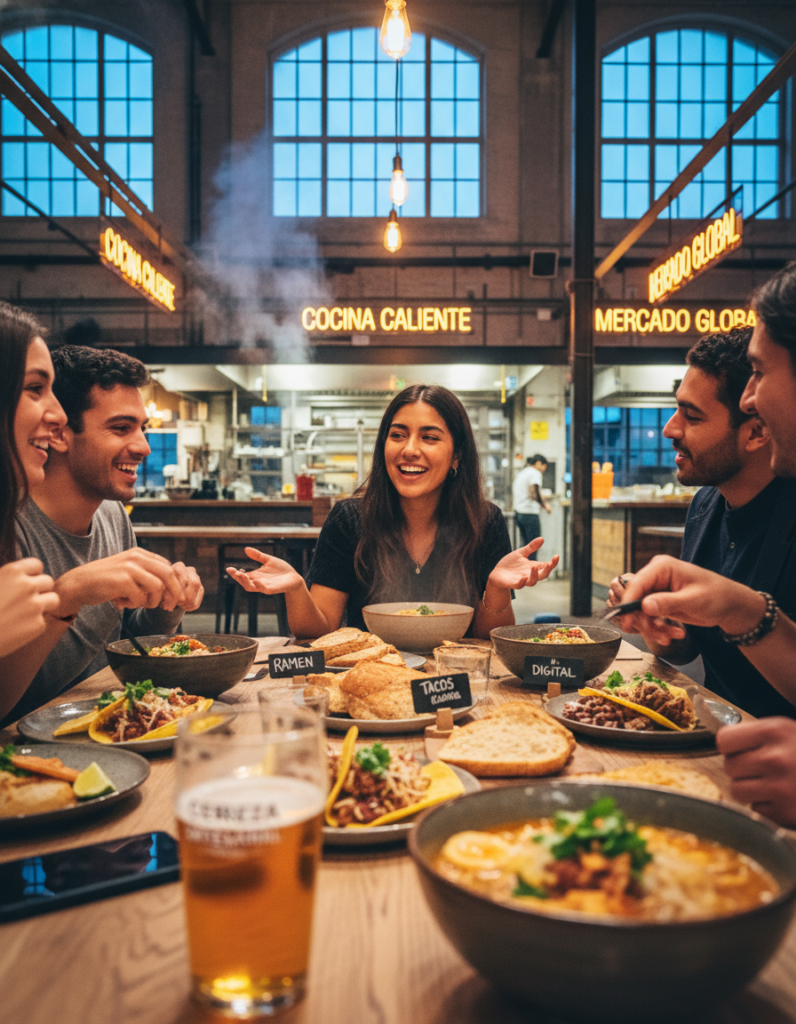
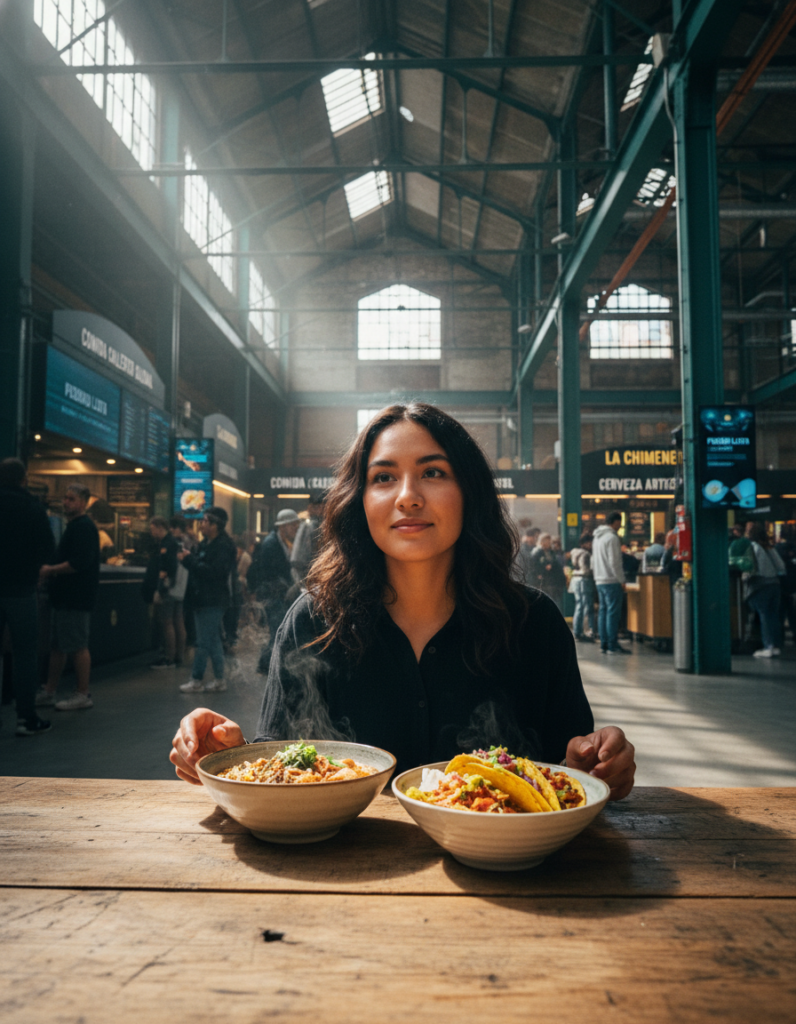
Even as Britain’s restaurant industry struggles with higher costs and wary consumers, food halls are gaining ground by offering cheaper entry for traders, broader choice for diners and a communal experience that fits how younger city residents increasingly want to eat and meet.
In Britain’s cities, one of the clearest signs of how dining culture is changing is not found in the formal restaurant room but in the collective buzz of the food hall. These large, shared spaces, often housed in converted markets, warehouses or department stores, are attracting operators, investors and customers at a time when much of the wider hospitality industry remains under financial pressure. Their appeal lies in a combination that is difficult for conventional restaurants to match: multiple kitchens under one roof, lower overheads for individual vendors, an atmosphere that is as much about spending time as it is about finishing a meal, and a format that suits diners who want flexibility, novelty and company without committing to a single cuisine or a single long sitting.
The rise has become notable enough to stand out against an otherwise troubled backdrop. The Guardian reported in early April that food halls in major UK cities were averaging annual revenue of about £5.6 million, with year-on-year growth of 10.75%, even as brick-and-mortar restaurants continued to close under the weight of higher wages, business rates and energy costs. A separate 2026 industry report, cited widely in the sector, said the number of UK food halls had grown by 31% in the previous 12 months, with dozens more in development. That contrast helps explain why food halls are no longer treated as an interesting niche or a passing lifestyle trend. They are increasingly being viewed as one of the more resilient urban hospitality formats of the moment.
Part of the reason is economic practicality. For many independent cooks and emerging operators, opening a full restaurant has become prohibitively risky. Rent, fit-out costs, staffing, utilities and stock commitments can turn a good food idea into a financially fragile business before the first service settles into rhythm. Food halls offer a different equation. Infrastructure is shared. Front-of-house functions are often centralized. Utility burdens are lower or at least more predictable. Operators can test menus, build an audience and refine their identity without taking on the full exposure of a standalone site. In an era when conventional hospitality margins can evaporate quickly, that lower threshold matters.
But the format is not flourishing only because it makes business sense. It is also thriving because it reflects a broader cultural shift in how younger urban consumers want to eat. The classic restaurant model is built around a degree of fixedness: one menu, one cuisine, one table, one pace. Food halls are built around optionality. A group can arrive together and eat separately. One person can order ramen, another tacos, another Palestinian chicken, another coffee and pastries. No one has to negotiate a compromise before walking in. In social terms, that suits a generation accustomed to personalization, informality and movement between work, leisure and social life in the same afternoon or evening.
That is why food halls often feel less like restaurants and more like civic lounges with kitchens attached. Many remain busy across multiple dayparts because they are not solely lunch or dinner destinations. Customers use them for remote work, coffee meetings, casual dates, family outings and after-work drinks. The food matters, but so does the permission to linger. A traditional restaurant tends to organize time around service. A food hall organizes space around occupancy. It invites people to stay without necessarily escalating their spending at every moment. For urban consumers, especially younger ones, that looser social contract can be more attractive than the ritual structure of restaurant dining.
In that sense, food halls are part of a larger experience economy, but one shaped less by luxury than by versatility. They deliver variety without requiring prestige. They are social without being heavily programmed. They allow experimentation without demanding a special occasion. This is particularly important at a time when many consumers remain cost-conscious. Eating in a food hall is often cheaper than a meal in a conventional restaurant, but it does not carry the feel of compromise. Instead, it can feel abundant: more options, more movement, more people, more atmosphere. In difficult economic times, that combination is powerful.
The urban setting is central to the model’s success. Food halls often thrive where cities are trying to reactivate underused buildings or create new destinations in areas that need more footfall. Sheffield’s Cambridge Street Collective, promoted as Europe’s largest purpose-built food hall, has become one of the most visible examples of the format’s scale and ambition. Manchester already has a deep food hall presence, while Liverpool and London continue to expand theirs, and new large-format sites are opening in repurposed retail spaces. This has made food halls part of a broader story about post-industrial and post-retail urban reinvention. They fill vacant space, generate evening economy activity and present a more flexible alternative to single-operator hospitality units.
That redevelopment role helps explain why investors are paying attention. Lenders and landlords increasingly see food halls not only as hospitality businesses but as mixed-use anchors that can support regeneration. OakNorth’s announcement this month that it had provided £11 million to Market Halls for expansion was a strong signal that the sector is attracting serious backing. The format offers diversification within a single site, which can spread risk more effectively than betting on one large tenant. If one vendor changes, the destination can continue operating with relatively little disruption. In volatile times, that modular structure has obvious appeal.
For chefs and traders, the model also functions as an incubator. Some concepts that begin in food halls later move into standalone restaurants after proving demand. Others remain where they started because the economics and visibility are strong enough to make expansion unnecessary. That flexibility is changing the pipeline of food entrepreneurship. Instead of a linear path from pop-up to permanent restaurant, food halls allow for a middle ground that is stable enough to build a business yet adaptable enough to keep testing ideas. This is especially valuable for cuisines that might struggle to secure traditional backing despite clear audience interest.
There is also a symbolic dimension to the food hall’s popularity. Younger diners increasingly describe eating out not simply as consumption but as participation in a scene. They value atmosphere, discovery and social texture as much as menu precision. Food halls deliver all three. They can feel local and cosmopolitan at once, offering neighborhood identity through independent operators while also satisfying the appetite for global flavors and internet-amplified food trends. In practice, they are one of the few urban dining formats that can accommodate the contradictory demands of modern consumers: value and novelty, convenience and authenticity, speed and sociability.
None of that means food halls are a cure-all for Britain’s hospitality problems. Their success is shaped by location, management quality and curation. A weak mix of traders or poor operational planning can quickly flatten the sense of energy they rely upon. There are also familiar concerns about what happens when successful food-led regeneration contributes to higher rents and shifts the social character of an area. In some cities, enthusiasm for food halls has already intersected with anxieties about gentrification and who ultimately benefits from redevelopment. The model can revitalize neighborhoods, but it can also become part of a broader urban story in which cultural buzz raises values faster than communities can absorb.
Even so, the present momentum is hard to ignore. At a moment when much of the restaurant trade is fighting to contain costs and protect margins, food halls are benefiting from a structure that aligns unusually well with both operator needs and consumer habits. They are cheaper to enter, easier to browse, more forgiving socially and often more adaptable architecturally. They turn dining into a shared platform rather than a fixed proposition. That feels especially attuned to younger city dwellers, who often approach food not as a single event in a private room but as one layer in a broader social experience.
The result is that food halls are becoming more than convenient places to eat. They are emerging as one of the defining urban hospitality forms of the current moment: spaces where commerce, culture and community overlap in a way that feels natural to contemporary city life. The restaurant has not disappeared, nor will it. But the rise of the food hall suggests that for many people, especially younger consumers, the future of going out may be less about sitting down for a formally bounded meal and more about entering a lively, flexible room where food is only the beginning of the encounter.”””