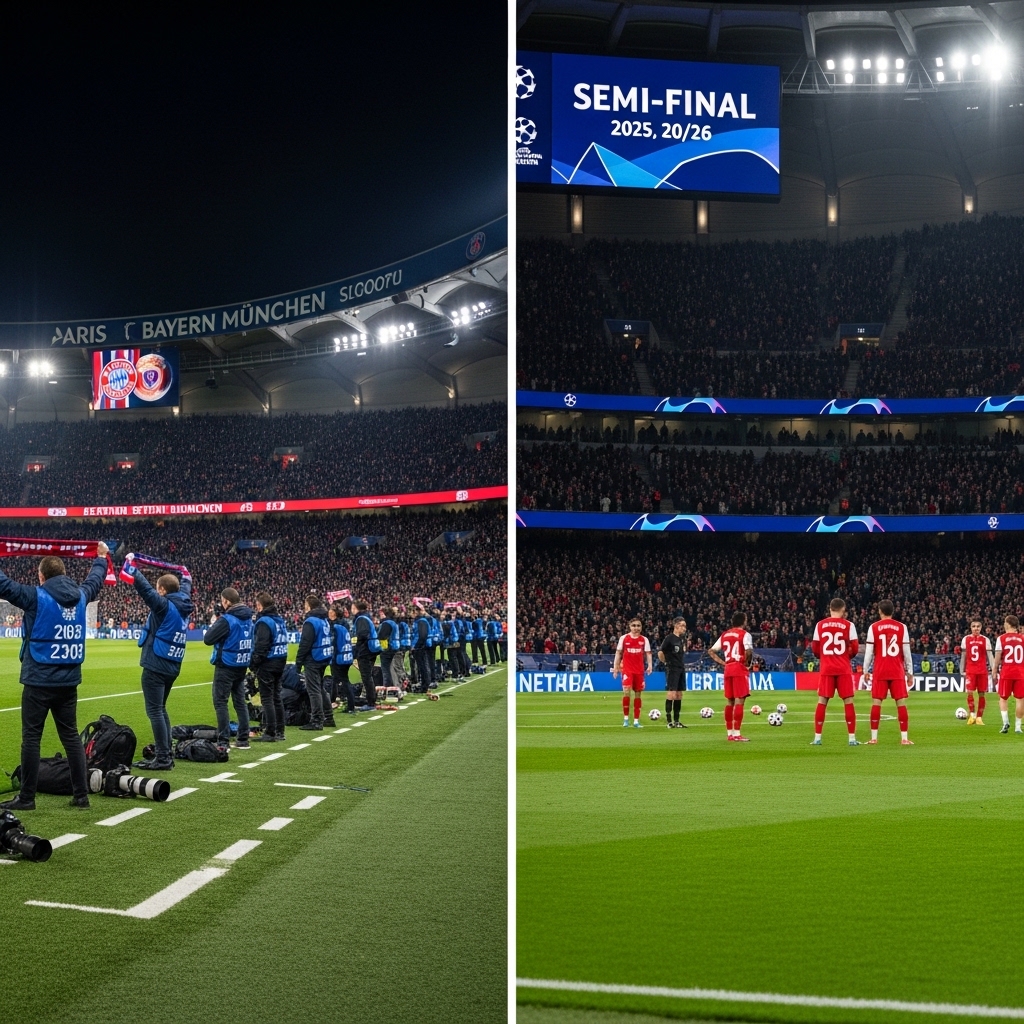
UEFA has confirmed the 2025/26 Champions League semi-final lineup, with Paris facing Bayern Munich and Atlético de Madrid meeting Arsenal in a last-four draw that brings together recent form, heavyweight history and sharply different tactical identities.
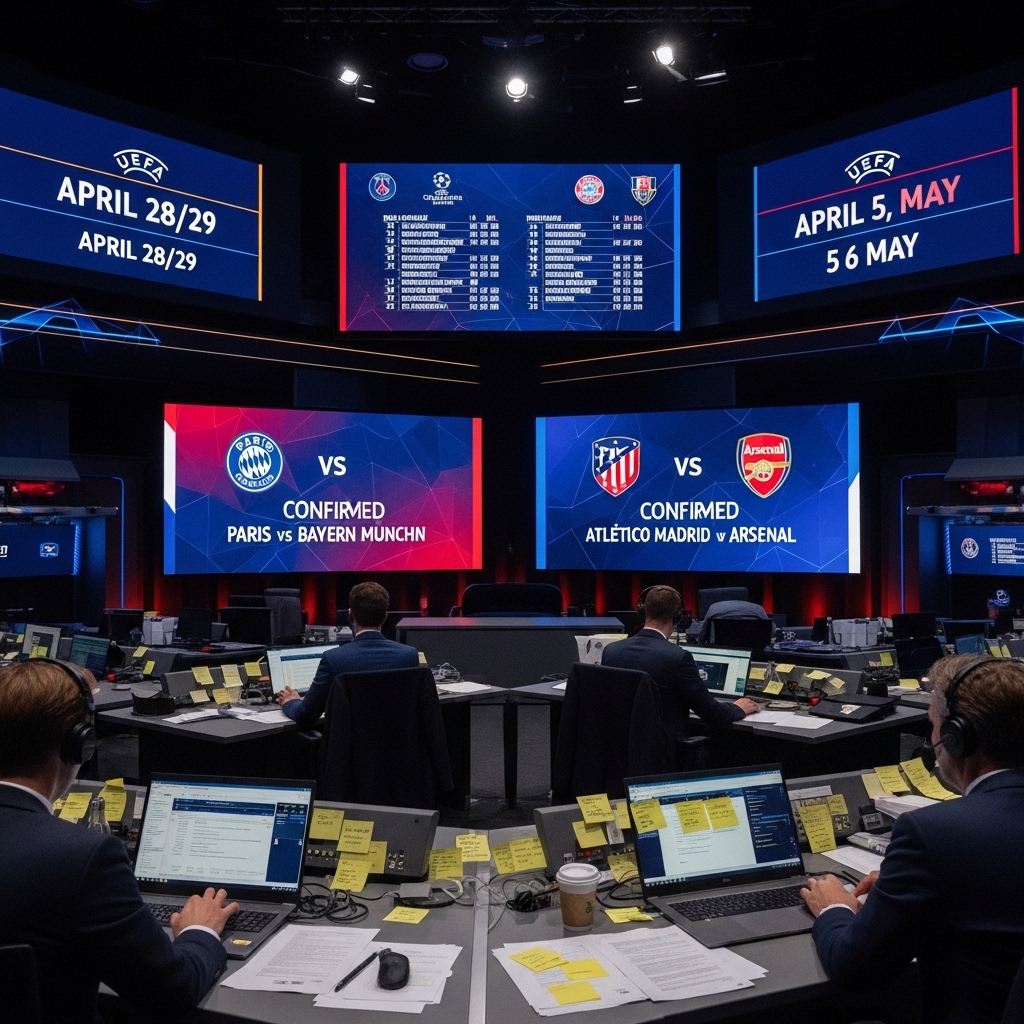
The Champions League has reached the stage where every detail is magnified, and this season’s semi-final field now reflects that familiar mix of pedigree, momentum and survival. UEFA confirmed on April 14 that the final four will be Paris, Bayern Munich, Atlético de Madrid and Arsenal, with the first legs scheduled for April 28 and 29 and the return matches on May 5 and 6. Paris will host Bayern in the opening semi-final on Tuesday, April 28, before Atlético welcome Arsenal on Wednesday, April 29. The second legs will then be played at Arsenal on Tuesday, May 5, and at Bayern on Wednesday, May 6. All matches kick off at 21:00 CET, with the final set for May 30 at the Puskás Aréna in Budapest.
That confirmation has turned the semi-finals into the main story in European football this week, not only because of the clubs involved but because of the routes they took to get here. Paris reached the last four in emphatic fashion, eliminating Liverpool 4-0 on aggregate after winning 2-0 at home on April 8 and repeating that scoreline at Anfield on April 14. Atlético advanced by overcoming Barcelona 3-2 on aggregate, following a 2-0 away win in the first leg and then absorbing a 2-1 home defeat in the return. Arsenal edged Sporting CP 1-0 over two matches after winning the away leg in Lisbon and then protecting that advantage in a goalless second leg. Bayern came through the most explosive tie of the quarter-finals, defeating Real Madrid 6-4 on aggregate after a 2-1 first-leg win in Madrid and a wild 4-3 victory in Munich.
The Paris-Bayern pairing has immediate narrative force. It brings together two of Europe’s most talent-rich squads and revives a fixture that already carries weight in the modern history of the competition. UEFA’s own Champions League coverage has highlighted the memory of the 2020 final between the clubs, won 1-0 by Bayern, and the new meeting now arrives with a place in Budapest at stake rather than a trophy on the line. Paris arrive after a flawless quarter-final against Liverpool, scoring four times across two matches without conceding. Bayern, by contrast, come in hardened by a more chaotic and dramatic passage, having survived a seven-goal second leg against Real Madrid to seal progression.
On paper, the contrast is compelling. Paris have looked increasingly controlled through the knockout rounds, dispatching Chelsea 8-2 on aggregate in the round of 16 before shutting out Liverpool twice in the quarter-finals. That sequence suggests a side capable not just of scoring in bursts but of managing elite opposition over 180 minutes. Bayern’s path has been different but no less impressive. They overwhelmed Atalanta 10-2 on aggregate in the round of 16, then showed both attacking power and resilience to outlast Real Madrid. If Paris enter the semi-final with the cleaner recent defensive record, Bayern arrive with evidence that they can survive turbulence and still land decisive blows.
The other semi-final offers a very different kind of tension. Atlético against Arsenal is not just a contest between La Liga and the Premier League; it is a collision between two teams whose quarter-final victories were built on control, discipline and narrow margins rather than spectacle. Atlético’s elimination of Barcelona was defined by their ability to make the first leg count, winning 2-0 away before limiting the damage in the return. Arsenal’s route was even tighter, with a single goal across two legs enough to see off Sporting CP. In knockout football, those details matter. Neither side has reached this stage by looking reckless, and that makes their meeting especially intriguing.
There is also a piece of recent history hanging over that tie. UEFA’s Champions League site notes a “league phase rewind” to Arsenal’s 4-0 victory over Atleti earlier in the season, a result that will inevitably shape the conversation around the semi-final even if knockout football rarely follows the same script twice. That earlier meeting offers Arsenal a reference point and a psychological lift, but Atlético’s knockout path since then shows why past scorelines can mislead. Diego Simeone’s team navigated Tottenham in the round of 16 with a 7-5 aggregate win and then removed Barcelona, underlining their capacity to adjust to very different opponents and game states.
For Arsenal, the semi-final represents both opportunity and scrutiny. Their quarter-final with Sporting was not the most glamorous of the last-eight ties, but it achieved the only objective that matters in April: progression. By winning 1-0 away and then preserving the lead at home, Arsenal gave themselves a route into the final four without needing a dramatic comeback or an emotional escape. That can be read two ways. Critics may see a lack of attacking freedom, but inside the club the greater value will be in game management, defensive focus and the ability to handle pressure without panic. A semi-final against Atlético is likely to demand exactly those qualities.
The dates themselves sharpen the sense of occasion. With the first legs arriving on April 28 and 29 and the return fixtures on May 5 and 6, the tournament now moves into a compact and unforgiving window in which tactical adjustments, injuries, suspensions and momentum shifts can become decisive almost overnight. UEFA has also fixed the final for Saturday, May 30, in Budapest, ensuring that every conversation around these four clubs now leads toward the same destination. There is little room left for long-term planning or gradual correction. At this stage, one poor half, one missed chance or one lapse in concentration can define an entire European campaign.
What makes this semi-final lineup especially compelling is its balance. Paris and Bayern bring star power, attacking depth and the aura of clubs expected to compete for the trophy. Atlético and Arsenal offer a different appeal: structure, intensity and the possibility that patience and discipline can be just as decisive as individual brilliance. The quarter-finals already hinted at that range. Bayern-Real Madrid delivered the competition’s most dramatic spectacle, while Arsenal-Sporting was settled by a single goal across two matches. Paris combined authority with efficiency against Liverpool, and Atlético showed they could absorb pressure while still dictating the terms that mattered most. :contentReference.
That variety is one reason the semi-finals have become the defining football story in Europe this week. There is no single stylistic template left in the competition. Instead, the final four offer four different cases for why they belong here: Paris through control, Bayern through firepower, Atlético through hardness and Arsenal through composure. The result is a pair of ties that feel open without being random. Every team has earned its place through a route that says something specific about its character.
By the time the first whistle sounds in Paris on April 28, the conversation around favorites and outsiders will already be loud. Yet the quarter-finals offered a useful reminder that labels can quickly dissolve over two legs. Barcelona were eliminated after losing the first leg at home. Liverpool were shut out twice. Real Madrid, so often the competition’s late survivors, were finally dragged into a shootout they could not win. Sporting pushed Arsenal into a low-margin battle and still fell short. The Champions League has now stripped the field to four, and UEFA’s confirmed bracket leaves little doubt about what comes next: two nights at the end of April, two more in early May, and then one place in Budapest waiting for whichever side can handle the pressure best. :contentReference.
For now, that is enough to place Paris, Bayern, Atlético and Arsenal at the center of the European game. The names are set, the dates are fixed, and the margins are likely to be thin. In a season that has already delivered emphatic wins, tense stalemates and one unforgettable seven-goal quarter-final second leg, the Champions League semi-finals arrive with exactly what the competition demands most: credibility, jeopardy and the sense that the biggest nights are still ahead.