SYDNEY SWEENEY DRAWS ATTENTION WITH “CHRISTY” IN A BUSY EARLY-APRIL STREAMING WEEK
Associated Press highlights “Christy” on HBO Max as one of the standout streaming titles of early April, alongside the fifth and final season of “Hacks” and the return of “Malcolm in the Middle,” giving the week an unusually strong mix of prestige drama, comedy closure and nostalgia.
Sydney Sweeney entered April’s streaming conversation from a direction that says much about both her career and the current entertainment economy: not through glamour, franchise spectacle or tabloid visibility, but through a bruising biographical performance in “Christy,” the HBO Max film in which she plays pioneering boxer Christy Martin.
In its weekly streaming guide for April 6–12, 2026, the Associated Press singled out “Christy” as one of the notable new titles arriving on digital platforms, placing it in a lineup that also included the launch of the fifth and final season of HBO’s “Hacks” and a four-episode revival of “Malcolm in the Middle.” The combination made for one of those increasingly common but strategically important streaming weeks in which platforms attempt to capture different audience segments at once: awards-minded movie viewers, loyal prestige-TV fans and nostalgia-driven family audiences.
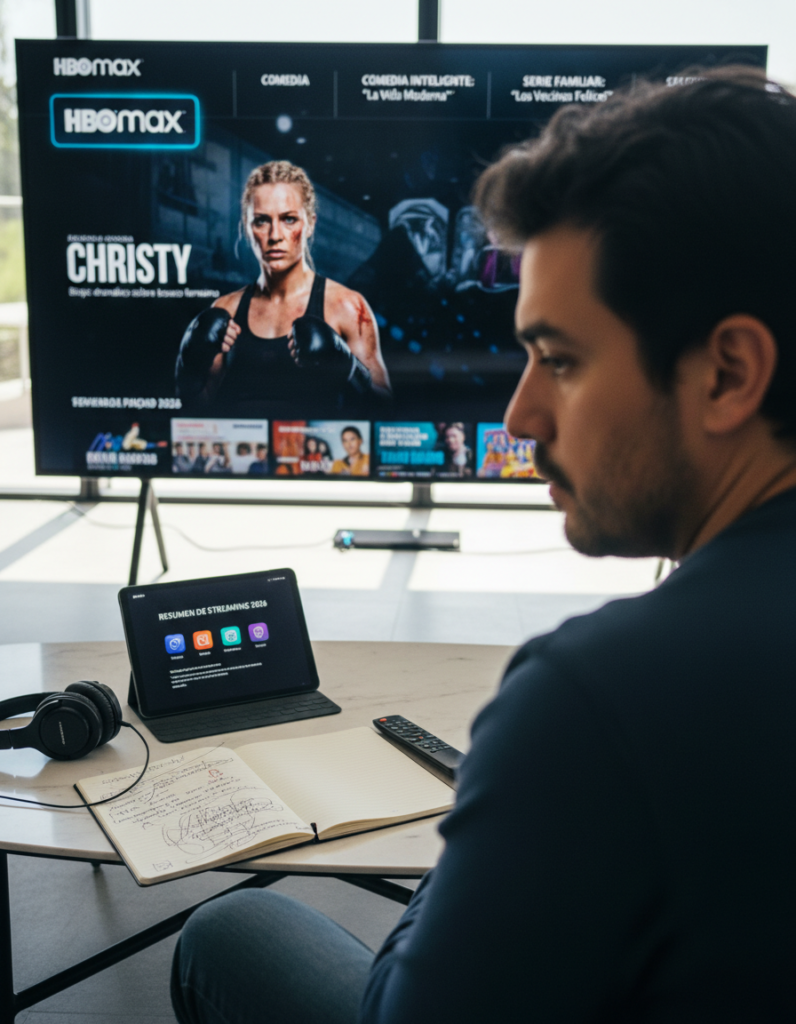
“Christy,” which began streaming on HBO Max on Friday, April 10, gives Sweeney one of the most serious roles of her career. Directed by David Michôd, the film follows the life of Christy Martin, the trailblazing American boxer whose rise in a male-dominated sport was shadowed by violence and abuse in her personal life. AP’s description of the film emphasized the unusual nature of Sweeney’s transformation, noting that the performance earned some of her best reviews and that it deliberately moved away from the highly curated, glamorous screen image with which she is often associated.
That matters because Sweeney has become one of the rare contemporary stars whose persona functions across multiple entertainment lanes at once. She can be sold as a pop-cultural obsession, as a premium-TV figure, as a rom-com lead and increasingly as a serious dramatic actor. “Christy” is significant not only because it is a boxing biopic, but because it helps reposition her within the prestige conversation. A role built around physical punishment, small-town origin, emotional trauma and sustained dramatic exposure asks audiences to look at her differently.
Streaming gives that repositioning a second chance to land. Films that struggle to dominate the theatrical conversation can often find a more attentive audience at home, where viewers approach them with fewer commercial expectations and more willingness to discover a performance on its own terms. In that sense, “Christy” fits a broader pattern in the platform era: star-driven adult dramas may not always command theaters, but they can gain renewed visibility once they arrive on major subscription services.
AP’s inclusion of the title in its weekly roundup suggests that “Christy” was not merely another catalog addition. It was one of the week’s key conversation pieces. That status was reinforced by the nature of the role itself. Christy Martin is not a fictional underdog but a real athlete whose life story carries the force of sports history, gender struggle and domestic trauma. For Sweeney, the film offers the kind of grounded, unadorned material that critics often see as a measure of range.
But “Christy” was only one part of a broader early-April streaming cluster. AP also highlighted the return of “Hacks,” one of HBO’s most acclaimed comedies, for its fifth and final season. The importance of that launch goes beyond simple scheduling. “Hacks” has become one of the defining prestige comedies of the streaming period, balancing sharp industry satire with an emotionally layered portrayal of ambition, age, reinvention and dependency. A final season means closure, and closure remains one of the strongest retention tools platforms have. Subscribers who may drift in and out of a service often come back for endings, particularly when the show involved has accumulated awards attention and audience loyalty over several years.
The final season of “Hacks” also serves another function in the same weekly ecosystem: it stabilizes the lineup with familiarity. Where “Christy” asks viewers to discover or reassess, “Hacks” invites them to return. In platform strategy, that contrast is useful. One title offers novelty and star transformation; another offers consistency and emotional payoff. Together they strengthen the sense that HBO Max, in particular, had an unusually strong week for adult-oriented streaming audiences.
Then there is “Malcolm in the Middle,” whose revival AP described as a four-episode return featuring Frankie Muniz, Bryan Cranston and Jane Kaczmarek. Nostalgia has become one of streaming’s most dependable currencies, but not every revival carries the same weight. “Malcolm in the Middle” belongs to a generation of television that was widely watched in a more centralized media era, before audience attention fragmented as dramatically as it has now. Bringing back a show like that is not merely an exercise in memory. It is an attempt to reconnect with a broad, multigenerational audience that may not share current viewing habits but still shares older cultural reference points.
Its presence in the same AP roundup as “Christy” and “Hacks” underlines how varied the streaming battlefield has become. The competition is no longer simply between genres. It is between modes of attention. A viewer may come for a serious biographical drama, stay for the return of a prestige comedy and then sample a revived sitcom rooted in earlier television culture. The platform that can support all three journeys in one week has an advantage.
This is why AP’s streaming roundups are useful beyond simple recommendation. They reveal what the industry itself considers the week’s most strategically visible content. Early April was not led by a single overwhelming blockbuster. Instead, it was defined by a portfolio of conversation starters. “Christy” represented the prestige-movie side of that equation. “Hacks” represented prestige-TV continuity. “Malcolm in the Middle” represented revival-era comfort and brand memory.
For Sweeney specifically, the week may prove particularly valuable. Her career has often generated disproportionate attention around image, celebrity and internet discourse. “Christy” gives the audience and the industry a different frame through which to assess her. A demanding real-person performance, especially one centered on physicality and pain, carries a seriousness that can alter casting perceptions as much as it alters critical ones. On streaming, where discovery can be incremental rather than opening-weekend driven, that effect may unfold more gradually but also more durably.
The broader implication is that the early-April lineup reflects a mature stage of streaming competition. Services are no longer relying only on scale. They are trying to win weeks. That means building release calendars where different audience desires intersect: discovery, loyalty, nostalgia, prestige and easy familiarity. The strongest weeks are not necessarily those with the single biggest title. They are often the ones where viewers feel there is more than one compelling reason to stay on a platform or rejoin the conversation.
By that standard, “Christy” arrived at an ideal moment. It did not need to carry the week alone. It needed to stand out within a crowded, varied field, and AP’s selection indicates that it did. Combined with the final chapter of “Hacks” and the return of “Malcolm in the Middle,” it helped shape an early-April window that felt unusually rich in recognizable but distinct offerings.
That may be the clearest takeaway from this particular streaming cycle. Platforms increasingly win not by offering one giant event, but by assembling clusters of relevance. In that cluster, Sydney Sweeney’s “Christy” has emerged as one of the most closely watched entries — not just because she is famous, but because the role asks her to be something more demanding, and because streaming now gives that kind of performance a powerful second stage.