
The global shift to battery-powered vehicles is accelerating, but cost, charging access and industrial rivalry are reshaping the road ahead.
Electric cars have crossed a threshold that once seemed distant. No longer confined to wealthy early adopters or small environmental circles, they now sit at the center of the global car market, forcing manufacturers, governments and consumers to reconsider what the automobile is for and who can afford the next generation of mobility.
The International Energy Agency said electric car sales exceeded 17 million worldwide in 2024, more than one-fifth of all cars sold globally. The figure marked a sharp increase from the beginning of the decade and showed how quickly the market had moved from experiment to scale. Yet the rise of electric vehicles has brought a new set of pressures that are more complex than the early optimism suggested.
For automakers, the challenge is no longer proving that electric cars can work. It is proving that they can be profitable, affordable and desirable in markets with very different incomes, roads and charging networks. In China, aggressive competition has produced a rapid cycle of new models, lower prices and advanced digital features. In Europe, buyers are balancing environmental rules with concerns over cost and infrastructure. In the United States, electric adoption remains uneven, with strong demand in some urban and coastal regions but slower growth in rural areas.
The car itself is changing. Electric vehicles are quieter, mechanically simpler and increasingly dependent on software. Their performance can be updated remotely. Their cabins often look more like digital living rooms than traditional cockpits. But this transformation also gives buyers new concerns. A car is no longer just a machine that can be repaired at a local garage. It is a connected device that depends on battery health, software support, cybersecurity and charging compatibility.
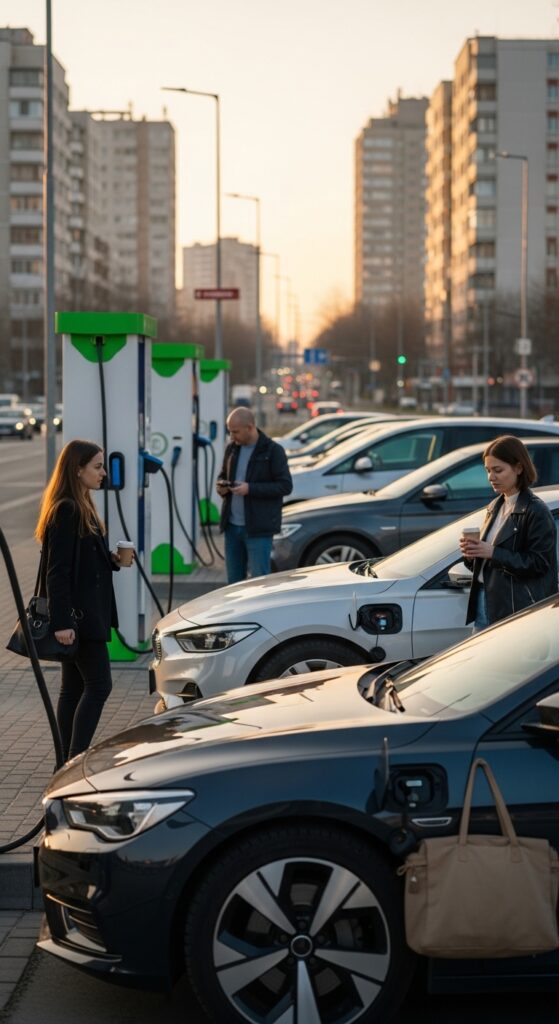
Charging remains one of the most visible obstacles. Public networks have expanded, but reliability varies widely. For homeowners with private parking, an electric car can be convenient and inexpensive to run. For apartment dwellers, taxi drivers or people in regions with weak infrastructure, the experience can be far less certain. Automakers and governments are investing heavily in charging stations, but the pace of installation has not always matched the pace of vehicle sales.
Affordability is the decisive issue. Premium electric models helped create excitement, but mass adoption depends on vehicles that ordinary households can buy without extraordinary subsidies. Chinese manufacturers have gained an advantage by producing lower-cost EVs at scale, while older automakers must manage legacy factories, combustion-engine supply chains and expensive new battery investments. The result is a market in which the price of transition is being tested every day.
The environmental argument remains powerful. Electric cars produce no tailpipe emissions, helping cities reduce local air pollution. Their climate benefit grows as electricity grids become cleaner. But the supply chain is not simple. Batteries require minerals such as lithium, nickel, cobalt and graphite. Mining and refining bring environmental and geopolitical risks. Recycling will become increasingly important as the first large wave of EV batteries reaches the end of its life.
The future is unlikely to be a straight line. Electric vehicles will continue to expand, but hybrids, plug-in hybrids and efficient gasoline vehicles will remain part of the market for years. The internal-combustion engine will fade at different speeds in different regions. Some consumers will move quickly. Others will wait for lower prices, longer range and more reliable charging.
The electric car has already changed the global auto industry. The next test is whether it can change everyday driving for everyone, not only for those who can afford to be first.”””
