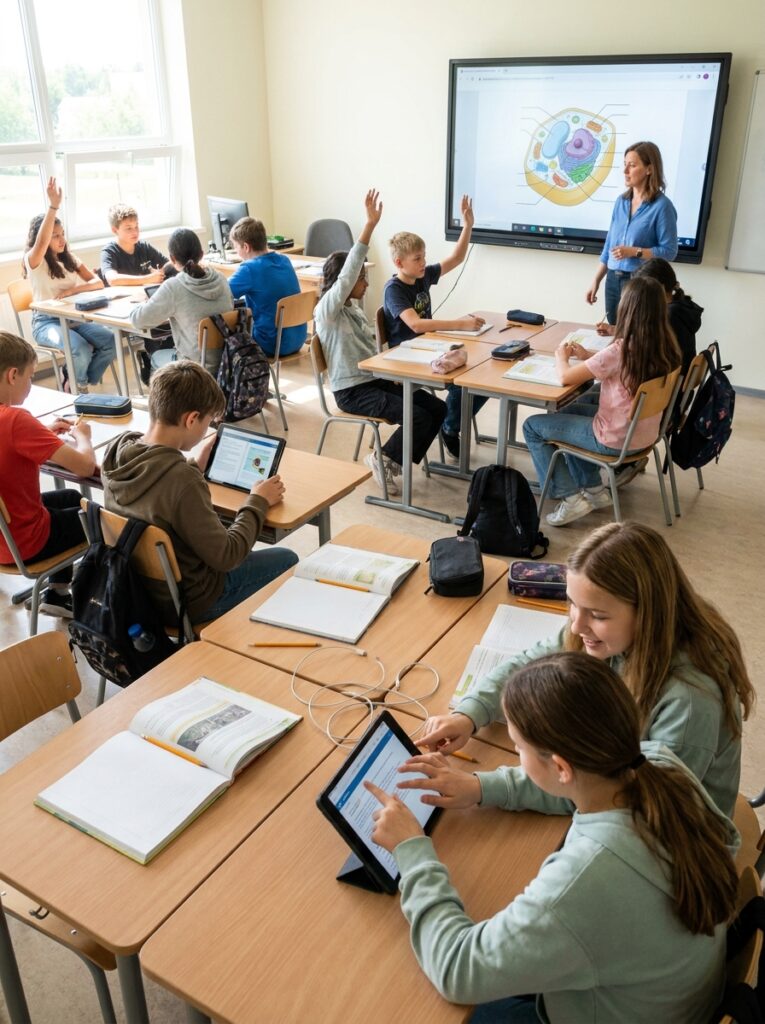
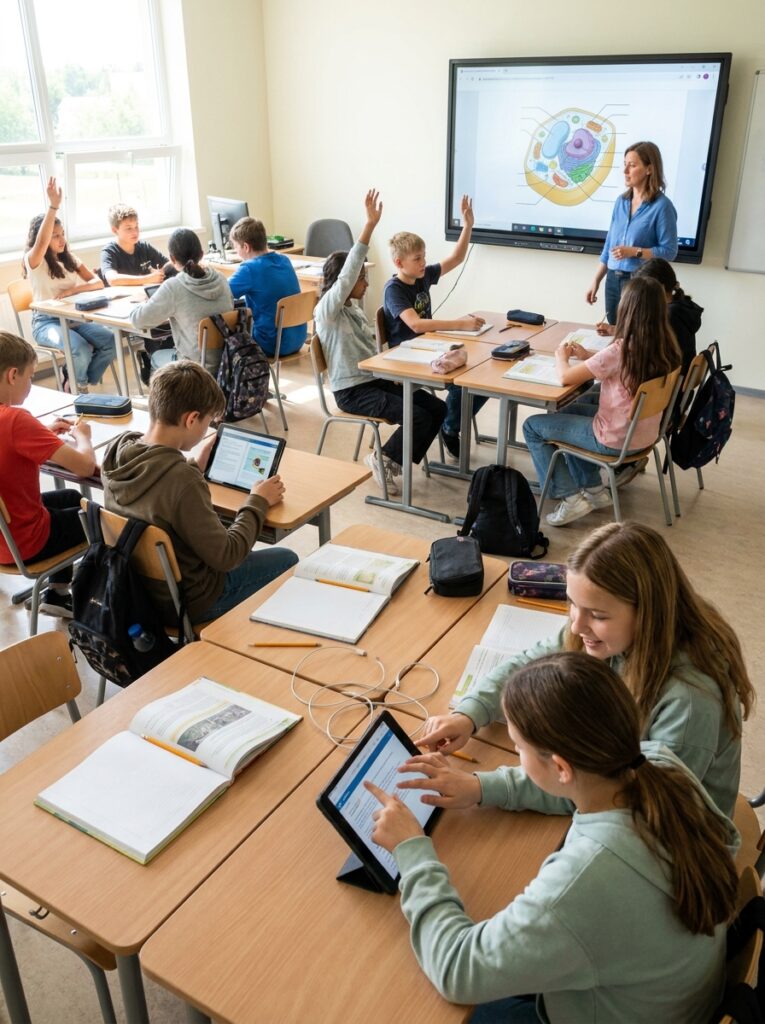
Online classrooms, e-books, learning apps and smart boards are reshaping how teachers teach, how students learn and how schools prepare for a digital future.
The modern classroom no longer ends at the classroom door. A lesson can begin on an interactive board, continue through an online platform, move into an e-book at home and be reinforced by a learning app on a phone or tablet. For students, education is becoming more flexible and more visual. For teachers, technology is changing the tools of instruction, assessment and communication. For schools, the challenge is no longer whether technology belongs in education, but how to use it well.
The transformation accelerated during the COVID-19 pandemic, when school closures forced millions of teachers and students into remote learning almost overnight. That emergency period exposed deep inequalities in internet access, devices and digital skills. It also proved that education could not rely only on physical classrooms. Since then, many systems have moved from crisis use of technology toward more deliberate models: blended learning, digital textbooks, online assignments, virtual tutoring, data-supported teaching and interactive classroom equipment.
Online classes are the most visible symbol of this shift. They allow students to attend lessons from home, review recorded lectures, join discussions, submit assignments and communicate with teachers without being physically present. For rural students, children with disabilities, working learners and those recovering from illness, online education can open doors that traditional schedules often close. A student in a remote village may access a language teacher, science lesson or exam preparation course that would otherwise be unavailable.
But online learning is most effective when it is designed as education, not merely as a video call. A strong online class needs clear structure, active participation, short explanations, discussion, feedback and follow-up tasks. Teachers must know when to lecture, when to ask questions, when to use breakout groups and when to let students work independently. Poorly planned online lessons can become passive screen time. Well-designed ones can give students more control over pace, place and review.
Blended learning may become the most durable model. In this approach, face-to-face teaching remains central, while digital tools extend learning beyond the school day. A teacher may introduce a topic in class, assign an online video for review, use an app for practice and then analyze student progress before the next lesson. This can make classroom time more valuable because teachers arrive with a clearer view of what students understand and where they are struggling.
E-books are another major change. Traditional textbooks are heavy, expensive to update and limited by print cycles. Digital books can include search functions, audio support, embedded videos, interactive quizzes, adjustable font sizes and links to additional materials. They can be updated more quickly when information changes. For students with visual difficulties or language barriers, e-books can provide accessibility features that print cannot easily match.
The shift to e-books also changes the economics of learning materials. Schools and governments may reduce printing and distribution costs over time, while students can carry entire libraries on one device. However, this benefit depends on access. A digital textbook is only useful if students have reliable devices, electricity, connectivity and the digital skills to use it. Without those conditions, technology can widen inequality instead of reducing it.
Learning apps have brought personalization into daily study. Mathematics apps can adjust question difficulty based on performance. Language apps can provide pronunciation feedback and spaced repetition. Science apps can simulate experiments that would be expensive or dangerous in a classroom. Reading apps can track fluency and comprehension. For students who need extra practice, apps can provide immediate feedback without the embarrassment of failing publicly.
The most powerful educational apps do not replace teachers. They help teachers see patterns. If a class of 40 students completes a digital quiz, the teacher can quickly identify which concepts confused most students and which learners need individual support. This data can guide instruction more efficiently than waiting for a major test. In this sense, technology can make teaching more responsive.
Smart boards and interactive displays are changing the front of the classroom. A blackboard once allowed teachers to write and draw. A smart board allows them to display videos, annotate diagrams, move objects, zoom into maps, solve problems step by step and save notes for students who were absent. In a geography lesson, students can explore satellite images. In biology, they can examine a 3D model of the heart. In mathematics, they can manipulate graphs in real time. The classroom becomes more visual and participatory.
For younger students, interactive boards can make lessons more engaging. They invite touch, movement and group participation. For older students, they can support complex explanations, presentations and collaborative problem-solving. The value is not in the screen itself, but in what it allows teachers and students to do together. A smart board used only as a projector is expensive furniture. Used creatively, it becomes a shared workspace.
Technology also improves communication between schools and families. Parents can receive updates on attendance, assignments, grades and school announcements through digital platforms. Teachers can send materials, reminders and feedback more quickly. In communities where parents work long hours or live far from school, these tools can strengthen the connection between home and classroom. Education becomes less isolated from family life.
Data is another force changing education. Digital platforms can record attendance, assignment completion, quiz scores and learning progress. Used responsibly, this information can help schools identify students at risk of falling behind. It can also help administrators understand whether a curriculum is working. But data must be handled carefully. Students are children and learners, not products. Privacy, consent, security and fairness must be central to any educational technology system.
Artificial intelligence is adding a new layer. AI tools can help generate practice questions, translate materials, support students with writing, summarize content and assist teachers with planning. They may eventually provide highly personalized tutoring. But AI also raises concerns about cheating, overreliance, misinformation and the loss of critical thinking. The question is not whether students will use AI. They already are. The question is how schools teach them to use it ethically and intelligently.
The human role of teachers remains essential. Technology can deliver content, track progress and support practice, but it cannot fully replace encouragement, judgment, empathy and classroom leadership. A teacher notices when a student is quiet, discouraged, confused or unusually absent. A teacher can connect a lesson to local life, adjust tone, build trust and create motivation. The best technology strengthens this human relationship rather than weakening it.
There are also health and attention concerns. Too much screen time can strain eyes, reduce physical movement and make concentration harder. Digital classrooms can expose students to distractions, advertisements and unsafe online spaces if not managed properly. Schools must set boundaries: when devices help learning, when they should be closed, and when paper, conversation, outdoor activity or hands-on work is better.
Equity remains the largest challenge. Modern education cannot depend on technology that many students cannot access. Governments and schools must invest not only in devices, but also in broadband, teacher training, technical support, accessible content and offline options. A digital learning system that works only for wealthy families is not modernization. It is exclusion with better graphics.
Technology makes education more modern when it makes learning more accessible, interactive, flexible and effective. It fails when it becomes a substitute for teaching, a source of distraction or a symbol of inequality. The goal is not to fill classrooms with screens. The goal is to give teachers better tools and students better chances.
The future classroom will likely be hybrid: part physical, part digital; part teacher-led, part self-paced; part textbook, part simulation; part discussion, part data. Its success will not be measured by the number of devices on desks, but by whether students understand more, participate more and feel better prepared for the world outside school.
Education has always changed with the tools of society. Chalk, paper, printing presses, radio, television and computers all entered classrooms at different moments. The current wave of technology is faster and more powerful, but the principle is the same. Tools matter most when they serve learning. In the hands of skilled teachers and supported students, technology can make education not only more modern, but more human, more inclusive and more connected to the future.
“””