
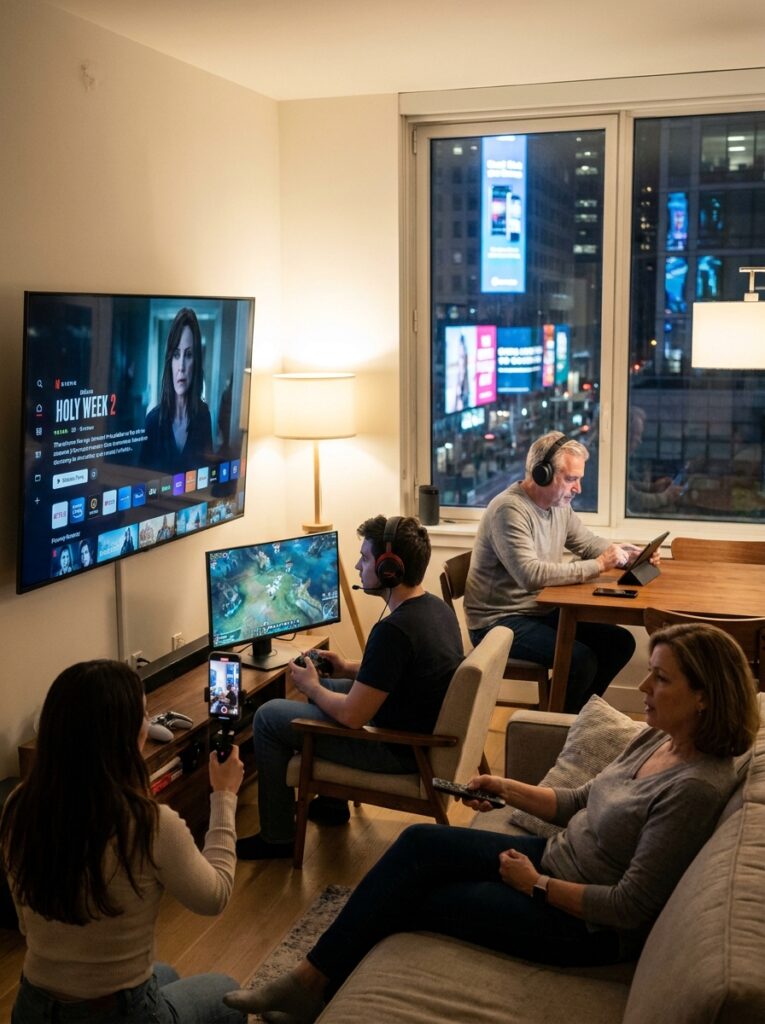
Streaming, social platforms, gaming and artificial intelligence are redrawing the global entertainment map, shifting power from studios and broadcasters toward platforms, creators and audiences.
The entertainment industry has always followed technology. Radio changed music. Television changed cinema. Cable changed sports and news. The internet, however, has done something deeper. It has not merely added a new distribution channel. It has altered how entertainment is produced, financed, marketed, consumed and measured. In the digital age, the audience is no longer waiting at a fixed hour, in a fixed place, for a limited set of programs. It is choosing, sharing, remixing, skipping, subscribing, canceling and sometimes creating.
The result is an industry that is larger, faster and more fragmented than at any point in its history. Global entertainment and media revenue has moved toward the scale of a major economic sector, not a cultural side business. Streaming video, video games, recorded music, podcasts, digital advertising, live events, social platforms and online creators now occupy the same attention economy. A film studio is not only competing with another studio. It is competing with a mobile game, a livestream, a short video, a podcast, a football match, a fan edit and an artificial intelligence tool that can generate images, music or scripts in seconds.
Streaming was the first major sign that digital distribution would overturn the old order. For decades, television schedules and cinema releases controlled access to premium entertainment. Streaming weakened that control by making libraries available on demand. Viewers became accustomed to watching entire seasons at once, pausing across devices and discovering foreign-language shows through recommendation systems. The success of global platforms showed that entertainment could travel across borders faster than ever, but it also created a new problem: abundance. When everything is available, attention becomes the scarce resource.
That scarcity has forced companies to rethink their business models. The early streaming era was defined by subscription growth. Platforms spent heavily to attract users with exclusive series, films and sports rights. As markets matured, the focus shifted toward profitability, advertising tiers, password-sharing restrictions, bundling and live programming. Streaming has not killed advertising; it has reinvented it. Data-driven ads can be targeted more precisely than traditional television commercials, while ad-supported plans give cost-conscious viewers a cheaper entry point. The digital entertainment economy increasingly asks consumers to pay with money, data, attention or some combination of all three.
Social media has become the industry’s most disruptive entertainment platform. For younger audiences in particular, entertainment often begins not with a studio release but with a feed. Short videos, creator channels, memes and livestreams compete directly with professionally produced programming. The creator economy has lowered barriers to entry for performers, comedians, educators, musicians, commentators and independent filmmakers. A teenager with a phone can reach a global audience without a broadcaster, label or studio. That democratization has produced extraordinary creativity, but it has also created a crowded market where visibility is shaped by algorithms and platform rules.
Gaming has become one of the strongest pillars of modern entertainment. It is no longer a niche activity separated from film, music or sports. Major game franchises now function as social spaces, storytelling platforms, esports arenas and merchandising engines. Games generate revenue through purchases, subscriptions, downloadable content, in-game items and advertising. They also influence the visual language of cinema and television, while film and TV producers increasingly adapt game worlds for screen audiences. The border between playing, watching and socializing has become less distinct.
Music offers another example of the digital shift. Streaming revived recorded-music revenue after years of decline, but it also changed the economics of fame. Songs can become global hits through playlists, short-video clips or fan communities before traditional radio reacts. Artists can release music more frequently, speak directly to fans and build careers across platforms. At the same time, streaming payouts, platform dependence and the speed of content turnover remain contentious. Musicians now compete not only with other songs but with the entire digital environment surrounding a listener.
Cinema has faced the most emotionally charged transformation. The theatrical experience remains culturally powerful, especially for blockbusters, local hits and event films. But the pandemic accelerated changes already underway: shorter theatrical windows, direct-to-streaming releases and a more selective moviegoing public. Theaters are no longer the default destination for every film. They are becoming premium venues for experiences that feel worth leaving home for. This does not mean cinema is dying. It means cinemas must offer something different from a living-room screen: scale, sound, shared emotion and a sense of occasion.
Live entertainment has gained renewed importance because it cannot be copied in the same way as digital content. Concerts, festivals, sports events and immersive performances give audiences a sense of presence and community that streaming cannot fully reproduce. Digital tools now support those experiences through ticketing, fan engagement, virtual extras and global promotion. In many cases, the internet does not replace live events; it amplifies demand for them. Fans discover artists online and then pay to see them in person.
Artificial intelligence is the newest and most controversial force in the industry. AI can help edit video, translate dialogue, generate visual effects, personalize recommendations, create marketing materials and support game development. It may reduce costs and open creative tools to smaller teams. But it also raises difficult questions about copyright, consent, labor and authenticity. Writers, actors, musicians and visual artists are asking how their work is used to train models and whether synthetic content will weaken human creativity or simply become another tool. The answer will depend on law, contracts, transparency and public taste.
Personalization has become both a strength and a risk. Recommendation engines help users find content in an overwhelming marketplace. They can introduce audiences to foreign dramas, independent musicians or niche creators who would once have struggled for distribution. But personalization can also narrow cultural experience by feeding users more of what they already like. The entertainment industry increasingly depends on algorithms that shape taste without being fully visible to the people affected by them.
The global nature of digital entertainment has also changed cultural power. English-language media remains influential, but audiences now regularly embrace Korean dramas, Spanish-language music, Japanese anime, Indian films, Turkish series, Nigerian cinema and regional creators from across the world. Local stories can become global products when platforms provide translation, distribution and discovery. This has opened new opportunities for producers outside traditional Western centers, even as major platforms still hold enormous leverage over financing and visibility.
For traditional media companies, survival depends on adaptation rather than nostalgia. Studios, broadcasters, labels and publishers still have valuable strengths: professional production, intellectual property, trusted brands and deep creative talent. But they can no longer rely on scarcity. They must compete in a market where audiences expect constant access, fair pricing, cross-platform availability and direct engagement. The winners will be companies that combine storytelling discipline with technological agility.
For consumers, the digital age has delivered unprecedented choice. It has also introduced subscription fatigue, privacy concerns, misinformation, piracy, platform lock-in and the instability of algorithm-driven culture. The same tools that allow independent creators to flourish can also reward outrage, imitation and low-quality content. The industry’s future will therefore be shaped not only by innovation but by governance: copyright rules, data protection, competition policy, platform accountability and labor standards.
The development of entertainment in the digital age is not a simple story of old media being replaced by new media. It is a convergence. Films become games. Games become social networks. Social platforms become television. Musicians become brands. Fans become promoters. AI becomes a production assistant. Live events become digital spectacles before and after they happen. The screen is no longer just a place to watch. It is a marketplace, a stage, a studio and a community.
The next phase will belong to entertainment companies and creators that understand attention without exploiting it, use data without abusing trust, and deploy artificial intelligence without erasing human originality. Technology will continue to change the tools, but the industry’s core remains familiar. People still want stories, music, laughter, suspense, beauty, identity and shared experience. The digital age has not ended entertainment’s oldest purpose. It has made the competition to fulfill it global, immediate and relentless.
“””
