
Automation is expanding into warehouses, hospitals, farms and homes, promising efficiency while raising questions about work, safety and human connection.
Robots have long been familiar in factories, where they weld, lift, paint and assemble with speed and precision. What is changing now is where robots are appearing. They are moving into warehouses, hospitals, farms, restaurants, hotels, sidewalks and homes.
The spread reflects advances in sensors, artificial intelligence, batteries, machine vision and control systems. Robots can now navigate more complex spaces, recognize objects and work closer to humans than older industrial machines. They remain limited, but their capabilities are improving.
Warehouses are among the fastest adopters. Robots move shelves, sort packages and help workers fulfill online orders. Automation can improve speed and reduce some physically demanding tasks. It can also increase pressure on human workers if systems are designed mainly to maximize output.
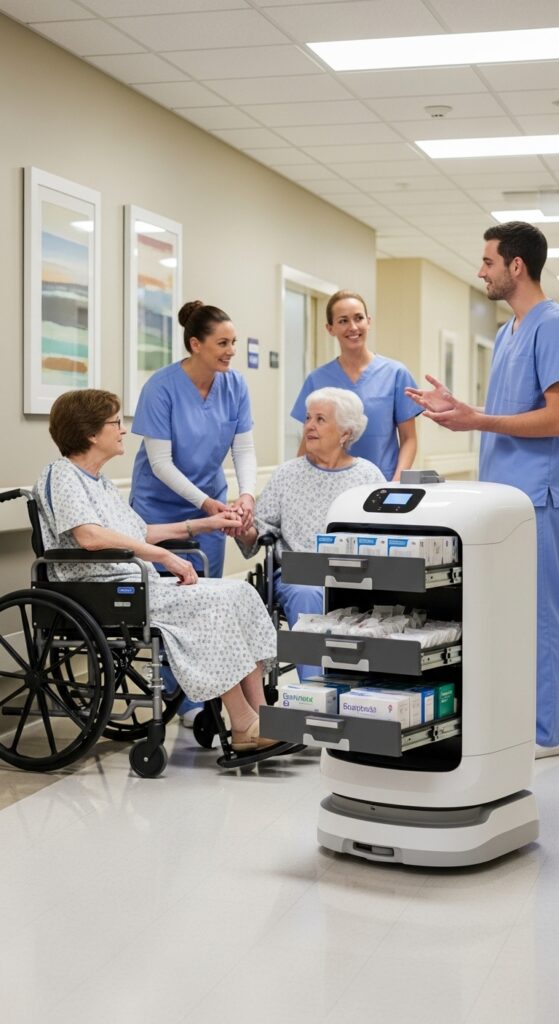
Hospitals are experimenting with robots that deliver supplies, disinfect rooms, assist surgery or support rehabilitation. In health care, robots may reduce repetitive work and help staff shortages. But care is not only a technical task. Patients need human contact, judgment and empathy. The best robots may be those that support health workers rather than replace them.
Agriculture is another frontier. Robots and autonomous machines can monitor crops, spray precisely, harvest certain fruits and reduce labor needs. This could help farms facing worker shortages and climate pressure. But cost remains a barrier for smaller farmers, and technology must adapt to messy outdoor conditions.
In homes, robots have made limited but real progress. Vacuum cleaners are common. Lawn robots, companion devices and home assistants are developing more slowly. The home is difficult because it is unpredictable. A factory can be organized for robots; a family apartment cannot.
McKinsey’s Technology Trends Outlook highlighted robotics and autonomous systems as part of a broader shift toward more adaptive and collaborative technologies. The trend is not only about machines replacing people. It is about new forms of human-machine cooperation.
The labor debate is unavoidable. Automation can raise productivity and reduce dangerous work. It can also eliminate jobs or weaken bargaining power if workers are not protected. The impact depends on how companies deploy technology and whether societies invest in training and transition support.
Safety standards are crucial as robots enter public spaces. A robot in a factory operates under controlled conditions. A delivery robot on a sidewalk must deal with children, pets, weather, stairs and unpredictable pedestrians. Trust will depend on reliability.
Robots also raise social questions. In elder care, companion robots may help reduce loneliness or remind people to take medicine. But they can also become a substitute for human care if institutions use them to cut costs. Societies must decide where automation is appropriate and where human presence is essential.
The military use of autonomous systems is one of the most serious concerns. Drones and robotic systems are changing conflict, surveillance and border control. The more autonomy machines gain, the more urgent the debate over accountability becomes.
Robotics will not arrive as a single revolution. It will spread task by task, industry by industry. Many robots will be ordinary, not humanoid. They will move goods, inspect pipes, clean floors, assist surgeons and monitor fields.
The future of robotics should be measured not only by what machines can do, but by what they allow humans to do better. Automation is most valuable when it reduces danger, expands capability and preserves dignity.”””
