
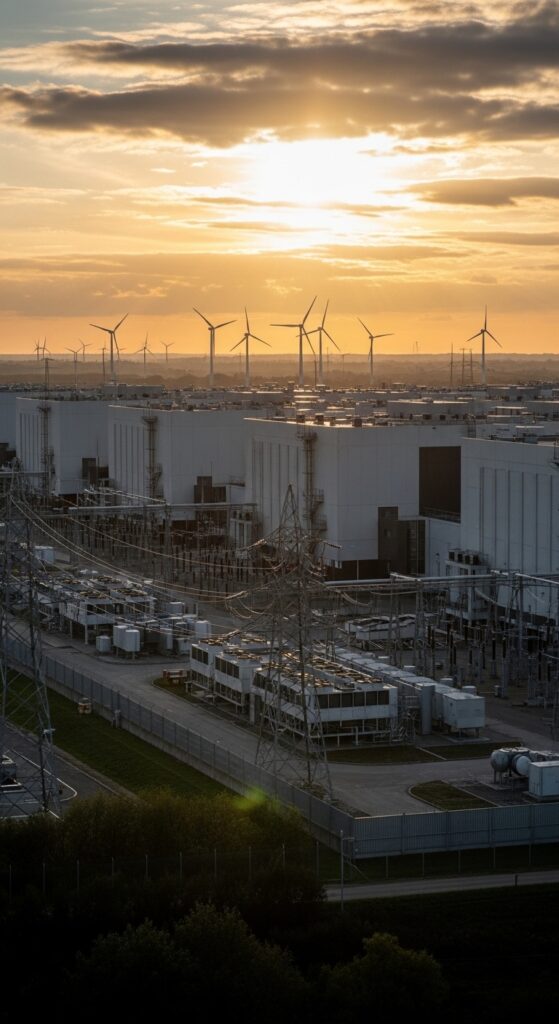
The digital economy increasingly depends on vast computing facilities that raise new questions about energy, water, land and local communities.
The factory of the AI age is not always filled with assembly lines or workers in hard hats. It may look like a windowless building on the edge of a city, packed with servers, cables, cooling systems and backup power. Data centers have become the industrial backbone of modern technology.
Cloud computing made it possible for companies to rent computing power instead of owning their own servers. That shift transformed software, finance, retail, media, health care and government services. Artificial intelligence is now pushing demand higher because advanced models require enormous computing capacity to train and operate.
Data centers are essential for everyday digital life. They store emails, stream films, process payments, host business software, run AI systems and support scientific research. But their physical footprint is becoming more visible. They require electricity, water, land, cooling and grid connections.
The International Energy Agency has warned that AI is set to drive rising electricity demand from data centers, even as AI may also help improve energy systems. This dual role is one of the central contradictions of the digital economy: technology can increase energy demand while also offering tools to reduce emissions elsewhere.
Communities are beginning to ask harder questions. A data center may bring tax revenue and construction jobs, but it may also strain local power grids or water supplies. In some regions, residents question whether massive computing facilities provide enough local benefit to justify their resource use.
The industry is responding with more efficient chips, better cooling, renewable energy contracts and efforts to use waste heat. Some facilities are being built near clean power sources. Others are exploring liquid cooling to handle AI servers that generate more heat than traditional systems.
Still, clean electricity is not unlimited. As data centers compete with homes, factories and electric vehicles for power, grid planning becomes critical. Transmission lines, storage and permitting may determine where digital infrastructure can grow.
Cloud concentration is another concern. A small number of major companies control much of the world’s cloud infrastructure. Their platforms provide reliability and scale, but dependence on them can create systemic risk. An outage at a major provider can affect thousands of services at once.
Security is central. Data centers hold sensitive information from governments, hospitals, banks and individuals. Physical protection, encryption, access control and cyber defense all matter. The more society depends on cloud systems, the more attractive they become to attackers.
The economics of AI may deepen inequality among companies. Large firms can afford computing power, specialized chips and technical talent. Smaller firms may depend on cloud providers and pay as they grow. Access to compute could become a competitive dividing line.
For users, cloud computing is mostly invisible until something goes wrong. A delayed payment, frozen app or unavailable service reveals how much of daily life depends on distant infrastructure. The cloud is not a cloud. It is steel, silicon, water and electricity.
The next phase of digital growth will require honesty about physical limits. AI may feel weightless on a screen, but it runs somewhere. The data center has become a new kind of industrial site, and its future must be planned with the same seriousness as energy, transport and housing.”””
