
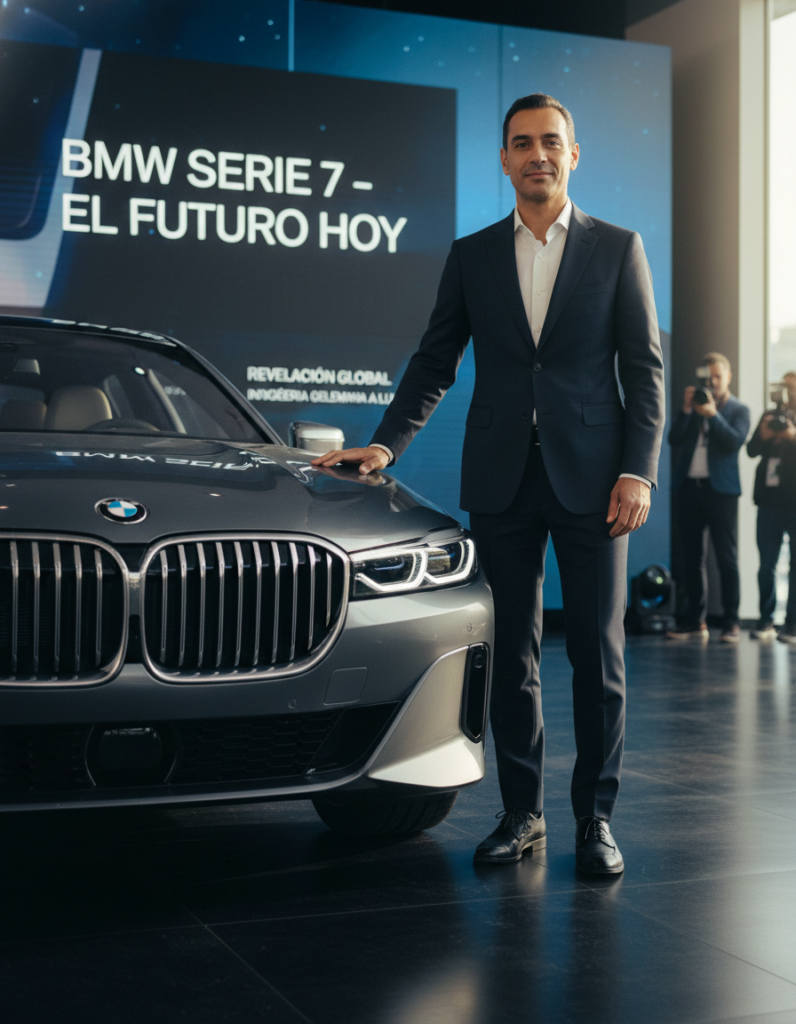
The German automaker has given its flagship sedan a sweeping update shaped by Neue Klasse design and technology, signaling that electrification, software and digital interfaces are now central to the future of its top luxury nameplate.
BERLIN — BMW has moved its flagship sedan decisively into a new technological phase, unveiling a heavily reworked 2027 7 Series shaped by the design language and digital architecture of its Neue Klasse program.
The significance of the reveal goes well beyond styling. For BMW, the 7 Series has long served as the company’s rolling statement of intent — the model where it introduces the ideas, technologies and luxury cues that later spread across the rest of the lineup. By bringing Neue Klasse thinking to the 7 Series, BMW is effectively declaring that its next era will not be defined only by electric vehicles as a separate category, but by a common architecture of software, interface design and electrified powertrains across its most important products.
BMW has said the Neue Klasse technology leap will be rolled out across the entire portfolio by the end of 2027, regardless of powertrain. That makes the new 7 Series especially important because it shows how that strategy looks when applied to the company’s largest and most prestigious sedan rather than to a dedicated EV alone. The result is a car that blends combustion, plug-in hybrid and fully electric options under one high-tech umbrella, while adopting much of the visual and digital identity that BMW has been building around Neue Klasse.
The exterior changes are substantial, even if the basic proportions of the current generation remain recognizable. Reporting on the reveal describes a flatter and more upright illuminated kidney grille, reshaped front-end treatment and slimmer rear lighting, all drawing the 7 Series closer to the cleaner, more horizontal look associated with BMW’s newer design direction. The update appears intended to soften some of the more polarizing cues of the outgoing car while still keeping the sedan visually imposing.
Inside, the transformation is even more consequential. The new 7 Series adopts BMW’s Panoramic iDrive concept, replacing the conventional instrument-cluster approach with a wide display zone projected across the base of the windshield. Coverage of the launch says the sedan also gets a large central touchscreen and a passenger display, while physical controls continue to recede in favor of software-driven interaction. In practical terms, BMW is repositioning the flagship cabin around screens, projection and connected computing rather than around traditional dashboard architecture.
That shift reflects a broader truth about the luxury car market in 2026: prestige is no longer measured only by leather, ride comfort and rear-seat space. Increasingly, it is also measured by how convincingly a car integrates interfaces, entertainment, assisted driving and digital personalization. The 7 Series has always been a technology showcase, but with this update BMW is making software and visual interaction feel like the centerpiece rather than the supporting act.
The powertrain strategy is equally revealing. The 2027 7 Series is not being turned into an EV-only flagship. Instead, BMW is keeping multiple propulsion paths alive at once. Launch coverage points to updated six-cylinder gasoline versions in the 740 and 740 xDrive, the return of the 750e plug-in hybrid, and revised i7 electric variants. A higher-performance V8-powered model is also expected later, underscoring BMW’s decision to preserve choice even as it accelerates electrification.
That matters because the top-end sedan market remains diverse in customer demand. Some buyers want the silence and instant torque of an EV. Others still prefer long-distance flexibility from combustion engines, while plug-in hybrids continue to appeal to those wanting electrified commuting without fully abandoning gasoline. BMW’s strategy suggests it sees the future of the luxury flagship not as a single format, but as a shared platform of design and technology that can accommodate several drivetrains at once.
The electric side of the equation is especially important. Reports on the i7 say the updated model adopts BMW’s sixth-generation eDrive technology, including cylindrical battery cells with higher energy density and faster charging performance. That brings the i7 closer to the core engineering promise of Neue Klasse, which BMW has promoted as a major step forward in charging speed, efficiency and vehicle computing. In the context of the 7 Series, those gains are not just engineering details — they are central to BMW’s attempt to prove that a flagship EV can deliver both luxury and technological credibility at the highest level of the market.
The timing is notable as well. BMW’s first true Neue Klasse production model is the new iX3, but the 7 Series shows that the company is not reserving this shift for clean-sheet EVs alone. Existing nameplates are being reworked to absorb the same visual language, interface philosophy and electrical architecture where possible. That means the transformation is broader than a normal facelift. It is part of a brand-wide reset in how BMW wants its cars to look, feel and operate by the end of this decade.
For the 7 Series specifically, this is a high-stakes move. Flagship sedans remain a small-volume segment compared with SUVs, but they carry outsized symbolic value. They shape perceptions of what a brand stands for. Mercedes-Benz has used the S-Class and EQS to define its luxury-tech message. Audi continues to balance traditional refinement with digital ambition. BMW’s answer is now becoming clearer: keep the full range of drivetrains alive for longer, but bind them together with one software-forward luxury identity.
There are risks in that approach. The heavier reliance on screens and projected interfaces may appeal to buyers who want a futuristic cabin, but it could alienate those who still value tactile controls and simpler ergonomics. Offering many powertrains also preserves flexibility, yet it can complicate messaging at a moment when some rivals are trying to present clearer electric-only narratives. And in design terms, BMW still faces the challenge of evolving its look without reviving the divisive reactions that some recent models generated.
But there is also a strategic advantage in BMW’s method. Rather than forcing customers into a single transition path, it is treating Neue Klasse as a technology ecosystem rather than as a badge reserved only for standalone EVs. That allows the company to modernize its flagship quickly while still meeting buyers where they are — whether they want gasoline, plug-in hybrid or battery-electric power.
Seen that way, the updated 7 Series is more than a model refresh. It is BMW’s clearest demonstration yet that Neue Klasse is not just about launching new electric cars; it is about rewriting the operating system of the brand itself.
For a nameplate that has always functioned as BMW’s technological flagship, the message is unmistakable. The future of the 7 Series will be more electrified, more digital and more unified across drivetrains — and BMW wants that future to arrive before 2027 is out.

