
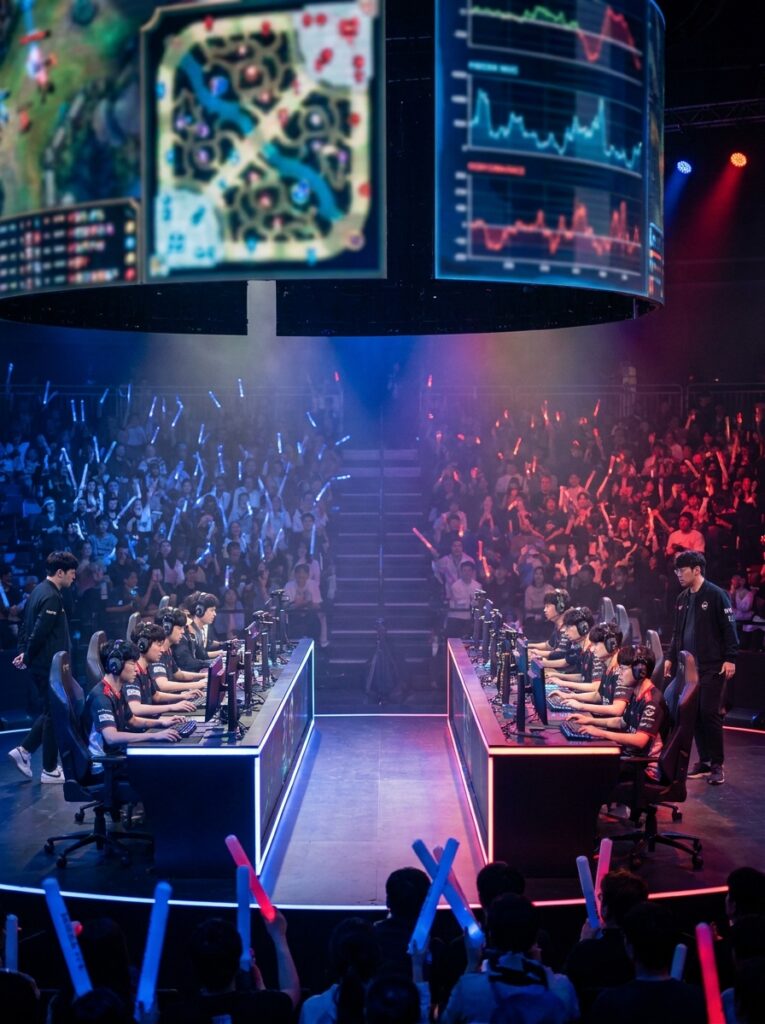
Competitive gaming has built the audiences, discipline and professional structures of modern sport, but it still faces questions over physicality, governance, health and who controls the game itself.
The question sounds simple: is esports a real sport? For millions of young fans, professional players, sponsors and tournament organizers, the answer is already yes. They see teams, coaches, training camps, packed arenas, national flags, prize money, strategy, pressure and careers built on elite performance. For skeptics, the answer remains no. They see people sitting at computers, moving mice and pressing keys, competing inside commercial video games owned by private publishers. Between those positions lies one of the most important cultural debates in modern entertainment.
Esports has grown from internet cafés, college dorms and local gaming communities into a global competitive industry. Major tournaments now fill stadiums, attract international sponsors and draw online audiences comparable to major broadcast events. Players train for hours each day, analysts study opponents, coaches design strategies and fans follow teams with the loyalty once reserved for football clubs, basketball franchises or Formula One drivers. In South Korea, China, Europe, North America, Southeast Asia and the Middle East, competitive gaming is no longer a subculture. It is part of mainstream youth entertainment.
The argument for esports as sport begins with competition. At the professional level, esports is not casual gaming. It requires reflexes, timing, memory, communication, tactical judgment and emotional control under extreme pressure. A League of Legends player must track movements across a complex map while coordinating with teammates. A Counter-Strike player must aim, position and react in fractions of a second. A Street Fighter or Tekken competitor must read an opponent’s habits and execute precise inputs under tournament pressure. These skills are not accidental. They are trained, measured and tested against other elite performers.
The physical element is less visible, but not absent. Esports does not demand the same bodily output as running, swimming, boxing or football. That is the main objection from traditionalists. Yet not all recognized sports depend primarily on raw physical exertion. Shooting, archery, billiards, darts, chess boxing and motorsport all occupy different places on the spectrum between physical skill, precision, strategy and mental endurance. Esports belongs near the precision-and-reaction end of that spectrum. The body is involved through eyes, hands, posture, breathing and nervous-system control, even if the contest is mediated through a screen.
The institutional evidence has grown stronger. Esports appeared as official medal events at the Asian Games in Hangzhou in 2023, a major step for recognition within the international multi-sport system. The International Olympic Committee has also spent years exploring virtual sports and esports, including the Olympic Esports Series and the creation of Olympic Esports Games. The IOC’s recent decision to end its Saudi partnership did not end the concept; it showed how complicated the project remains. Olympic recognition is not only about popularity. It requires governance, integrity, values, commercial agreements and a clear distinction between sport and entertainment product.
That distinction is one of esports’ biggest challenges. Traditional sports are usually governed by federations that do not own the basic rules of the activity in the same way a publisher owns a video game. No company owns running or football. In esports, the game itself is intellectual property. Riot Games controls League of Legends and Valorant. Valve controls Counter-Strike and Dota 2. Epic Games controls Fortnite. Publishers can change rules, alter balance, restructure leagues or shut down competitive circuits. This gives esports a commercial dependence that traditional sports rarely face.
The instability of titles also complicates recognition. A sport such as tennis can evolve over decades without disappearing. A video game can lose popularity within years. Competitive scenes rise and fall with patches, sequels, business models and player migration. Fans may follow an organization, but often they follow a specific game. This makes long-term governance difficult. If esports is to be treated as sport, it must solve the question of continuity: what exactly is being recognized, the activity of competitive gaming or the individual titles that come and go?
Another concern is violence and content. Many of the world’s most popular esports titles involve simulated combat. For Olympic institutions and schools, this creates a values problem. Some argue that tactical shooters are no more morally disqualifying than boxing, fencing or martial arts, all of which involve stylized combat. Others say games built around gunplay and killing avatars are difficult to reconcile with youth development and Olympic messaging. This debate helps explain why official sports bodies often prefer virtual versions of existing sports, such as cycling, sailing or taekwondo, rather than the biggest commercial esports titles.
Health is also central to the discussion. Professional esports players can face wrist injuries, eye strain, back pain, sleep disruption, stress, burnout and short career spans. The sedentary nature of the activity is a real concern, especially when gaming culture encourages long practice hours. At the same time, elite teams increasingly treat health like a performance issue. Players work with coaches, nutritionists, psychologists and physical trainers. The best organizations understand that reaction time and decision-making decline when sleep, posture, diet and mental health are ignored.
The World Health Organization’s classification of gaming disorder has added sensitivity to the debate. Supporters of esports emphasize that professional competition is not the same as uncontrolled gaming. Critics warn that glamorizing gaming without health safeguards may encourage unhealthy habits among young fans. Both points matter. Esports can be disciplined, social and skill-based, but it exists within a broader gaming ecosystem where excessive play can harm some users. Responsible development requires honest separation between competition, entertainment, education and addiction risk.
The social argument for esports is powerful. Gaming is one of the main cultural languages of young people. Pew Research Center has reported that a large majority of American teenagers play video games, and many describe gaming as a way to spend time with others. Esports turns that social activity into organized competition. For some young people who do not feel at home in traditional athletics, it provides belonging, ambition and teamwork. It also connects fans across borders. A teenager in Vietnam, Brazil, Germany or Canada can watch the same match, understand the same mechanics and cheer the same player.
Economically, esports has become part of the wider struggle for attention. Platforms, sponsors, betting firms, hardware companies, streaming services and national governments all see value in competitive gaming’s young audience. This has brought investment, professionalism and global visibility. It has also brought risk. Prize pools and leagues can depend heavily on sponsors or state-backed ambitions. Some teams have struggled financially despite large audiences. The industry has learned that popularity does not automatically produce stable business models.
The comparison with traditional sport is therefore both useful and limited. Esports has sport-like structures: competition, spectators, training, ranking, teamwork, stars, coaches, commentators and national pride. But it also has entertainment-industry features: publisher ownership, rapid technological change, influencer culture, streaming algorithms and game updates that can alter the competitive field overnight. It is not simply the digital version of football. It is a new category that borrows from sport, gaming, media and technology at once.
The fairest answer may be that esports is a real competitive sport, but not a traditional athletic sport. It should not have to pretend that sitting at a keyboard is the same as running a marathon. It should also not be dismissed as meaningless because its arena is digital. Human competition has always adapted to tools, spaces and culture. The stadium, the racetrack, the chessboard and the sailing course all test different combinations of body, mind, equipment and environment. Esports tests a modern combination: cognition, reflex, teamwork and digital mastery.
Recognition should come with responsibility. If esports wants the respect granted to sport, it needs stronger governance, transparent rules, anti-cheating systems, player protections, health standards, age safeguards and clearer independence from purely commercial decision-making. It must prove that elite gaming can be more than spectacle. It must show that it can sustain fair competition, protect athletes and serve communities beyond profit.
For traditional sports institutions, the challenge is to adapt without losing meaning. They do not need to accept every popular game as a sport. But they cannot ignore a generation for whom digital competition feels as real as anything played on grass, hardwood or ice. The future may not be a single answer. Some esports titles will gain deeper institutional recognition. Others will remain entertainment products. Hybrid formats, virtual sports and competitive gaming leagues will continue to evolve.
The debate over whether esports is a real sport reveals something larger than gaming. It shows that the definition of sport is not fixed. It changes as societies change, technologies change and audiences change. Esports has already proven that it can produce elite competitors, dramatic narratives and global communities. The remaining question is whether it can build the lasting institutions that turn a popular competition into a trusted sport.
For now, esports is real enough to fill arenas, shape careers and command the attention of millions. Whether everyone calls it sport may matter less than the fact that it is forcing the sporting world to rethink what competition means in the digital age.
“””
