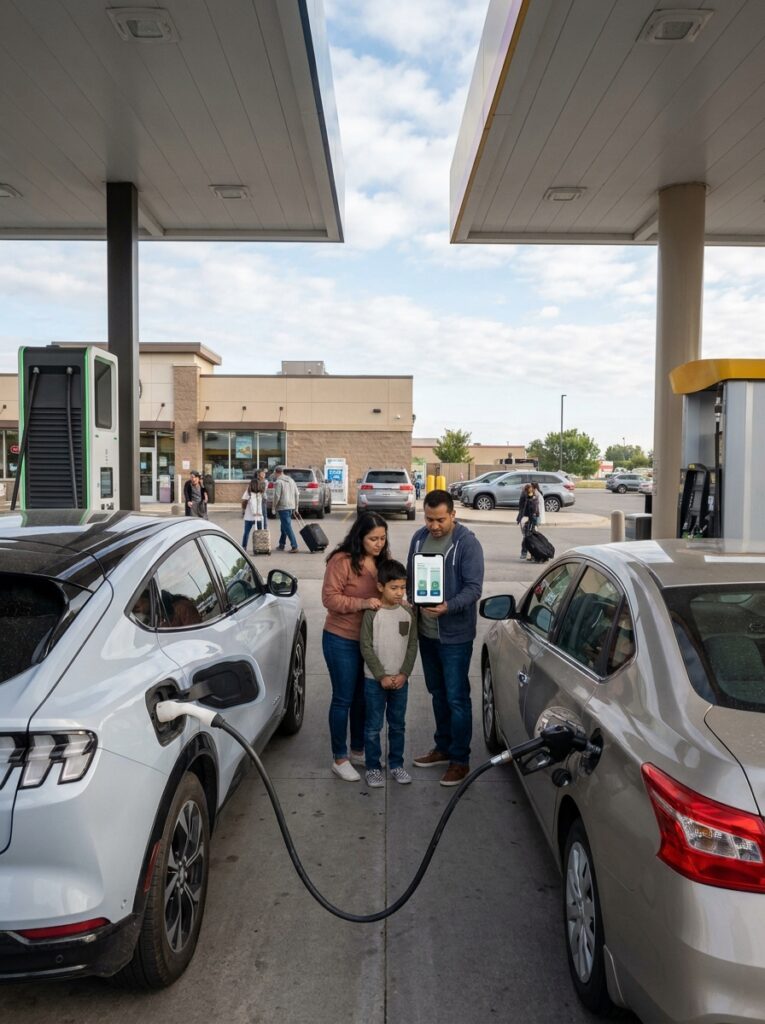

The right answer in 2026 depends less on ideology than on where a driver lives, how far they travel, how they refuel and how long they plan to keep the vehicle.
For more than a century, the gasoline car defined personal transportation. It was familiar, flexible and supported by a vast network of filling stations, repair shops and dealerships. Electric vehicles have now challenged that certainty. They promise lower running costs, quieter driving, cleaner urban air and reduced dependence on oil. But they also bring questions about charging, battery life, resale value, insurance and upfront price. For buyers standing in a showroom or scrolling through listings online, the choice is no longer simple.
The most honest answer is that electric cars are the better choice for many drivers, but not for everyone. Gasoline cars remain a practical option for people who drive long distances in areas with weak charging infrastructure, cannot charge at home or need a lower purchase price. Hybrids, meanwhile, increasingly occupy the middle ground, offering fuel savings without requiring drivers to change their routines. The best decision starts not with technology, but with the buyer’s daily life.
Electric vehicles have a clear advantage in daily commuting when home charging is available. A driver who can plug in overnight begins most mornings with a full battery and avoids routine trips to the gas station. For urban and suburban households with a driveway, garage or reliable workplace charger, this is one of the strongest arguments for going electric. Charging becomes part of the rhythm of life, like charging a phone. The car is refueled while parked, not while the owner waits beside a pump.
Running costs also tend to favor EVs, especially for drivers who charge at home and travel many miles each year. Electric motors are efficient, and electricity prices are often less volatile than gasoline prices. EVs also have fewer routine maintenance items. There are no oil changes, spark plugs, exhaust systems or multi-speed automatic transmissions in the traditional sense. Tires can wear quickly on heavier EVs, and repairs can be expensive after a collision, but routine servicing is generally simpler.
Gasoline cars still retain an advantage in purchase price and convenience. In many markets, comparable EVs remain more expensive upfront than gasoline models, even when the gap has narrowed. Insurance can also be higher for some electric models because of expensive components, specialized repairs and battery-related concerns. For a buyer who drives relatively little, the fuel savings of an EV may take years to offset the higher initial cost. A lightly used gasoline car can still be the financially sensible choice for someone on a tight budget.
Long-distance travel is another area where gasoline vehicles remain easier for many drivers. Filling a tank takes minutes, and fuel stations are widely available across highways, rural areas and developing markets. EV charging is improving rapidly, but the experience is uneven. Fast chargers can be convenient when they work well and are located along major routes. They can also be crowded, expensive, out of service or poorly placed. For drivers who regularly cross remote regions, tow heavy loads or travel on unpredictable schedules, gasoline still provides reassurance.
The environmental case favors electric vehicles, but it is not as simple as saying EVs have zero emissions. They have no tailpipe emissions, which matters greatly in cities where air quality affects public health. However, electricity generation and battery production still carry environmental costs. The cleaner the power grid, the stronger the climate advantage of an EV. In regions with more renewable, nuclear or low-carbon electricity, electric vehicles deliver a larger emissions benefit. In coal-heavy grids, the advantage can be smaller, though it often improves over time as power systems become cleaner.
Battery production is one of the most debated parts of the EV transition. Mining and processing lithium, nickel, cobalt and other materials can raise environmental and labor concerns. Automakers and governments are responding with new battery chemistries, recycling programs and supply-chain rules, but the issue remains real. Gasoline vehicles, however, carry their own long-term environmental burden through oil extraction, refining, transport and combustion. The environmental comparison is not between a perfect technology and a dirty one. It is between two systems with different costs, risks and trajectories.
Driving experience is another major dividing line. EVs are quiet, smooth and quick from low speeds because electric motors deliver torque immediately. In city traffic, this can make an EV feel more refined than a gasoline car at the same price. Regenerative braking also allows some drivers to use one-pedal driving, slowing the car by lifting off the accelerator while recovering energy. For many owners, the first week in an EV changes their expectations of how a car should feel.
Gasoline cars still appeal to drivers who value mechanical familiarity, engine sound, lightweight handling or the simplicity of refueling anywhere. Enthusiasts may prefer the character of an internal combustion engine, while practical buyers may simply trust a technology they already understand. Mechanics are widely available, used parts are abundant and resale markets are mature. For people who keep vehicles for many years in places with limited EV service support, that familiarity matters.
Cold weather complicates the EV equation. Batteries can lose range in low temperatures, and heating the cabin consumes energy. Modern EVs with heat pumps manage this better than earlier models, but winter driving still requires planning. Gasoline vehicles also suffer in cold weather, but drivers are accustomed to the trade-offs. In hot climates, EV battery cooling systems add another layer of engineering, though most major manufacturers now design batteries for wide temperature ranges. Climate should be part of the buying decision, not an afterthought.
For apartment dwellers, the picture is mixed. A person without home charging may depend heavily on public chargers. That can make EV ownership more expensive and less convenient. Public fast charging often costs more than home electricity, and waiting for a charger can erase some of the convenience advantage. Cities that install curbside chargers, workplace chargers and reliable fast-charging hubs can make EVs practical for renters. Without that infrastructure, a gasoline car or hybrid may still be easier.
For families, the decision depends on household patterns. A two-car household may find the ideal solution is one EV for commuting and local errands, plus one gasoline or hybrid vehicle for longer trips. A single-car household must be more careful. If the family regularly drives long distances, carries heavy loads or lacks predictable charging, a hybrid may be the most balanced option. If most driving is local and home charging is available, an EV can be the more economical and comfortable daily vehicle.
The used-car market is also changing the calculation. Used EV prices have fallen in many places, making electric models more accessible. But buyers should check battery health, remaining warranty, charging capability and software support. A cheap used EV can be an excellent commuter car if its range fits the owner’s needs. It can be a poor choice if the buyer expects it to perform like a new long-range model. Gasoline used cars are easier to evaluate for many mechanics, but they may come with engine, transmission or emissions-system repairs as they age.
The best advice is to calculate total ownership cost rather than focus only on the sticker price. Buyers should compare purchase price, financing, insurance, depreciation, fuel or electricity, maintenance, taxes, incentives and expected resale value. They should also consider time. The cheapest vehicle on paper is not always the best if it creates stress every week. A car that fits a buyer’s routine is usually the smarter purchase.
For many drivers in 2026, the electric vehicle is the better choice if they can charge at home, drive mostly in cities or suburbs, keep the car for several years and want lower routine operating costs. The gasoline car is still the better choice for buyers who need the lowest upfront cost, drive long distances through areas with limited charging or cannot reliably plug in. The hybrid deserves serious consideration for anyone who wants lower fuel use without the charging question.
The debate is often framed as a battle between past and future. In reality, it is a personal infrastructure decision. The EV future is arriving quickly, but it is arriving unevenly. For the right driver, an electric car is already the most sensible, economical and enjoyable option. For another driver, gasoline remains practical. The smartest buyer will not ask which technology is winning. They will ask which one fits their roads, budget, home and life.
“””