The NBA postseason has moved past the play-in stage and into a first round that already looks deeper, faster and less predictable than a typical opening week, with the Portland Trail Blazers back in the bracket, the San Antonio Spurs drawing renewed attention around Victor Wembanyama, and several heavyweight series taking shape across both conferences.
The SoFi NBA Play-In Tournament ran from April 14 through April 17, and the first round of the 2026 NBA Playoffs began on April 18, locking in a field that mixes established contenders with young teams trying to accelerate their timeline. Portland’s return to the postseason was among the most closely watched developments of play-in week. The Trail Blazers beat Phoenix 114-110 on April 14 to secure the Western Conference’s No. 7 seed, while Orlando and Philadelphia advanced in the East and the Suns claimed the West’s final berth on April 17. By the time the playoffs tipped off on April 18, the bracket was fully set.
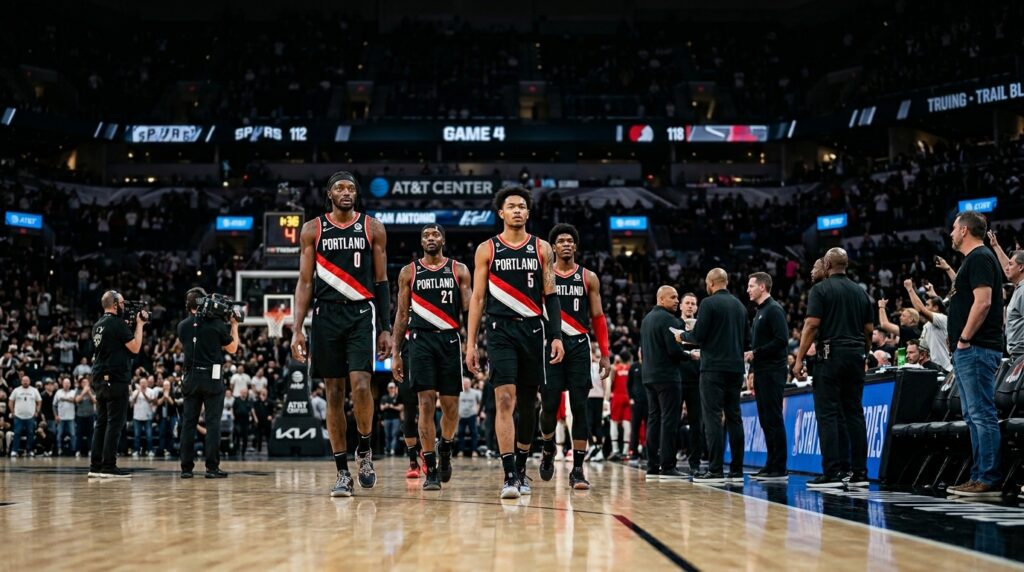
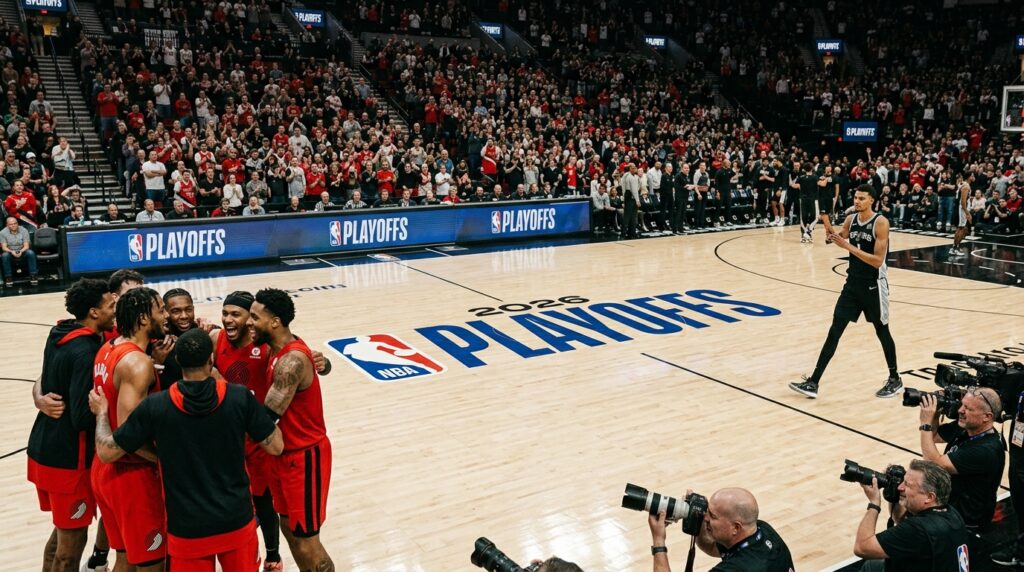
That setup produced one of the most intriguing first-round pairings in the West: No. 2 San Antonio against No. 7 Portland. The matchup immediately validated the attention around it. San Antonio won Game 1, 111-98, on April 19, with Wembanyama delivering 35 points in his playoff debut, a Spurs franchise playoff debut record according to NBA.com coverage. But Portland answered quickly, taking Game 2 by a 106-103 score on April 21 to wrest back home-court advantage and tie the series 1-1 heading into Games 3 and 4 in Oregon. NBA.com said Scoot Henderson scored a playoff career-high 31 in the Game 2 win, while Wembanyama exited early and was later described in league coverage as being in concussion protocol.
Portland’s presence alone changes the feel of this bracket. The franchise had spent recent seasons associated more with development and retooling than immediate postseason relevance. Now it is in a series against one of the league’s most compelling young powers, and it has already shown it can absorb a headline performance from Wembanyama and still make the series uncomfortable for San Antonio. The Blazers are no longer just a pleasant postseason surprise. They have become an early example of how thin the gap can be between a higher seed and a dangerous lower one.
Elsewhere in the West, the defending champion Oklahoma City Thunder began with the sort of authority expected from a No. 1 seed. Oklahoma City beat Phoenix 119-84 in Game 1 on April 19, with NBA.com describing the Thunder as carrying their regular-season momentum directly into the playoffs. That series resumed with Game 2 on April 22. The top line from the opener was simple: the Thunder looked like a team trying to end doubt before it starts, not one feeling its way into the bracket.
The West’s other two series have also opened with strong identity. The Los Angeles Lakers, seeded fourth, took a 2-0 lead over the fifth-seeded Houston Rockets with wins of 107-98 on April 18 and 101-94 on April 21. NBA.com credited LeBron James with another forceful Game 2 performance, while league coverage highlighted the unusual father-son subplot of LeBron and Bronny James appearing together on the playoff stage. The Lakers have not run away from Houston, but they have established control early and now head on the road with the cushion every veteran team wants.
Denver and Minnesota, meanwhile, look set for the kind of long, bruising series that could shape the entire conference. The Nuggets won Game 1, 116-105, on April 18, but the Timberwolves responded with a 119-114 victory on April 20 to level the series at 1-1. NBA.com called it a series “for the ages” after the split, a reflection of both the talent and the physical edge in the matchup. If Oklahoma City entered the postseason as the conference’s clearest standard-bearer, Denver-Minnesota has already begun to resemble the kind of first-round pairing that feels more like a conference semifinal.
The Eastern Conference has developed a similarly layered first round, though with a slightly different tone. Detroit entered as the No. 1 seed and one of the season’s strongest developmental success stories, only to see eighth-seeded Orlando steal Game 1 on the road, 112-101, on April 19. NBA.com called it a physical, hard-fought upset that immediately shifted pressure onto the Pistons. Game 2 was scheduled for April 22, making Detroit’s response one of the day’s most important storylines. A young top seed can dominate the regular season, but the playoffs test emotional durability as much as talent, and Orlando has already forced that question.
Boston and Philadelphia also opened with exactly the kind of volatility that keeps a bracket alive. The Celtics routed the 76ers 123-91 in Game 1 on April 19, a result NBA.com framed as a “dose of Celtics basketball.” But Philadelphia struck back on April 21 with a 111-97 win to even the series at 1-1 behind big production from its backcourt. The split matters not only because it resets the matchup, but because it restores the sense that the Eastern bracket may not be as top-heavy as it first appeared after opening weekend.
The third-seeded New York Knicks and sixth-seeded Atlanta Hawks have already produced one of the round’s sharpest early twists. New York took Game 1, 113-102, on April 18, but Atlanta stormed back from a 12-point fourth-quarter deficit to win Game 2, 107-106, on April 20. NBA.com described the finish as one of the rarest playoff comebacks, and the result instantly changed the mood around the series. Instead of the Knicks carrying a routine 2-0 lead south, the series goes to Atlanta level at 1-1, with questions now centered on whether New York let an early grip on the matchup slip away.
Cleveland, by contrast, is one of the few teams to have translated home-court advantage into total early command. The Cavaliers beat Toronto 126-113 in Game 1 and 115-105 in Game 2, opening a 2-0 lead behind strong scoring from Donovan Mitchell and support from James Harden and Evan Mobley, according to NBA.com. That does not end the series, but it does make Cleveland one of the East’s steadiest teams through the opening week. In a round defined by split series and warning signs for favorites, the Cavaliers have looked unusually settled.
Taken together, the first round has already delivered the ingredients the league wants from April basketball: recognizable stars, emergent young cores, at least one resurgent franchise, and enough early resistance to keep the bracket from feeling pre-scripted. Portland’s return is central to that. The Trail Blazers did not simply qualify; they added immediate competitive tension to a bracket that could have tilted toward chalk. Their series with San Antonio now carries both the novelty of a re-emerging Portland team and the broader league fascination with the Spurs’ youth movement.
There is also a larger significance to the way this bracket is taking shape. The 2026 first round is not just about who advances. It is about how the balance of power is being negotiated between contenders trying to validate regular-season form and younger teams testing whether their timeline can be accelerated. Oklahoma City wants to defend a title with authority. San Antonio wants to prove its rise is not merely theoretical. Detroit wants to show its No. 1 seed means more than a promising season. Portland, Orlando and Atlanta all want to demonstrate that lower seeds can still distort the map.
As of April 22, some series have already tilted, some have reset, and others are only beginning to reveal their fault lines. But the shape of the postseason is clear enough now: this is not an opening round built solely around inevitability. It is built around pressure. And in that environment, Portland’s return, San Antonio’s spotlight, and a bracket full of heavy pairings have given the 2026 playoffs an immediate sense of consequence.”””