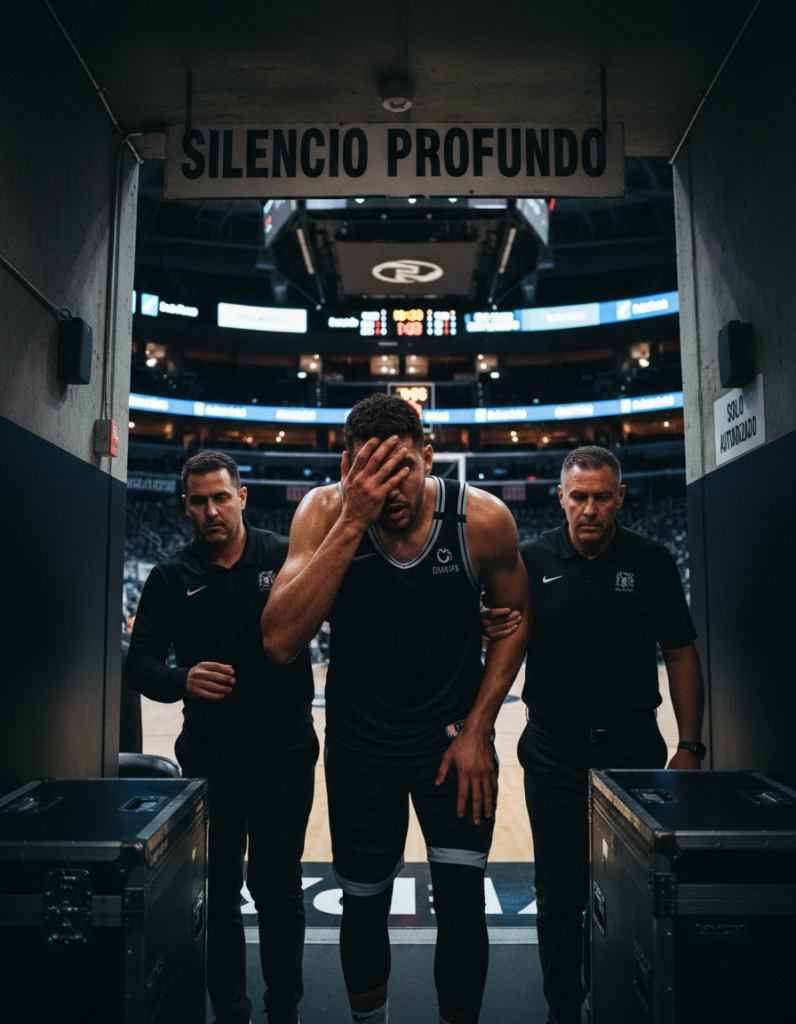
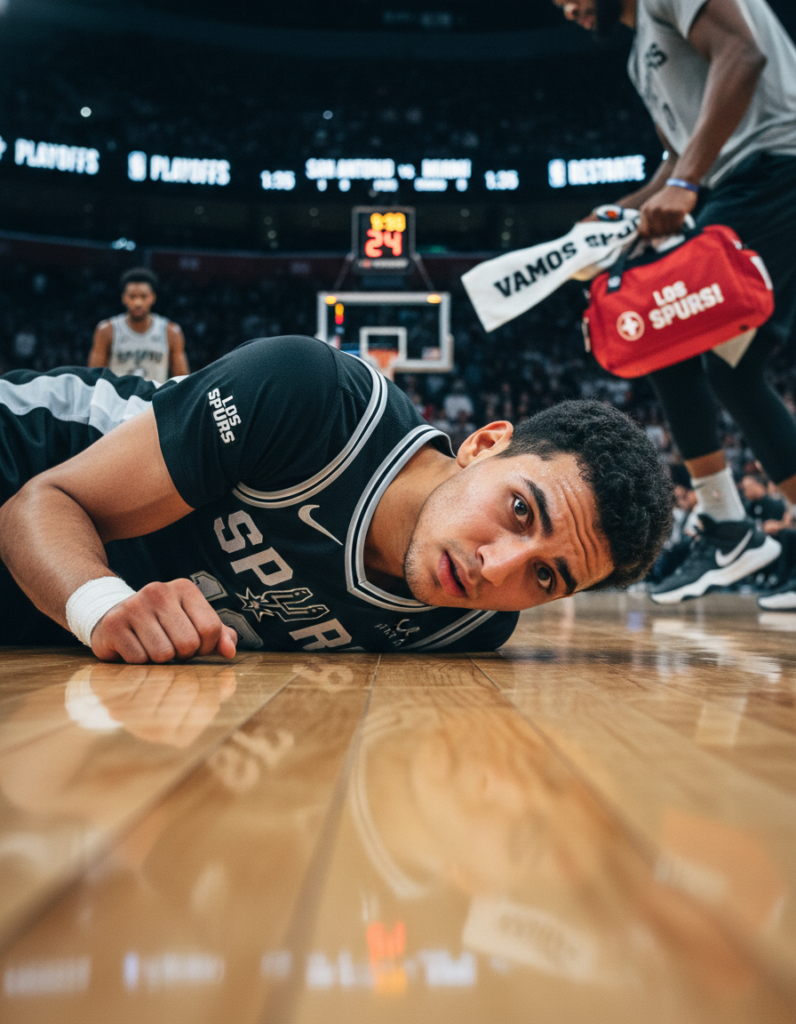
Victor Wembanyama’s face-first fall and immediate entry into the NBA’s concussion protocol after Game 2 has turned a first-round series that seemed to tilt toward San Antonio into one of the most closely watched health and competitive storylines of the international sports week.
The San Antonio Spurs lost more than a game on Tuesday night. They lost control of the emotional and tactical balance of their first-round playoff series, and they left the floor with a far greater concern than the 106-103 defeat itself. Victor Wembanyama, the franchise’s defining player and one of the most recognizable young stars in global sport, was diagnosed with a concussion after a frightening fall in the second quarter against the Portland Trail Blazers. By the end of the night, the series was tied 1-1, and the conversation had shifted abruptly from San Antonio’s basketball advantages to uncertainty over whether its most important player will be available at all in the immediate future.
The sequence was alarming in the way only head injuries can be. Wembanyama tumbled forward and struck his face on the court, leaving him visibly shaken before he exited and was ruled out for the remainder of the game. Afterward, the Spurs confirmed that he had entered the league’s concussion protocol. In the compressed rhythm of the NBA playoffs, where every 48 hours can reshape a series, the diagnosis immediately elevated the stakes beyond a routine injury update. It changed the atmosphere around the matchup.
That is because Wembanyama is not simply San Antonio’s best player. He is the structural force around which the Spurs’ identity is built. His size, mobility and defensive range alter the geometry of a game in ways that few players in basketball can replicate. Offensively, he stretches defenses and punishes mismatches; defensively, he can erase drives, deter shots and change how opponents use the paint. When he left the floor, the Spurs not only lost a star. They lost the system-wide impact that makes them a more complete and intimidating playoff team.
The game itself illustrated that vulnerability. San Antonio had seized control early and looked positioned to take a commanding lead in the series, but Portland rallied after Wembanyama’s exit and escaped with a three-point win. The immediate standings damage was obvious: instead of carrying a 2-0 advantage into the road portion of the series, the Spurs now head to Portland tied. Just as significant was the psychological effect. A series that appeared to be drifting toward San Antonio suddenly opened up.
For Portland, the timing of that shift could hardly have been more consequential. Playoff series are often decided not only by talent, but by whether a lower-seeded or less favored team can identify a point of disruption and turn it into belief. The Trail Blazers now have both a result and a reason to think differently about the matchup. Winning Game 2 on the road was important on its own. Winning it after seeing the opponent’s central figure leave with a concussion gave the result a different weight.
That does not mean Portland would be advancing merely because of one injury. But it does mean the terms of the series have changed. If Wembanyama misses time, the Spurs will have to replace not just points and rebounds, but an entire defensive ecosystem. Players who were previously working in clearly defined supporting roles may need to absorb larger offensive burdens. The margin for error in transition defense, rim protection and late-game shot creation becomes smaller. In the postseason, those losses are rarely abstract.
The concussion element is what makes projection especially difficult. Unlike many muscular or joint injuries, concussion recovery does not follow a neat public timetable. The NBA’s protocol exists precisely because symptoms and clearance timelines vary from player to player. Even if a player appears physically stable soon after the incident, medical progression determines availability, not competitive urgency. That creates a tension familiar across modern sports: the playoffs reward speed and resilience, but concussion management requires patience and caution.
For the Spurs, that tension is both competitive and ethical. They are trying to win a playoff series, but they are also dealing with the health of a 22-year-old cornerstone whose long-term value to the franchise far outweighs any single game. The organization has little room to indulge short-term risk. San Antonio’s public posture after the game reflected that reality. There was no dramatic promise of a rapid return, only acknowledgment that protocol would decide the next step.
That kind of restraint matters in a sports environment where star injuries can quickly become spectacles. Wembanyama’s profile ensures that every update will be amplified. He is not only central to the Spurs’ present; he is one of the NBA’s international flagbearers, a player whose rise is followed intensely in Europe, North America and beyond. An injury involving him, especially in the playoffs and especially one involving a head impact, inevitably becomes a global sports story.
It also lands at a significant point in the season. The playoffs are where reputations harden. Young stars are measured not only by box scores, but by whether they can impose themselves in a seven-game series under pressure. Wembanyama entered this postseason as one of the players most capable of defining April and May. Instead, at least for the moment, the question is whether the series will proceed without him and what that absence will reveal about both teams.
San Antonio’s challenge now is twofold. First, it must find enough tactical flexibility to survive without the defensive certainty and matchup chaos Wembanyama creates. Second, it must manage the emotional swing of seeing its most important player injured in real time. Teams often talk about collective response, next-man-up discipline and postseason composure, but there are limits to how cleanly those phrases translate on the floor. It is one thing to prepare for adversity in theory. It is another to watch the centerpiece of the roster leave after a frightening collision and then hold a lead against a playoff opponent sensing opportunity.
Portland, meanwhile, has every reason to treat this as an opening, while understanding that nothing is yet guaranteed. The Trail Blazers still have to win possessions, road momentum must be converted into home execution, and the series remains vulnerable to another swing if Wembanyama returns quickly. But after stealing Game 2, the Blazers have reintroduced uncertainty into the matchup. That alone is valuable.
The larger significance of the injury lies in how quickly it transformed the frame through which the series is viewed. Before Tuesday night, the conversation centered on San Antonio’s upward trajectory, Wembanyama’s influence and whether the Spurs were beginning to look like a dangerous Western Conference force ahead of schedule. After Tuesday night, the central issue became far simpler and more fragile: can the Spurs withstand even a brief postseason stretch without the player who makes so much of their identity possible?
That question will shape not just the next game, but the tone of the series. If Wembanyama is unavailable, Portland’s confidence grows and San Antonio’s depth is placed under severe stress. If he returns quickly, the Spurs still must show that the emotional aftershock of the injury has not altered their edge. In either case, the series is no longer only about schemes and talent. It is about health, recovery and the unpredictable way playoff trajectories can change in a single fall.
In an era when sports audiences follow injuries almost as closely as tactics, Wembanyama’s concussion has become one of the defining international sports developments of the week because it sits at the junction of player welfare and championship consequence. It is a medical issue, a competitive issue and a narrative turning point all at once. The Spurs entered the night hoping to tighten their grip on the series. They left it waiting on protocol, medical evaluation and the uncertain timing that now governs the next chapter of their postseason.”””