
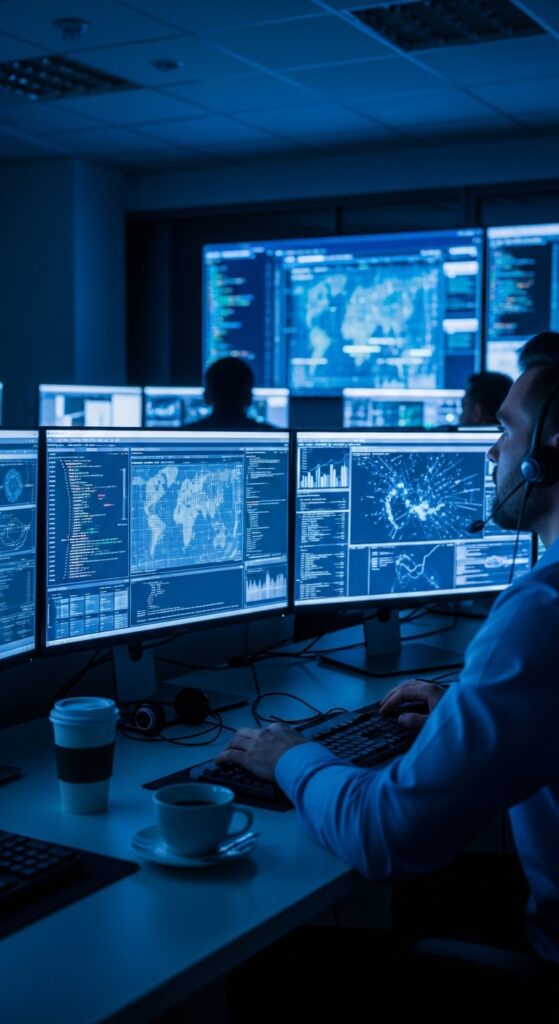
AI-powered attacks, ransomware and supply-chain vulnerabilities are forcing companies and governments to treat cyber defense as essential infrastructure.
Cybersecurity has moved from the server room to the center of public life. Banks, hospitals, schools, power grids, transport networks and government agencies all depend on digital systems. When those systems fail or are attacked, the consequences are no longer abstract. They can delay surgery, freeze payments, disrupt travel and expose private lives.
The World Economic Forum’s Global Cybersecurity Outlook 2026 found that AI-related vulnerabilities were the fastest-growing cyber risk identified by respondents during 2025. The same report said the share of organizations assessing the security of their AI tools nearly doubled from 37 percent in 2025 to 64 percent in 2026, a sign that awareness is turning into action.
Ransomware remains one of the most damaging threats. Criminal groups break into systems, encrypt data and demand payment. Hospitals and local governments can be especially vulnerable because they often run complex systems with limited budgets. Even when victims refuse to pay, recovery can be expensive and slow.
Artificial intelligence is changing both attack and defense. Attackers can use AI to write more convincing phishing emails, automate reconnaissance and generate malicious code. Defenders can use AI to detect unusual behavior, prioritize alerts and respond faster. The contest is becoming faster and more automated.
Supply chains are a growing concern. A company may secure its own systems but still be exposed through software vendors, cloud providers, contractors or hardware suppliers. A vulnerability in one widely used tool can affect thousands of organizations. Cybersecurity therefore depends on networks of trust, not isolated defenses.
The human factor remains critical. Many breaches begin with stolen credentials, weak passwords or employees tricked by fraudulent messages. Training matters, but it must be realistic. Workers cannot be expected to defeat sophisticated attacks alone. Systems must be designed to reduce the damage when mistakes happen.
Governments are strengthening rules for critical infrastructure, breach reporting and data protection. Companies are being asked to prove not only that they respond to attacks, but that they prepare for them. Cyber insurance has also become more demanding, pushing organizations to improve security before coverage is granted.
Small businesses face a difficult problem. They rely on digital tools but often lack dedicated security teams. A cyberattack can be existential for a small firm. Affordable security services, shared guidance and stronger default protections from technology providers are becoming more important.
The rise of connected devices expands the attack surface. Smart cameras, industrial sensors, medical devices, vehicles and home appliances can all become entry points if poorly secured. The Internet of Things makes the physical world more digital and the digital world more physically consequential.
Public trust is at stake. People will not embrace digital health records, online banking, smart cities or AI-driven services if they believe their data is unsafe. A single major breach can damage confidence for years.
Cybersecurity is often described as a technical challenge. It is also a governance challenge, a business challenge and a social challenge. It requires investment before disaster, cooperation across borders and clear responsibility after failure.
The digital economy cannot function without trust. Cybersecurity is the infrastructure of that trust.”””
