OpenAI’s new image-generation upgrade is gaining cultural momentum in India, but early third-party data suggests the global rollout is producing only modest overall growth.
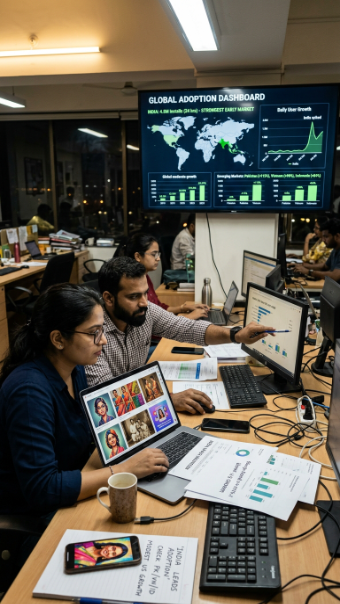
India has emerged as the most active early market for ChatGPT Images 2.0, underscoring how quickly artificial intelligence image tools are becoming part of everyday digital expression in one of the world’s largest internet economies. But the broader global picture is more restrained: according to data reviewed by TechCrunch from Sensor Tower and Similarweb, the new feature has generated a visible burst of attention without yet producing a dramatic worldwide jump in usage.
The contrast captures a central tension in the current phase of consumer AI. The technology is becoming more capable, more visual and more culturally adaptable, but user growth is no longer driven simply by novelty. For OpenAI, India’s response shows the strength of a market where mobile-first creativity, social sharing and multilingual communication converge. Elsewhere, the same launch appears to be meeting a more mature audience, one that has already seen waves of AI image tools arrive in rapid succession.
ChatGPT Images 2.0 was introduced by OpenAI in late April as a major upgrade to image generation inside ChatGPT. The company described the model as better at understanding complex prompts, producing detailed visuals and rendering text across languages. Those capabilities matter in India, where users frequently move across English, Hindi, Bengali and other languages, and where visual content often travels faster than text across platforms such as Instagram, WhatsApp and short-video apps.
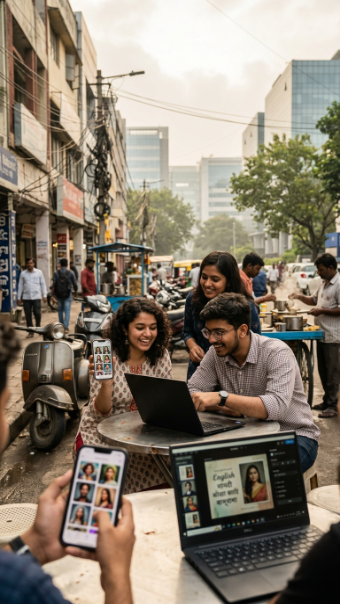
TechCrunch reported that India has become the largest user base for ChatGPT Images 2.0 since launch. OpenAI said early patterns in the country point less to purely functional use and more to self-expression. Users are creating studio-style portraits, avatars, cinematic portrait collages, fantasy-themed images, fashion moodboards, stylized newspaper covers and restored older photos. That range suggests the tool is not being treated only as a productivity feature, but as a personal media engine.
The numbers point to scale, though not an explosion everywhere. Sensor Tower data cited by TechCrunch showed ChatGPT app downloads rising 11% week over week after the Images 2.0 rollout. But daily active users and sessions increased by only about 1%, suggesting that many existing users may have sampled the feature without fundamentally changing their ChatGPT habits. Similarweb data showed global web traffic to ChatGPT rising about 1.6% week over week during the same period.
India’s role is more substantial in absolute terms. Sensor Tower estimated that ChatGPT was downloaded about 5 million times in India during the launch week, compared with about 2 million downloads in the United States. Similarweb data also indicated that daily active users in India rose about 3.4% week over week. Those figures suggest India is not merely reacting to a viral moment; it is becoming a major center of consumer AI experimentation.
The strongest percentage spikes, however, appeared elsewhere in emerging markets. Sensor Tower data cited by TechCrunch showed that countries including Pakistan, Vietnam and Indonesia saw sharper increases in ChatGPT app downloads, with gains of up to 79% week over week during the rollout period. That pattern suggests image generation may be especially powerful as an acquisition tool in markets where the category is still expanding and where visual, mobile-first online behavior dominates.
For India, the appeal of ChatGPT Images 2.0 appears to be partly cultural and partly infrastructural. The country has a vast base of young smartphone users, a creator economy that rewards fast-moving visual trends and a multilingual population that can benefit from improvements in non-Latin scripts. A tool that can generate a polished portrait, a festival poster, a social media graphic or a fantasy self-image from a short prompt fits naturally into that environment.
The feature also arrives after earlier viral waves showed how quickly AI-generated visuals can spread across Indian social media. Previous image trends, including stylized portraits and animation-inspired transformations, drew heavy participation from Indian users and helped position the country as a key battleground for consumer AI companies. ChatGPT Images 2.0 appears to be building on that behavior, though with more advanced controls and broader visual formats.
OpenAI’s upgrade is designed to address some of the weaknesses that limited earlier image models. Users often complained that AI-generated text appeared misspelled or visually garbled, especially in non-English languages. Images 2.0 is intended to improve multilingual text rendering, including in Hindi and Bengali. That could make the tool more useful for posters, invitations, educational visuals, small-business marketing and other formats where readable text is central to the image.
The model also adds so-called thinking capabilities for some users, allowing ChatGPT to reason through image structure before generating an output. In practical terms, that can help with more complex requests, such as producing multiple consistent images from a single prompt, building visual explainers from uploaded files or maintaining the same characters and style across a sequence. The feature can generate images at up to 2K resolution and supports a wider range of aspect ratios, making it more suitable for banners, vertical posts, presentations and multi-panel layouts.
Still, the modest global engagement data shows that technical improvements do not automatically translate into sustained mass adoption. Many users may try an image feature once or twice and then return to text-based ChatGPT tasks. Others may already use rival tools from Google, Microsoft, Adobe, Midjourney or mobile editing apps. The market for AI-generated imagery has become crowded, and each new release must compete not only on quality but on convenience, price, trust and cultural relevance.
That competition is intensifying. Google’s image-focused AI efforts have also gained attention in India, and Microsoft has continued to integrate image tools across its products. The broader race is no longer simply about which model can produce the most beautiful image. It is about which platform can turn image generation into a habitual, practical part of daily work and personal expression.
India may be particularly important because it offers both volume and variety. Users may create personal portraits, wedding visuals, political memes, devotional posters, educational diagrams, product mockups or social media campaigns. This diversity gives AI companies a testing ground for multilingual text, culturally specific imagery, identity-sensitive editing and high-volume mobile usage. Success in India can reveal whether an AI image tool can operate across languages, aesthetics and social contexts at scale.
The rapid adoption also raises familiar concerns. More realistic and accessible image tools can help small businesses, students and creators, but they can also complicate debates over misinformation, consent and synthetic media. In a country with a dense political media environment and massive social distribution networks, the ability to quickly generate persuasive visuals may require clearer safeguards, labeling practices and user education.
For now, the early evidence suggests that ChatGPT Images 2.0 is a hit in India, but not yet a runaway global growth engine. Its strongest signal is cultural: users in India appear eager to place themselves, their languages and their social identities inside AI-generated media. Its weaker signal is commercial: outside select emerging markets, the launch has not yet produced a major surge in engagement.
That distinction matters for OpenAI. The company has built one of the world’s most recognizable AI products, but sustaining momentum will require more than headline-grabbing launches. It will need to convert experimentation into repeated use, and repeated use into trust. India’s response shows that the opportunity is real. The global data shows that the next phase will be harder.