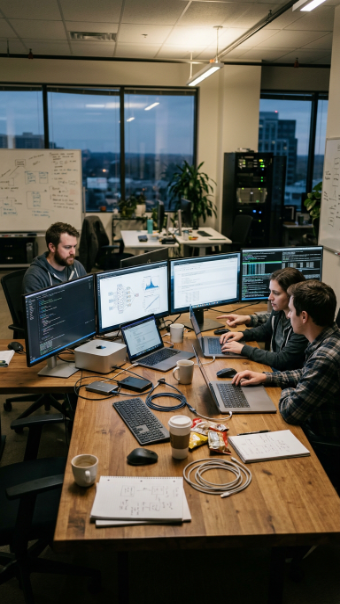
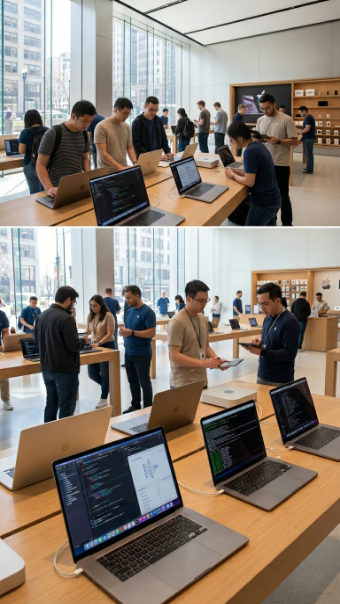
Mac revenue beat expectations as developers, schools and enterprises turned to Apple silicon machines for local artificial intelligence work, even as supply constraints limited sales.
Apple’s latest earnings report delivered the familiar headline numbers investors expect from the iPhone maker: a record March quarter, powerful services growth and another massive share buyback. But one of the most striking signals came from a smaller part of the company’s empire. The Mac, long overshadowed by the iPhone and increasingly positioned as a mature personal computer business, showed signs of becoming a beneficiary of the artificial intelligence boom.
The company reported Mac revenue of $8.4 billion for its fiscal second quarter ended March 28, up 6% from a year earlier and above Wall Street expectations of roughly $8.1 billion. The gain was modest compared with the iPhone’s scale, but it carried strategic weight because Apple said demand was stronger than it had anticipated and that several Mac models remained constrained by supply.
Apple’s overall quarterly revenue rose 17% year over year to $111.2 billion, while diluted earnings per share increased 22% to $2.01. Services revenue reached an all-time high of about $31 billion. The iPhone, still Apple’s largest business by far, generated nearly $57 billion in revenue. Against that backdrop, the Mac’s $8.4 billion contribution was not the largest financial story. It was, however, the clearest example of how demand for AI computing may be changing the role of the personal computer.
Chief Executive Tim Cook told analysts that supply limits in the March quarter were concentrated mainly in iPhone and, to a lesser extent, Mac. Looking ahead to the June quarter, he said several Mac models would represent the majority of Apple’s supply constraints, reflecting continued high demand. The explanation was unusually direct for Apple: customers were recognizing the Mac mini and Mac Studio as strong platforms for artificial intelligence and agentic tools faster than Apple had predicted.
That comment suggested a shift in the market’s understanding of where AI work happens. Much of the global AI investment cycle has centered on cloud data centers, high-end graphics processors and the enormous infrastructure needed to train frontier models. Apple’s Mac story is different. It is about local inference, software development, prototyping, privacy-sensitive workloads and the growing number of tasks that can be handled on powerful desktop and notebook machines rather than sent to remote servers.
Apple has spent years building that argument through its own silicon strategy. Since moving the Mac away from Intel processors, the company has emphasized performance per watt, long battery life and tightly integrated chips. The unified memory architecture in Apple silicon has also become important for certain AI workloads because it allows processors to access large pools of memory efficiently. That does not make a Mac a substitute for a data center cluster, but it does make the machine attractive to developers who want to run models locally, test AI applications or build enterprise tools without relying entirely on cloud infrastructure.
Apple executives used the earnings call to connect that technical foundation with customer behavior. Cook described the Mac as a platform capable of running advanced models locally in ways that were not previously possible for many users. Chief Financial Officer Kevan Parekh said leading AI developers, including Perplexity, were choosing Mac as a preferred platform for building enterprise-grade AI assistants and autonomous-agent tools. He also cited corporate and education deployments, including Freshworks using MacBook Pro and MacBook Air machines to accelerate AI development and Kansas City Public Schools shifting high school students from Windows laptops and Chromebooks to Apple’s MacBook Neo.
The MacBook Neo appears to have played a separate but related role in the quarter. Apple launched the product during the period as a lower-priced entry point into the Mac lineup, and Cook said customer response had been stronger than expected. The device helped Apple reach customers who were new to Mac as well as users who had held onto older machines for years. Parekh said Apple set a March quarter record for customers new to the Mac and that the overall Mac installed base reached an all-time high.
That matters because Apple’s AI ambitions depend not only on software announcements but also on the size and quality of its device base. The company has framed Apple Intelligence as an integrated system built into iPhone, iPad and Mac, emphasizing privacy and on-device processing rather than positioning AI as a separate product. A larger base of modern Macs gives Apple more room to deliver AI features that require recent hardware and to court developers who are deciding which platforms should support their AI applications first.
Still, Apple’s Mac momentum comes with constraints. The same forces driving AI demand are also tightening parts of the semiconductor supply chain. Cook said constraints on Apple’s custom chips were tied to availability at advanced manufacturing nodes. He also warned that memory costs were rising, with a significantly larger impact expected in the June quarter and a growing effect beyond that period. That warning is important because local AI workloads often benefit from higher memory configurations, and high-memory machines are precisely the kinds of devices that can become harder to supply when memory markets tighten.
Apple also cautioned that the Mac mini and Mac Studio may take several months to reach supply-demand balance. That is an unusual position for a company known for operational discipline and careful product forecasting. In this case, the shortage itself may reinforce the message that demand is real. But it also creates a practical risk: sales can only rise as far as supply allows, and frustrated buyers may delay purchases or consider alternatives if delivery times stretch too far.
The investor reaction to the Mac’s performance is likely to be mixed but attentive. On one hand, the Mac remains much smaller than the iPhone and services businesses. A strong quarter for Mac cannot by itself redefine Apple’s growth profile. On the other hand, the category’s improvement helps answer a question that has followed Apple throughout the AI cycle: whether the company is merely adding AI features to existing products or whether it can benefit commercially from the broader shift toward intelligent computing.
For now, the evidence is early but meaningful. Apple is not claiming that artificial intelligence alone drove Mac revenue higher. Product refreshes, the launch of MacBook Neo, education demand, emerging-market growth and corporate deployments all contributed. But executives were clear that AI-related use cases were part of the upside, especially for desktop models such as Mac mini and Mac Studio. In a market where investors have often criticized Apple for moving more cautiously than rivals in generative AI, the Mac gave the company a more tangible AI story.
The quarter also underlined a wider industry theme. AI may not be confined to chatbots, cloud subscriptions or data center hardware. It may also revive demand for capable personal computers, especially machines that can combine strong local performance with efficient power use and secure software ecosystems. For Apple, that could make the Mac more than a legacy product line. It could become a bridge between the company’s hardware past and its AI future.
The challenge will be execution. Apple must convert demand into supply, manage rising component costs and show developers that its platform is not only polished but essential for AI work. It must also demonstrate that its own AI software can move quickly enough to justify the hardware story. WWDC will offer another opportunity for Apple to define that strategy. But in the latest quarter, the market received a clear signal: even before Apple fully explains its next AI chapter, some customers are already buying Macs to write it themselves.