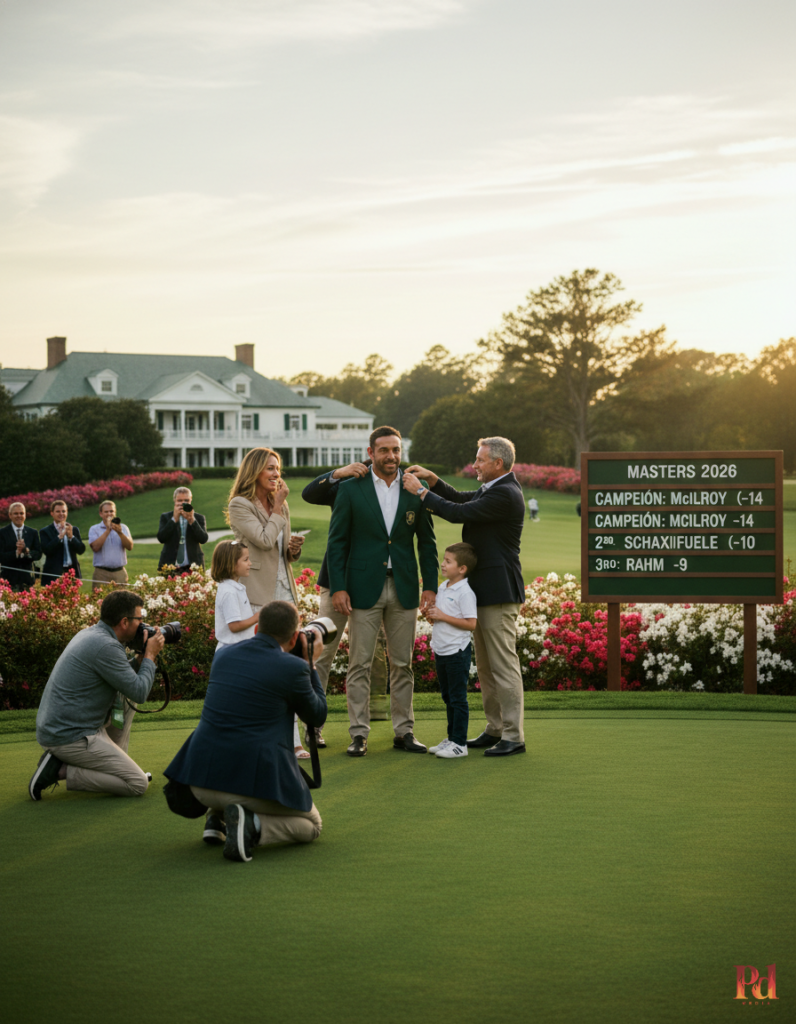
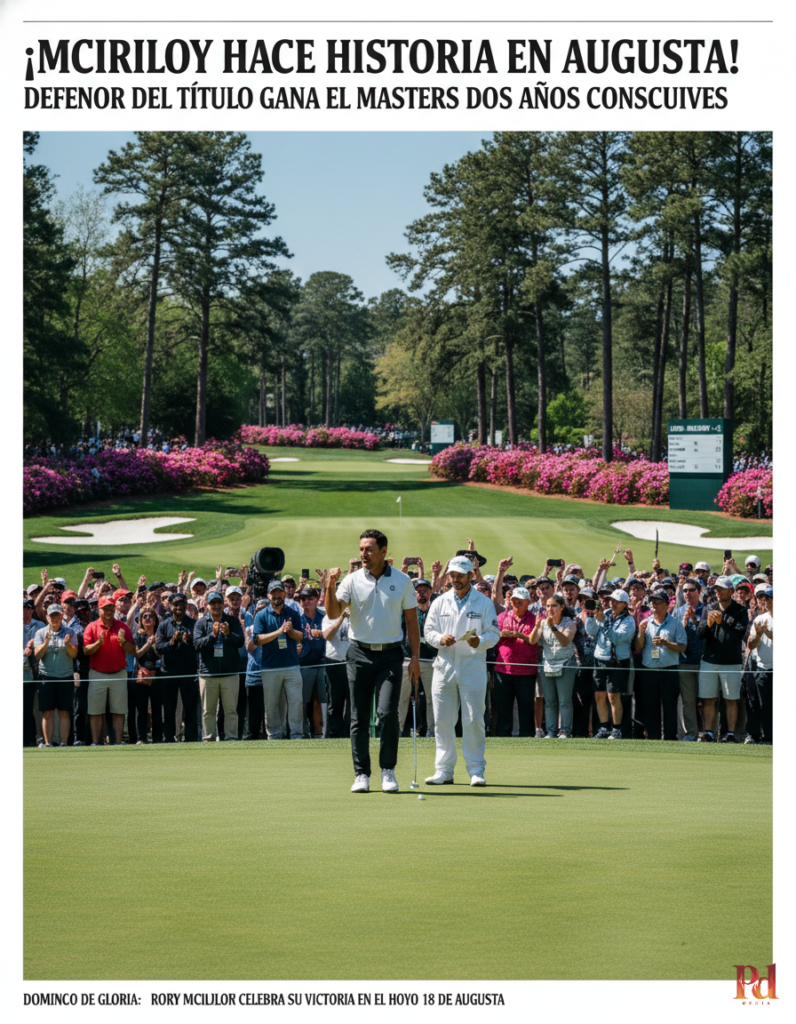
By becoming the first man since Tiger Woods to win back-to-back Masters titles, Rory McIlroy has turned a long-awaited career milestone into a new era of dominance, putting the sport’s balance of power squarely under his control at the start of the 2026 major season.
Rory McIlroy arrived at Augusta National this month carrying a burden that, for much of the past decade, had defined him as much as his talent. He left with something altogether different: authority.
By winning the 2026 Masters, McIlroy did more than secure another green jacket. He became the first player since Tiger Woods in 2001 and 2002 to successfully defend the title at Augusta National, joining one of the most exclusive groups in golf and extending a story that had already shifted dramatically when he won here in 2025 to complete the career Grand Slam.
Now, what had looked like redemption has become something larger. In a matter of 12 months, McIlroy has transformed from one of the game’s most scrutinized stars into its central figure, the player around whom the men’s sport is once again being organized.
His latest victory came in a setting that has historically tested every weakness in his game and every scar in his competitive memory. Augusta had long served as the annual stage for questions about his nerve, his timing and his ability to turn generational ability into enduring major dominance. For years, the Masters was the one title that haunted him most. Then came the breakthrough in 2025. And now, in 2026, came proof that the first victory was not merely catharsis, but possibly the beginning of a sustained run.
McIlroy finished 12 under par and held off world No. 1 Scottie Scheffler by a single stroke, according to event coverage and tournament reporting after Sunday’s final round. The margin underscored both the quality of the challenge and the scale of the response. He did not coast to history. He had to protect it, manage it and earn it under pressure. That is one reason the win may resonate more deeply than the first. A breakthrough can liberate a champion. A defense can define one.
The achievement also changes the broader conversation around men’s golf. For much of the recent era, the sport has lacked a single weekly focal point strong enough to consistently transcend results and pull the wider public into its orbit. There have been brilliant players, major champions and compelling young contenders, but not always one dominant narrative force. In April 2026, that force is McIlroy.
It is not only because he won again. It is because of what this title says about durability, adaptation and timing. McIlroy is no longer being discussed only as a player with historic gifts or unresolved what-ifs. He is now being judged on the terms reserved for players who shape eras. Back-to-back Masters titles move him into that category whether the rest of the season cooperates or not.
That does not mean the competition has faded. Scheffler remains a towering rival and arguably the most consistent elite golfer of the past several seasons. The younger generation is still pressing. The major championship landscape remains volatile by nature. But McIlroy’s repeat victory at Augusta gives him something no ranking table can fully quantify: gravitational pull.
Every major now will be viewed through his presence. Every leaderboard will invite comparisons to whether he can extend this run. Every conversation about legacy, momentum and sporting relevance will begin with him. In that sense, April has not simply produced another champion. It has reorganized the frame through which the men’s game is being watched.
There is also a symbolic dimension to the moment. Woods’ shadow has lingered over modern golf for decades, not only because of the number of titles he won but because of the way he concentrated attention. When a player becomes the first to do something at Augusta since Woods, the comparison is unavoidable. McIlroy is not Woods, and golf’s media ecosystem is more fragmented now than it was at the height of Tiger’s dominance. Yet the historical bridge still matters. It tells audiences, sponsors and even fellow competitors that what they are witnessing belongs in a rarer class than an ordinary major victory.
The Masters is uniquely suited to create that effect. No other men’s major returns each year to the same course with the same visual language, the same ritual and the same burden of memory. Augusta does not just crown champions; it builds mythology through repetition. That is why repeating there is so difficult and why doing so instantly changes a player’s place in history. The course remembers everything, and this week it remembered McIlroy as the man who had already conquered it.
Now the challenge is whether he can turn seasonal supremacy into something more durable. Golf’s structure resists easy dynasties. Players do not face each other directly in the manner of team sports or tennis. Form can shift quickly. A putter can cool. A draw can harden. A single bad hour can undo four days. That is what makes major accumulation so difficult even for the greatest players. But McIlroy has put himself in the one position every elite golfer wants: he has made the next question feel plausible rather than speculative.
Can he add to his major count quickly? Can he control more than one chapter of this season? Can he turn the emotional release of 2025 and the authority of 2026 into a broader late-career peak? Those questions no longer feel romantic. They feel immediate.
His position at the center of men’s golf has also been reinforced by the way his story travels beyond the scorecard. McIlroy remains one of the sport’s most recognizable and articulate figures, a player whose relevance extends into debates about the future structure of professional golf as well as its weekly competition. In a fractured era, visibility matters. So does emotional clarity. McIlroy’s journey from repeated Masters disappointment to consecutive victories offers the kind of arc modern sports still struggles to manufacture authentically. It is understandable to casual fans and compelling to committed ones.
That is why this April belongs to him so completely. Not just because he won, but because his victory clarifies the stakes of the season to come. He is no longer chasing validation at Augusta. He has it. He is no longer trying to prove he can close the door on the sport’s grandest stage. He has done that twice in succession. He is no longer merely part of golf’s elite. He is its most commanding current storyline.
And that may be the most consequential part of all. Men’s golf has spent years searching for the next sustained center of attention, the player who can fuse performance, history and public interest into a single compelling force. At Augusta in 2026, Rory McIlroy looked very much like that player.
The green jacket he won last year changed his biography. The one he won this year changed the sport’s conversation.
As the tour moves beyond Augusta and into the next major tests of the calendar, the pressure will remain immense. So will the expectations. But those are the conditions that come with real command. For the moment, McIlroy is not simply the reigning Masters champion. He is the defining figure of men’s golf in April, the player everyone else must now answer.