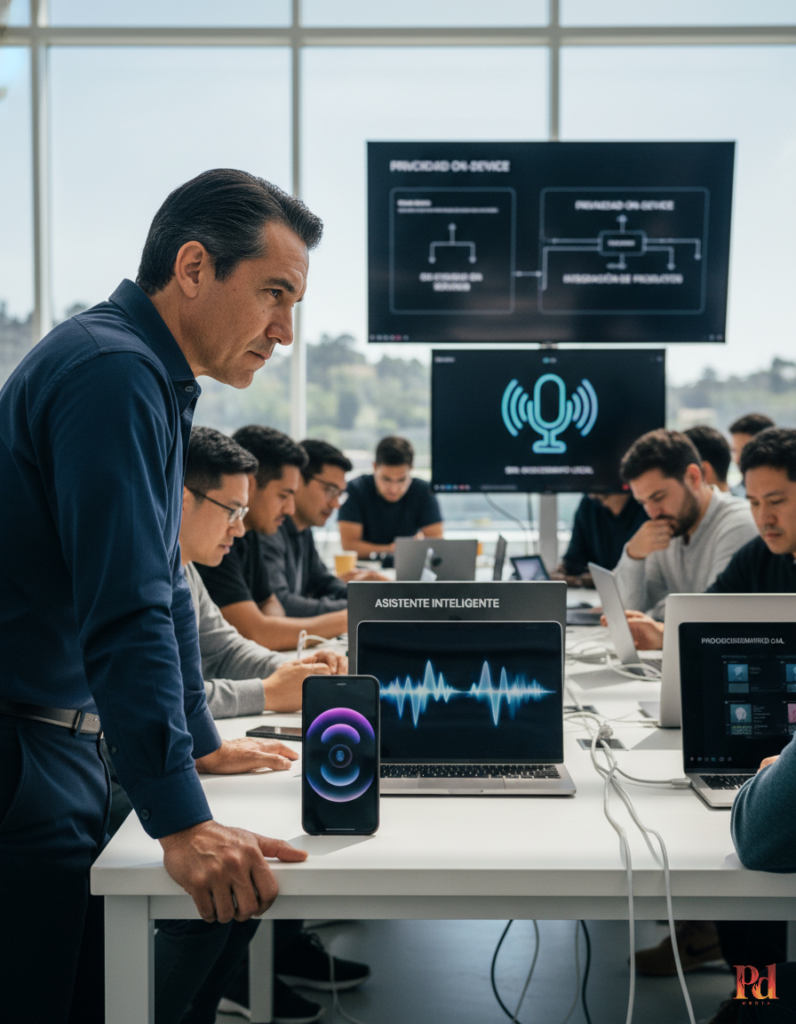
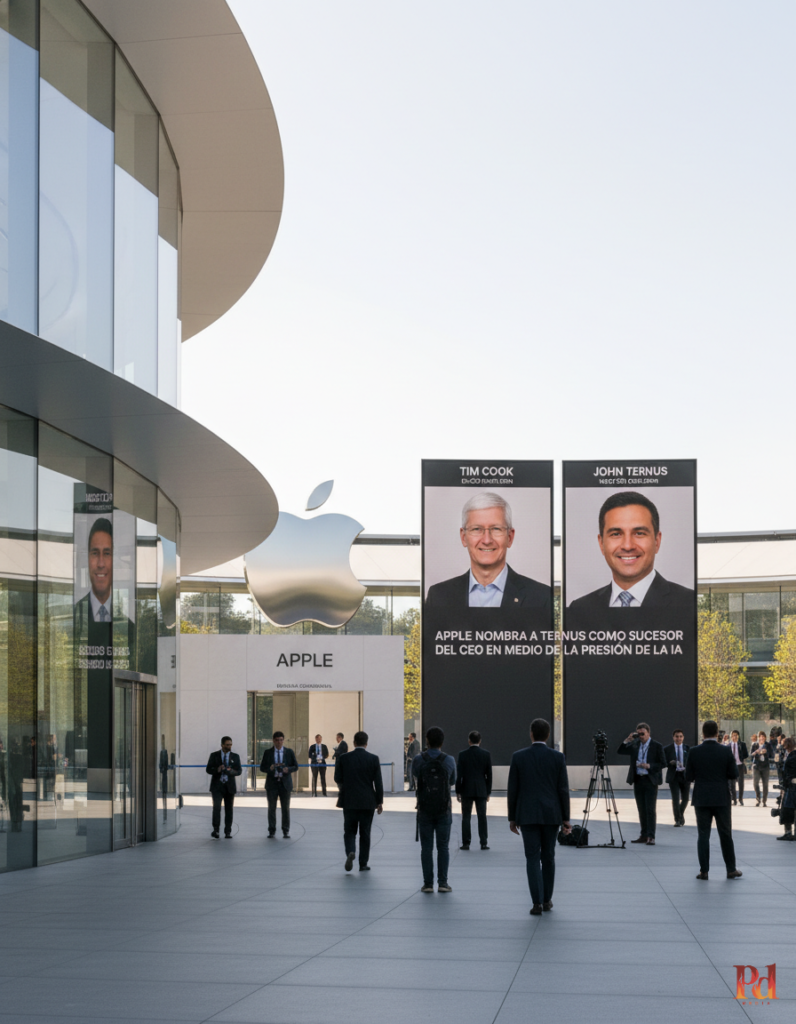
Apple’s carefully managed leadership handover gives the iPhone maker continuity at the top, but it also thrusts a hardware veteran into one of the company’s most uncomfortable strategic debates: whether Apple can still set the pace in artificial intelligence rather than react to it.
Apple has confirmed that John Ternus, the company’s senior vice president of Hardware Engineering, will become chief executive officer on September 1, 2026, succeeding Tim Cook after a 15-year run that reshaped the company from a premium device maker into a $4 trillion technology giant with vast services, semiconductor and wearables businesses.
The announcement, made in an official Apple press release on April 20, ends months of succession speculation and signals that the company’s board has chosen stability, product discipline and internal continuity over a more dramatic break with the Cook era. Cook will remain closely involved as executive chairman, a move that suggests Apple wants the transition to appear orderly at a moment when investors are looking not only at who will lead the company, but also at what problem that leader is being asked to solve.
That problem is increasingly clear. Apple is entering the Ternus era while under growing scrutiny over AI.
For years, Apple’s strategy has been built on patience, secrecy and the belief that it need not be first so long as it is best at integrating new technology into polished products. That formula worked in smartphones, tablets, smartwatches and wireless earbuds. In AI, however, the market has moved with unusual speed. Rivals such as Microsoft, Google and OpenAI have pushed generative AI from research labs into consumer products, search tools, office software and digital assistants at a pace that has made Apple’s more controlled rollout look cautious at best and delayed at worst.
When Apple unveiled Apple Intelligence in June 2024, it framed the initiative as a privacy-centered answer to generative AI. The company promised systemwide writing tools, image generation, smarter notifications and, crucially, a more capable Siri able to understand personal context, see what is on a screen and take actions across apps. Apple also said Siri would be able to tap ChatGPT when useful, reflecting a notable willingness to rely on outside models where needed.
The ambition of that presentation was unmistakable. So was the importance of Siri. More than a feature, Siri was presented as the interface through which Apple would make AI feel native to the iPhone, iPad and Mac. Yet that same vision has become one of the biggest sources of tension around the company.
Apple later acknowledged that the more personalized Siri it had been promoting would take longer to arrive. By late 2025, the company announced an AI leadership shake-up: John Giannandrea, the executive who had led machine learning and AI strategy since 2018, would step down and retire in spring 2026, while AI researcher Amar Subramanya would join Apple and report to software chief Craig Federighi. In that announcement, Apple said Federighi had been instrumental in overseeing work to bring a more personalized Siri to users “next year,” an admission that the centerpiece of Apple’s AI story had slipped beyond the timeline many users and analysts expected.
That delay has mattered because the comparison set is unforgiving. Consumers have become accustomed to chatbots and assistants that can generate text, summarize documents, interpret images and maintain more fluid, conversational exchanges. Even where Apple has shipped meaningful AI features, such as writing tools and image-related capabilities, the company continues to be judged heavily on Siri, the long-promised voice assistant that was supposed to become more useful, more context-aware and more central to everyday device use.
This is the context in which Ternus takes over.
At first glance, he may seem an unconventional choice for an AI-defining moment. He is not known primarily as a software strategist or AI researcher. He is a hardware engineer who joined Apple’s product design team in 2001, became a vice president of hardware engineering in 2013, and joined the executive team in 2021. Over that span, Apple says, he oversaw hardware engineering across nearly every major product line, including iPhone, iPad, Mac, Apple Watch and AirPods. He has been associated inside and outside the company with product reliability, materials innovation, durability and the engineering discipline that underpins Apple’s most profitable devices.
But Apple’s choice also reflects its institutional logic. The company rarely separates product leadership from corporate leadership. Apple’s strength has long come from controlling the full stack: chips, hardware, software, services and increasingly the privacy architecture that links them together. In that framework, a hardware leader is not merely a steward of devices but a manager of how technologies become products that millions of people actually use.
Ternus therefore inherits an AI challenge that may be less about inventing the most advanced large language model and more about proving Apple can turn AI into something coherent, dependable and commercially persuasive across its ecosystem.
That is still a formidable assignment. Investors will want signs that Apple can move faster. Developers will want clearer tools and timelines. Consumers will want evidence that Siri can finally become a genuinely useful assistant rather than a symbol of unrealized potential. And employees will be watching to see whether Apple under Ternus remains committed to its traditional product rigor or becomes more willing to make bolder moves, whether through partnerships, acquisitions or a faster cadence of feature releases.
Cook’s long tenure raises the stakes further. Under his leadership, Apple expanded far beyond the iPhone without ever escaping its dependence on it. The company built a services business worth more than $100 billion annually, scaled wearables into a major category, rolled out Apple-designed silicon across its devices, and pushed privacy and environmental messaging to the core of its brand. It also reached more than 2.5 billion active devices, according to Apple. But the handover comes as the company’s next chapter is being judged not by supply-chain mastery or financial discipline, areas where Cook excelled, but by whether Apple can once again appear direction-setting.
The symbolism of Ternus matters here. He is the first engineer in years to take the top job at a time when the technology industry is once again rewarding builders, researchers and product visionaries who can explain not just quarterly performance but the shape of the next platform shift. Apple clearly believes that a leader steeped in product creation, rather than operations alone, is the right face for that era.
Still, no leadership title can resolve the core question on its own. Apple’s AI challenge is not simply reputational. It is structural. The company must show that its privacy-first, tightly integrated approach can keep pace with a market that has rewarded openness, rapid iteration and aggressive public experimentation. It must also convince users that intelligence on Apple devices will be more than a menu of disconnected features.
For now, Apple’s succession plan offers reassurance on governance. It does not yet settle the strategic debate surrounding the company. Ternus arrives with deep credibility inside Apple and a record closely tied to the company’s product successes. But from September 1 onward, he will be measured not only by the next iPhone or Mac, but by whether Apple can make AI feel as indispensable, intuitive and polished as the products that made the company what it is.
In that sense, Apple’s CEO transition is not just about replacing Tim Cook. It is about whether the world’s most closely watched consumer technology company can regain the initiative in the industry’s defining race.”””