
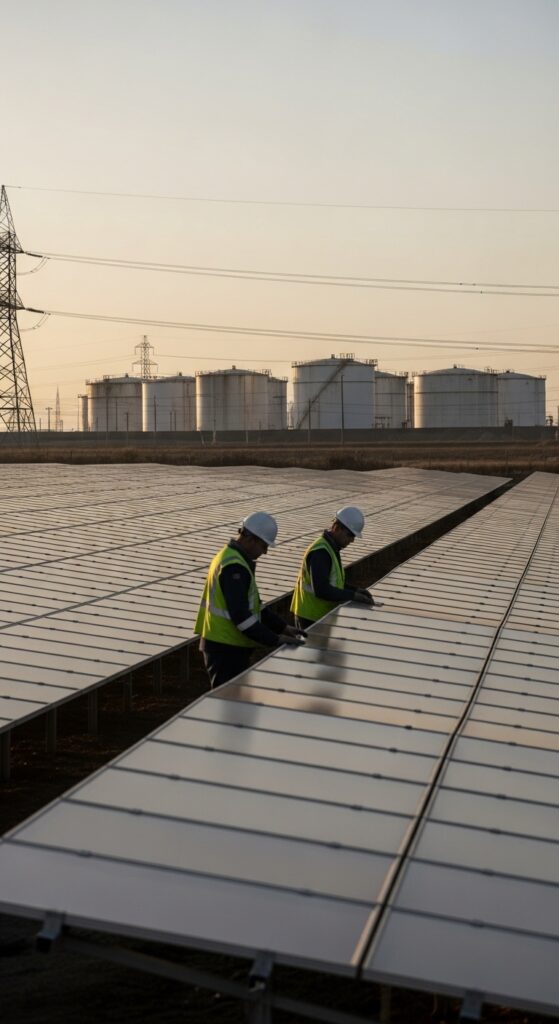
As fossil fuel volatility collides with rapid renewable growth, governments are rethinking the balance between climate goals and economic protection.
Energy has returned to the center of global politics with unusual force. Prices, supply routes, climate targets and industrial strategy are now linked in ways that affect almost every household and government budget.
The International Energy Agency’s Global Energy Review 2026 found that clean energy growth continued strongly in 2025, with solar power making a historically large contribution to rising electricity supply. Yet fossil fuels remain deeply embedded in transport, industry, heating and power systems. The result is a world moving toward cleaner energy while still vulnerable to fossil fuel shocks.
Recent international discussions have shown how politically difficult the transition remains. Around 50 countries gathered in Colombia for talks aimed at reducing dependence on fossil fuels, an effort designed to address a subject often avoided in formal climate negotiations: how to move away from coal, oil and gas in a fair and practical way.
The challenge is not simply technical. Solar panels, wind turbines, batteries and electric vehicles are improving quickly. Costs have fallen in many markets. But energy systems are built over decades. Grids must be upgraded. Storage must expand. Workers must be retrained. Fossil fuel-producing regions need credible economic alternatives.
For energy-importing countries, renewable power is increasingly seen not only as climate policy but as security policy. A domestic solar farm or wind project cannot eliminate all risks, but it can reduce exposure to international fuel price spikes. The argument for clean energy now includes sovereignty, stability and public health.
For fossil fuel exporters, the transition is more complicated. Oil and gas revenues fund budgets, public services and employment. A rapid decline without planning could create economic and political instability. This is why discussions of a “just transition” are no longer abstract. They involve real questions of revenue, debt, jobs and development.
Consumers judge energy policy through bills. A government may promise long-term savings from clean energy, but families facing high prices need immediate relief. Subsidies can protect households, but they can also strain budgets and sometimes benefit wealthier consumers more than the poor. Targeted support is difficult but increasingly necessary.
The private sector is watching policy signals closely. Energy companies, utilities, automakers and manufacturers need confidence before investing billions. Mixed messages can slow deployment. A country that promises a green transition but fails to permit transmission lines or storage projects will struggle to deliver.
The energy transition also depends on minerals. Lithium, copper, nickel, cobalt and rare earths are essential for batteries, grids and motors. Their extraction raises environmental, labor and geopolitical concerns. Clean energy supply chains must avoid repeating the worst patterns of fossil fuel dependence.
The central reality is that energy systems are now judged by three tests at once: affordability, security and emissions. Focusing on only one can create backlash. Ignoring climate risk threatens future stability. Ignoring affordability threatens public support. Ignoring security leaves economies exposed.
The world is not choosing between old and new energy overnight. It is managing an uneven transition under pressure. The countries that succeed will be those that build cleaner systems fast enough to reduce risk while protecting citizens from the costs of change.”””
