
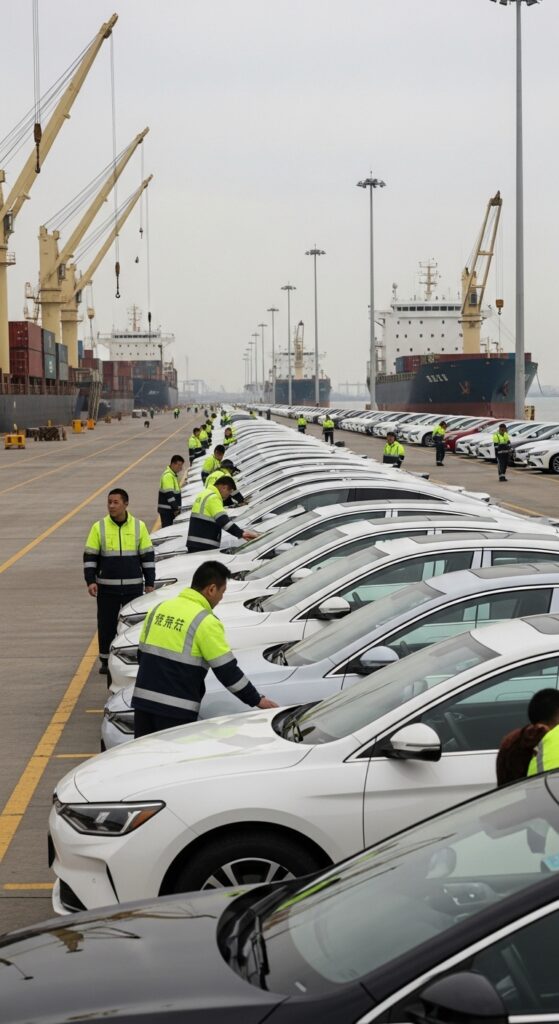
At the Beijing auto show, Chinese brands displayed the speed, technology and ambition that are forcing traditional automakers to rethink their future.
China’s rise as an automotive power is no longer a forecast. It is a fact reshaping factories, trade policy and consumer expectations across the world. At the 2026 Beijing Auto Show, domestic manufacturers presented electric vehicles, intelligent cockpits, ultrafast charging systems and driver-assistance technologies that showed how quickly the country’s car industry has moved from imitation to leadership.
The show, one of the world’s largest automotive gatherings, reflected a market where competition is intense and innovation cycles are short. Chinese companies are launching vehicles at a pace that has put pressure on established brands from Europe, Japan and the United States. Models are increasingly judged not only by design and price, but by software, artificial intelligence features, battery performance and the ability to update after purchase.
The shift has been years in the making. China built the world’s largest car market, then used industrial policy, battery investment and domestic demand to accelerate electric-vehicle production. Local consumers embraced connected cabins, large digital screens and fast model updates. Automakers responded with a speed rarely seen in older markets, where product cycles were traditionally longer and dealer networks more rigid.
The result is a new kind of car export power. Chinese automakers are moving into Southeast Asia, Latin America, the Middle East and parts of Europe. Some are exploring or building overseas factories to reduce exposure to tariffs and political barriers. Their expansion is not simply about low prices. It is about selling vehicles that combine affordability with features once associated with luxury models.
Traditional automakers are trying to respond. Some global companies have announced China-focused strategies, local partnerships and faster development programs. They know that losing relevance in China could mean losing influence in the future of the car itself. But the task is difficult. Foreign brands that once dominated premium and family-car segments now face domestic rivals that are technologically confident and deeply familiar with local buyers.
Trade tensions are rising as a result. European and American officials have expressed concern that Chinese electric vehicles benefit from subsidies and could threaten domestic industries. China argues that its companies are succeeding because of scale, efficiency and innovation. The dispute has made cars a central issue in the wider contest over manufacturing power, clean technology and global supply chains.
For consumers outside China, the effects could be mixed. More competition may lower prices and increase choice. It may also provoke tariffs that make vehicles more expensive or limit availability. Governments are trying to balance climate goals, industrial jobs and national security concerns. The car, once a symbol of private freedom, has become a strategic product.
China’s advantage is not guaranteed. A crowded domestic market has produced price wars, margin pressure and questions about long-term profitability. Some brands may disappear or consolidate. International expansion also brings regulatory, safety and service challenges. Selling cars abroad requires more than exporting vehicles; it requires trust, parts networks, financing and after-sales support.
Still, the direction is clear. The center of automotive innovation has become more global, and China now sits near the middle of it. The next phase of competition will not be decided only by horsepower or heritage. It will be decided by batteries, software, cost discipline and the ability to move fast without losing public trust.”””
