
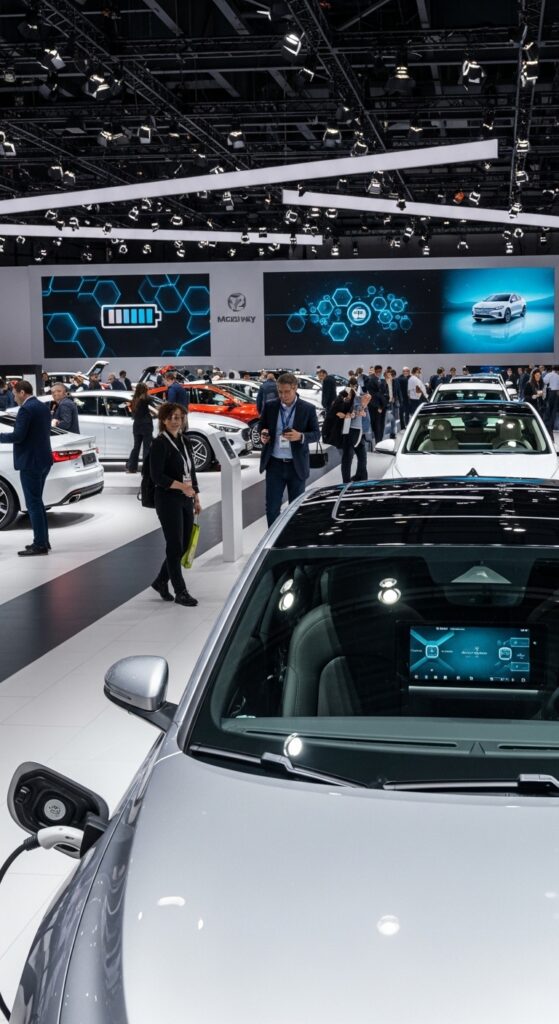
As automakers race from combustion engines toward batteries, artificial intelligence and export battles, the car is becoming less a machine of movement than a platform of power, data and industrial strategy.
The automobile, once defined by horsepower, steel and the sound of combustion, is being remade by forces that reach far beyond the showroom. In 2026, cars sit at the center of a global contest over energy security, manufacturing dominance, artificial intelligence, climate policy and consumer affordability. From Detroit to Stuttgart, Shanghai to Seoul, the industry is confronting the most consequential transformation since the assembly line.
The change is visible in the vehicles themselves. New models arriving in major markets increasingly resemble computers on wheels: battery-powered, software-driven and connected to networks of chargers, mobile apps and cloud services. Dashboards have become digital command centers. Over-the-air updates can alter performance after purchase. Driver-assistance systems are no longer luxury extras but competitive necessities. For buyers, the question is no longer simply whether a car is fast, comfortable or reliable, but whether it is efficient, intelligent, secure and affordable to maintain.
Electric vehicles remain the clearest symbol of the shift. Global electric car sales exceeded 17 million in 2024, according to the International Energy Agency, meaning more than one in five new cars sold worldwide was electric. That figure marked a dramatic expansion from only a few years earlier, when battery-powered cars were still seen in many countries as niche products for wealthy early adopters. The growth has been driven by falling battery costs, tougher emissions rules, government incentives, expanding charging networks and the aggressive rise of Chinese manufacturers.
China has become the center of gravity in the new automotive order. Its companies have scaled electric-vehicle production at a speed that has unsettled traditional automakers in Europe, Japan and the United States. At the 2026 Beijing Auto Show, Chinese brands displayed not only electric cars but also fast-charging batteries, intelligent cockpits and advanced driver-assistance systems, underscoring how quickly the country’s domestic market has become a laboratory for the next generation of mobility. The event featured more than 1,400 vehicles and scores of global debuts, a sign of both industrial ambition and fierce competition.
That competition is not limited to technology. Chinese automakers are expanding exports while facing trade barriers and political scrutiny abroad. European officials have raised concerns over subsidies and market distortion. The United States has taken an even harder line toward Chinese electric vehicles, citing both economic and security concerns. In response, some Chinese companies are looking to build factories overseas, a strategy that could reduce tariff exposure while giving them closer access to local consumers. The result is a fragmented global market in which cars are increasingly shaped by geopolitics as much as engineering.
Europe remains one of the most important battlegrounds. In 2025, battery-electric vehicles accounted for 17.4 percent of new car registrations in the European Union, according to the European Automobile Manufacturers’ Association. Hybrid-electric cars held an even larger share, reflecting a market in transition rather than one moving in a single straight line. Many European drivers are interested in lower-emission vehicles but remain cautious about charging access, resale value and purchase price. Automakers have responded with a wider range of hybrids, plug-in hybrids and fully electric models, trying to avoid losing buyers who are not yet ready to abandon gasoline entirely.
In the United States, the path has been uneven. Electric vehicles have gained ground in coastal states and urban markets, but adoption has been slower in rural areas where driving distances are longer and charging infrastructure remains less dense. Some consumers still worry about battery range in winter, repair costs and the availability of affordable models. Automakers that once announced rapid electric-only timelines have adjusted their strategies, placing renewed emphasis on hybrids while continuing to develop battery-electric platforms. The shift does not signal the end of electrification, but it does show that the road is more complicated than early forecasts suggested.
Affordability has become the central issue. The first wave of electric vehicles often targeted premium buyers, but mass adoption depends on cars that middle-income households can purchase without subsidies. Chinese manufacturers have gained an advantage by producing lower-cost models at scale. Legacy automakers, carrying older factories, dealer networks and pension obligations, face a tougher calculation. They must invest billions in batteries and software while still earning profits from combustion models that remain popular in many markets. The transition is expensive, and the winners may be those that can make electric cars desirable without making them financially unreachable.
Battery technology is another decisive front. Faster charging, longer range and lower cost could remove many of the barriers that still limit electric-vehicle adoption. Companies are racing to improve lithium-ion chemistry while also exploring sodium-ion and solid-state batteries. At the same time, battery supply chains raise difficult questions. Lithium, nickel, cobalt and graphite are concentrated in specific regions, and processing is heavily dominated by China. Governments in North America and Europe are trying to build more resilient supply chains, but mining, refining and permitting take years. The clean-car revolution still depends on dirty, complex and politically sensitive industrial systems.
The environmental promise of electric cars is real but not automatic. Battery-electric vehicles produce no tailpipe emissions, which can improve air quality in cities and reduce greenhouse-gas emissions when powered by cleaner electricity. But manufacturing batteries is energy-intensive, and the climate benefit varies depending on how electricity is generated. Recycling will become more important as the first large generations of EV batteries age out of service. Policymakers and manufacturers are under pressure to prove that cleaner driving does not simply move pollution from exhaust pipes to mines, factories and power plants.
Software is changing the business model as much as the powertrain. Automakers increasingly see cars as platforms for subscription services, navigation upgrades, entertainment features and autonomous-driving packages. That creates new revenue opportunities but also new tensions with consumers who may resist paying monthly fees for capabilities built into the vehicle. It also raises cybersecurity concerns. A connected car can collect data on location, driving behavior and personal habits. Regulators are beginning to ask who owns that data, how it is stored and whether foreign-built vehicles could pose security risks.
Autonomous driving remains one of the most ambitious and controversial promises in the industry. Full self-driving capability, once forecast by some executives as imminent, has proven harder than expected. Urban streets are unpredictable, weather can confuse sensors, and legal responsibility after crashes remains unresolved. Still, progress continues. Driver-assistance systems can already manage lane-keeping, adaptive cruise control and some automated parking. Robotaxi trials are operating in selected cities, though they face regulatory limits and public skepticism. The likely near-term future is not universal driverless cars, but a gradual expansion of automated features under human supervision.
For workers, the transformation is unsettling. Electric vehicles have fewer moving parts than combustion cars, which can reduce labor needs in engine and transmission manufacturing. At the same time, new jobs are emerging in battery plants, software engineering, charging infrastructure and semiconductor supply. The challenge is whether old industrial communities can adapt quickly enough. Labor unions in the United States and Europe have pushed for guarantees that the electric transition will preserve wages and domestic manufacturing. Governments are using subsidies and industrial policy to steer investment, but the outcome remains uncertain.
Consumers are caught between innovation and anxiety. Many drivers are attracted to the instant torque, quiet ride and lower running costs of electric cars. Others remain attached to the familiarity of gasoline vehicles, especially in regions where public chargers are unreliable or long-distance driving is common. Car ownership itself is also changing. Younger urban residents in some countries are delaying purchases, relying instead on ride-hailing, public transit or car-sharing. Yet in much of the world, especially where public transport is limited, the car remains a symbol of freedom, status and economic mobility.
The internal-combustion engine is not disappearing overnight. Gasoline and diesel vehicles will remain on roads for decades, particularly in developing economies where electric models are still expensive and charging infrastructure is sparse. Commercial fleets, heavy-duty transport and rural markets may take longer to electrify. Automakers are therefore managing two worlds at once: one built on the profitable legacy of combustion, the other on the uncertain but unavoidable future of electrification and software.
The car’s next chapter will not be written by one technology or one country. It will be shaped by battery chemistry, trade policy, charging networks, consumer trust, labor politics and the cost of capital. It will also be shaped by whether automakers can convince ordinary people that the new generation of vehicles is not only cleaner and smarter, but dependable and affordable. More than a century after cars transformed cities, industries and daily life, they are doing so again. This time, the engine is only part of the story.”””
