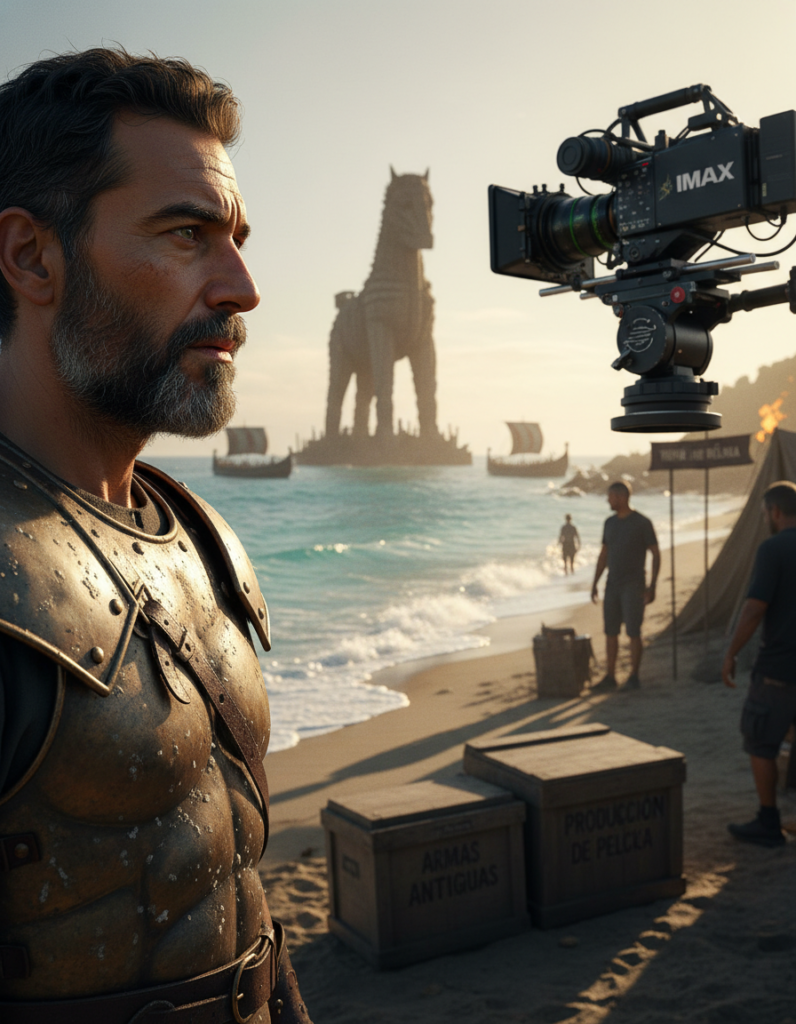
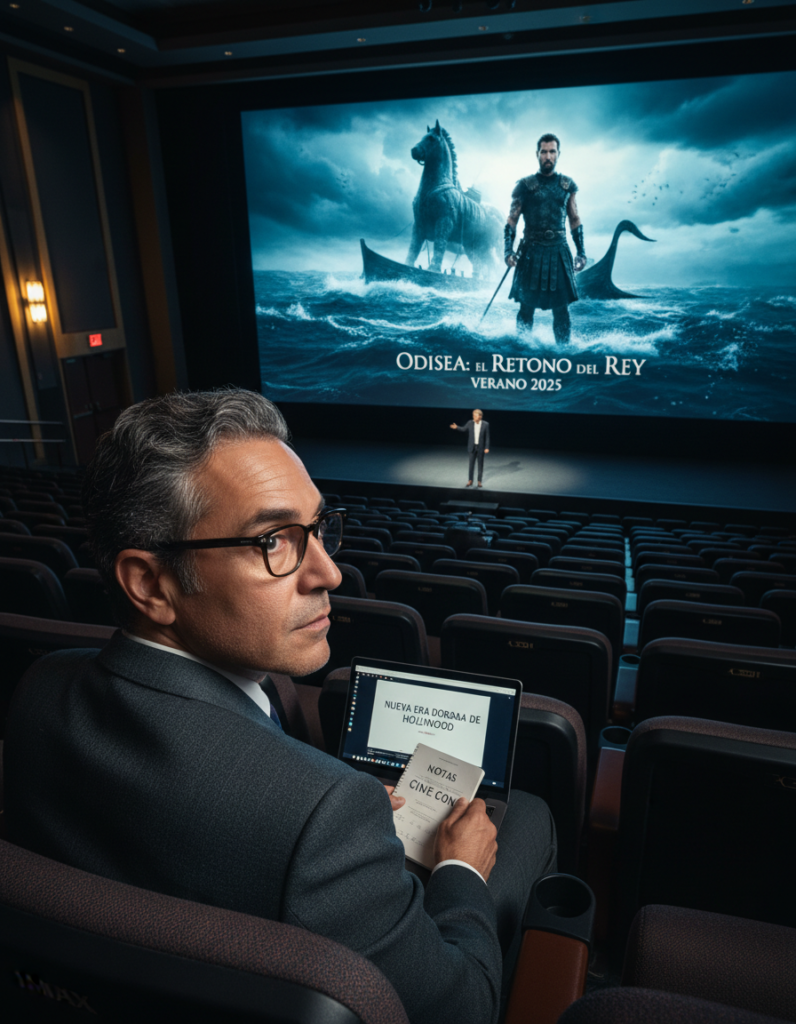
An extended preview for Christopher Nolan’s IMAX-shot epic suggests that one of 2026’s biggest films may also be one of Hollywood’s clearest arguments that large-scale original storytelling can still command theatrical awe.
Christopher Nolan did not arrive at CinemaCon with a sequel, a reboot or a comic-book extension of a familiar franchise. He arrived with Homer.
That fact alone helps explain why the extended preview for The Odyssey, shown during Universal’s presentation in Las Vegas, landed with unusual force. On one level, the film is already easy to frame as a major event: it is directed by one of the industry’s most powerful filmmakers, shot for IMAX, fronted by Matt Damon as Odysseus and backed by an ensemble cast that includes Anne Hathaway, Tom Holland, Zendaya and Robert Pattinson. But the deeper fascination around The Odyssey is not simply that it looks large. It is that it represents a particular kind of largeness that Hollywood has lately struggled to sustain: an original, filmmaker-driven epic sold on scale, seriousness and cinematic ambition rather than existing franchise loyalty.
The footage Nolan unveiled at CinemaCon appears designed to make exactly that case. According to reports from the presentation, the preview emphasized both the mythic and human dimensions of the story, including material tied to the Trojan Horse and the aftermath of war, while framing the film not merely as a parade of classical imagery but as a drama centered on family and homecoming. Nolan himself described the project as a long-held dream and characterized the story in emotionally direct terms. That matters because The Odyssey is not being positioned as a museum piece or a purely literary adaptation. It is being sold as a visceral theatrical experience with an intimate emotional engine.
That has become one of Nolan’s great commercial strengths. For all the conceptual density often associated with his work, he tends to anchor spectacle in simple dramatic ideas: grief, guilt, sacrifice, survival, memory, duty, return. In The Odyssey, that anchor may be especially clear. The ancient Greek epic is vast in its narrative architecture, but at its core it is also one of the oldest and most durable story structures in Western literature: a man trying to get home, a family waiting, a world transformed by absence, and a journey made dangerous not only by monsters and gods but by the distortions of time, power and identity.
The CinemaCon response suggests Nolan is leaning into both halves of that equation. The film’s IMAX presentation and large-format photography promise a visual event calibrated for the theatrical screen, while the emphasis on Odysseus as a husband, father and haunted survivor gives the material a modern emotional legibility. In a marketplace where studios often worry that original films need some kind of built-in shorthand to be understood instantly, The Odyssey offers a different proposition. The shorthand is not intellectual property in the contemporary corporate sense. It is narrative archetype.
Casting is central to that strategy. Damon as Odysseus is not an incidental star pairing but an especially telling one. He brings familiarity, gravity and an ability to play intelligence under pressure without tipping too far into self-conscious grandeur. Odysseus is one of literature’s most complicated heroic figures: cunning, resilient, compromised, often admirable and not always noble. Damon’s screen persona has long been effective in roles that demand endurance, calculation and moral ambiguity. That makes him a logical center for a Nolan film that seems likely to present the character not as a marble legend but as a tactician and survivor trying to navigate the wreckage of war.
Around him, the supporting cast broadens the film’s appeal without making it feel like an exercise in stunt casting. Hathaway, Holland, Zendaya and Pattinson are all recognizable enough to draw different audience segments, yet each also fits Nolan’s larger habit of assembling ensembles that function as both dramatic engines and event-movie signals. A cast like this does not simply populate the frame. It tells the audience that the project is being mounted at the highest level of prestige and scale.
That combination of prestige and scale is especially important for Universal, which is effectively using The Odyssey as a statement about the future of theatrical exhibition. CinemaCon, after all, is not merely a fan event. It is an industry stage where studios address exhibitors, reassure theater owners and present evidence that the big screen still matters. In that context, Nolan’s presence carried significance beyond one film. He has become one of the clearest living embodiments of theatrical-first moviemaking, a director whose work is often discussed not just in terms of narrative or performance but in terms of format, projection and the physical experience of watching.
The Odyssey therefore arrives as both a movie and an argument. It argues that audiences will still turn out for films that are not based on existing cinematic universes, provided they are given enough scale, confidence and formal purpose. It argues that IMAX is not just a premium surcharge mechanism but a storytelling tool that can make a literary adaptation feel immediate and overwhelming. And it argues that a classical epic, in the hands of a filmmaker with commercial credibility, can operate as mainstream entertainment rather than prestige homework.
That last point may be more important than it sounds. Homer has never lacked cultural stature, but prestige and accessibility do not always travel together in modern studio logic. What CinemaCon seems to have shown is that Nolan is not approaching The Odyssey as something remote or ceremonious. The preview reportedly emphasized kinetic action, physical ordeal and a lived-in, tactile sense of danger. If that balance holds, the film could occupy a rare space in the market: intellectually respectable, mythically resonant and still legible as a summer spectacle.
There is also a reason the timing feels apt. Hollywood has been searching for ways to revive confidence in original large-scale filmmaking after years in which franchise dependence became both economically rational and creatively narrowing. The post-pandemic box office has repeatedly shown that audiences will still come out in large numbers for movies that feel urgent, but “urgent” has increasingly meant either event-sequel familiarity or exceptional filmmaker branding. Nolan sits at the intersection of those two things. His name itself functions almost like a franchise, but one built on authorship rather than repetition.
That gives The Odyssey a special kind of pressure. It is not just expected to be good. It is expected to prove something. If it works, the film could strengthen the industry belief that starry, expensive, original epics remain viable when placed in the hands of directors with genuine theatrical command. If it falters, skeptics will see it as evidence that even Nolan cannot reliably turn literary scale into mass-market momentum. Few filmmakers are asked to bear that kind of symbolic weight. Nolan increasingly is.
Still, the CinemaCon footage suggests the film understands that burden and is trying to convert it into advantage. The Odyssey is not pretending to be small, ironic or fashionably restrained. It appears to be embracing the old idea of epic cinema while modernizing the emotional access points. That is a high-risk move in an era of fragmented attention, but also one of the few strategies likely to make a non-franchise production feel genuinely must-see.
The release date of July 17, 2026 places the film squarely in the heart of the summer corridor, where studios traditionally reserve their most confident theatrical plays. That positioning is both logical and revealing. Universal is not treating The Odyssey as an awards-season prestige artifact with crossover hopes. It is treating it as a centerpiece event, a film intended to dominate conversation, premium screens and industry attention.
What Nolan appears to have shown at CinemaCon, then, was more than an extended preview. He offered a glimpse of a film trying to bridge several divides at once: between antiquity and modern spectacle, between auteur cinema and commercial scale, between literary reverence and visceral entertainment. Whether The Odyssey fully delivers on that promise will not be known until audiences see the finished film. But the early message is already clear.
Nolan is not simply adapting Homer. He is testing whether one of the oldest stories in Western literature can become one of the most contemporary arguments for why theaters still matter.