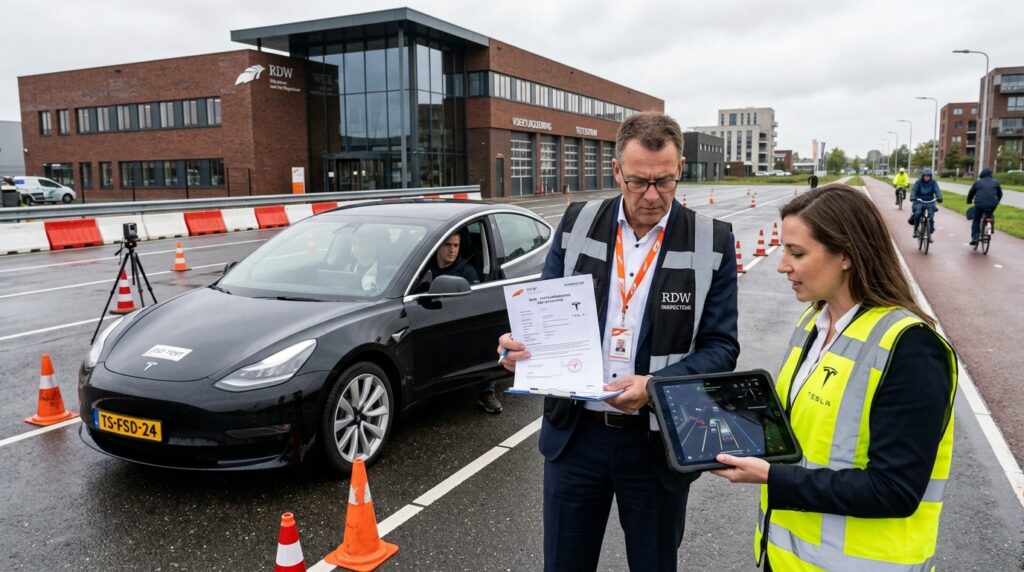
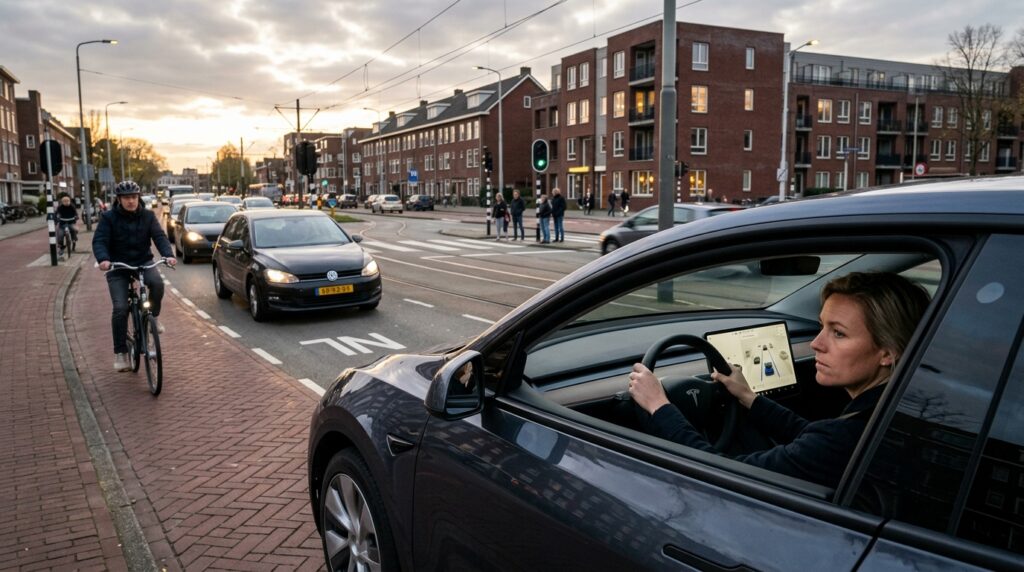
The Netherlands has granted type approval to Tesla’s advanced driver-assistance system after more than 18 months of testing, giving the company its first regulatory foothold for FSD Supervised in continental Europe while underscoring that the system remains driver-controlled, not autonomous.
Tesla has secured a notable regulatory milestone in Europe after the Dutch vehicle authority RDW said it had issued a type approval for the company’s FSD Supervised system, allowing the driver-assistance feature to be used in the Netherlands and potentially opening a path toward wider European Union recognition. :contentReference[oaicite:0]{index=0}
The approval matters because it gives Tesla something it has long struggled to obtain in Europe: formal permission for a more advanced version of its assisted-driving software in a market governed by stricter pre-approval rules than the United States. RDW said the system had been “extensively examined and tested” for more than one and a half years on both test tracks and public roads before the type approval was issued on April 10, 2026. :contentReference[oaicite:1]{index=1}
For Tesla, the Dutch decision is both symbolic and practical. Symbolically, the Netherlands becomes the first European country to authorize FSD Supervised on public roads under this approval, a development that gives the company a long-sought headline in a region where its self-driving ambitions have repeatedly encountered delays and regulatory caution. Practically, it offers a first live market in Europe for a system that Tesla has spent years promoting as central to its software and subscription strategy. :contentReference[oaicite:2]{index=2}
Yet the wording used by RDW is just as important as the fact of approval itself. The Dutch regulator went out of its way to say that a vehicle using FSD Supervised “is not self-driving” and that the system is a “driver controlled assistance system,” meaning the human behind the wheel remains responsible and must always stay in control. RDW also said the system monitors whether the driver’s eyes are on the road and whether their hands are available to take over immediately if needed. :contentReference[oaicite:3]{index=3}
That distinction is crucial because Tesla’s branding has long generated controversy. The phrase “Full Self-Driving” can suggest a level of autonomy that regulators do not accept as an accurate description of the technology currently being approved. In the Netherlands, as in the rest of Europe, the system is being framed not as a robot driver but as an advanced form of driver support, one that can perform many tasks but still requires active human supervision at all times. :contentReference[oaicite:4]{index=4}
The Dutch approval therefore marks progress, but not the arrival of autonomous Teslas on European streets. Instead, it reflects a narrower but still consequential regulatory judgment: that Tesla’s supervised driver-assistance system can be used legally under Dutch approval so long as the driver remains attentive and available to intervene. RDW said correct use of the system can make a positive contribution to road safety and argued that continuous, strict in-cabin monitoring makes it safer than some other driver-assistance systems. :contentReference[oaicite:5]{index=5}
That language places the approval in the broader European philosophy of vehicle regulation. RDW noted that in the European Union, vehicles and vehicle systems must obtain type approval in advance from authorities such as the Dutch agency, whereas the U.S. relies more heavily on self-certification and subsequent oversight in real-world use. RDW also emphasized that the European software and functionality should not be treated as directly comparable to the U.S. version of FSD Supervised. :contentReference[oaicite:6]{index=6}
In other words, this is not simply Tesla exporting its American product into Europe unchanged. The Dutch regulator is making clear that what has been approved is a Europe-specific implementation, assessed under European rules and safety expectations. That matters because Tesla’s U.S. FSD system has faced recurring scrutiny, investigations and criticism, making it especially important for European authorities to distinguish their approved version from the one better known to American drivers and critics. :contentReference[oaicite:7]{index=7}
The timing is also significant for Tesla’s business in Europe. The company has been under pressure to show that its software story can extend beyond North America, especially as competition in electric vehicles intensifies and software-related revenue remains a key part of the company’s long-term narrative. An approved premium driver-assistance feature in Europe could help Tesla market its vehicles not just on battery range and brand recognition, but on the perceived sophistication of its software stack. That does not guarantee a sales boost, but it gives Tesla a fresh commercial and technological talking point in a region where regulatory permission is often as valuable as engineering ambition. :contentReference[oaicite:8]{index=8}
There is also a geopolitical and regulatory angle. According to RDW, the current type approval is valid only in the Netherlands for now. To make the system usable across the entire European Union, RDW must submit the application to the European Commission, after which EU member states would vote. A majority in the relevant committee would be required for broader approval. :contentReference[oaicite:9]{index=9}
That means the Dutch decision could be the first step in a larger European process rather than the end of one. If other member states eventually support the application, Tesla would gain a much more meaningful foothold across the bloc. If they resist, the approval may remain a narrower national breakthrough, important but limited. Either outcome would still leave the Netherlands with a distinct place in Tesla’s European driver-assistance story: the first jurisdiction to grant this form of approval.
The Dutch announcement also helps clarify where Tesla sits within the wider assisted-driving landscape in Europe. RDW noted that approvals for advanced driver-assistance systems are not unique to Tesla. It cited examples including BMW and Ford receiving approvals for certain hands-off motorway functions under defined conditions. What makes the Tesla decision stand out is not that Europe has never allowed advanced assistance before, but that Tesla’s system is broader in ambition and has drawn outsized public attention because of the company’s self-driving claims and global profile. :contentReference[oaicite:10]{index=10}
That attention will likely only intensify as the first Dutch users begin receiving the software. Reporting from The Verge said version 2026.3.6 had started rolling out to a limited number of users, and that drivers would need to complete a tutorial and quiz before the feature could be enabled. That requirement fits with the overall regulatory message: this is a supervised system whose safe use depends not only on software capability, but on ensuring the driver understands the limits. :contentReference[oaicite:11]{index=11}
For the broader mobility sector, the milestone is notable because it shows how the next phase of assisted-driving deployment in Europe may unfold: not through sweeping declarations of autonomy, but through incremental national approvals, tight monitoring requirements and regulatory language designed to keep the human driver firmly at the center of legal responsibility. Tesla’s breakthrough in the Netherlands fits that pattern. It is a meaningful step forward, but also a heavily qualified one. :contentReference[oaicite:12]{index=12}
That balance may end up defining the significance of the Dutch approval. On one hand, it is a real win for Tesla, which can now point to a European authority that has spent more than 18 months testing and then approving FSD Supervised. On the other hand, the approval comes wrapped in repeated warnings that the vehicle is not self-driving, that the driver remains accountable, and that broader EU use is still contingent on further procedural and political steps. :contentReference[oaicite:13]{index=13}
For now, then, the Netherlands has given Tesla exactly what the company needed most in Europe: a credible regulatory milestone without endorsing the stronger autonomy narrative often implied by the product’s name. In the process, RDW has drawn a line that may shape the next stage of Europe’s conversation about automated driving: advanced assistance can move forward, but only under supervision, and only with the human driver unmistakably still in charge.