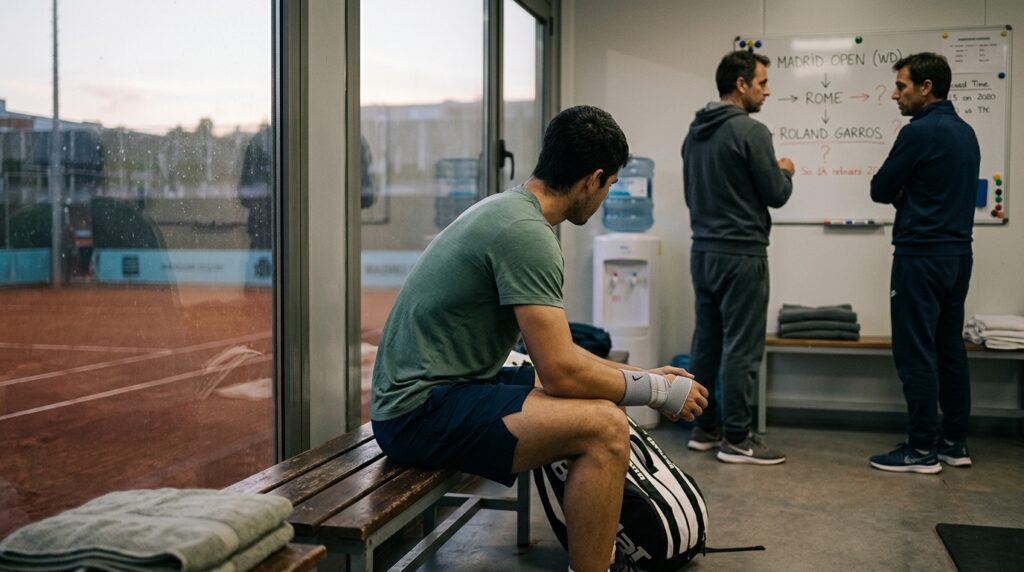
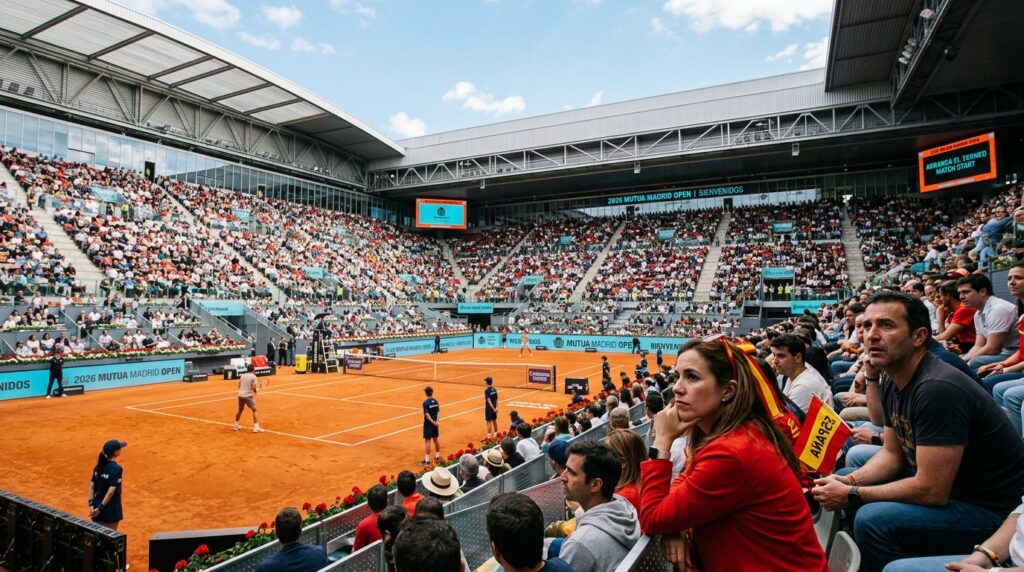
Carlos Alcaraz’s withdrawal from his home Masters 1000 event has removed one of the biggest attractions in Madrid and shifted fresh attention toward the wider race for momentum heading into Rome and Roland Garros.
The Mutua Madrid Open has begun at Caja Magica with the usual promise of two weeks of high-level clay-court tennis, but the biggest story surrounding the tournament is not who arrived. It is who did not.
Carlos Alcaraz, the Spanish star who has become one of the defining figures of the men’s game and one of the tournament’s strongest local draws, withdrew before the event because of a wrist injury, leaving Madrid without its home favorite and altering the shape of the men’s competition at one of the most important stops before the French Open.
The tournament is running from April 22 to May 3 on the ATP side, while the women’s event began on April 21, with both draws unfolding on the red clay of Madrid’s Caja Magica. On paper, the event still carries the weight expected of a combined ATP Masters 1000 and WTA 1000 stop. In practice, however, Alcaraz’s absence has changed the mood around the fortnight, especially in Spain, where his rise has helped make the Madrid Open feel not just like a major tournament, but increasingly like a national stage.
Alcaraz confirmed his withdrawal last week, saying he needed to listen to his body and prioritize his long-term health. The ATP said the world No. 2 would miss his home event because of a wrist injury. The decision followed another worrying interruption in the clay swing, depriving Madrid of one of its most marketable players and one of the few men on tour with a proven record of lifting the title in the Spanish capital.
For tournament organizers, fans and broadcasters, that is an immediate blow. For the broader clay season, it may be more significant still.
Madrid sits in a delicate place on the calendar. It is not the final destination, but it often serves as a revealing checkpoint before Rome and Roland Garros. Success here can sharpen a player’s credentials as a genuine title contender in Paris. Equally, an injury or withdrawal in Madrid can raise deeper questions about fitness, scheduling and how much physical stress top players are willing to absorb in the compressed European clay swing.
That is why Alcaraz’s withdrawal has resonated beyond the boundaries of one tournament. It comes at a moment when the men’s tour has been shaped repeatedly by the availability of its biggest names. When healthy, Alcaraz has been central to the sport’s current hierarchy and to the commercial energy around major events. When absent, the draw does not simply lose a contender. It loses a reference point.
The ATP’s official preview of the event had listed Jannik Sinner and Alexander Zverev among the leading names expected to headline the 2026 edition, and the ATP’s live seed list now places Sinner as the No. 1 seed and Zverev as No. 2. Felix Auger-Aliassime, Ben Shelton, Alex de Minaur and Lorenzo Musetti are among the other seeded players in a field that remains deep even without Alcaraz. Defending champion Casper Ruud is also in the mix, though not near the very top of the seedings.
That leaves Sinner, in particular, under even brighter light. The Italian has increasingly been viewed as the man to beat across the tour’s biggest events, and Alcaraz’s absence removes one of the opponents most capable of disrupting his path. The Guardian reported this week that Sinner called Alcaraz’s withdrawal “tough to swallow,” while also acknowledging that the absence of both Alcaraz and Novak Djokovic materially changes the tournament’s competitive balance.
The remark captured two truths at once. First, top players and fans alike prefer major events to be full-strength, especially on clay, where rivalries and long-form tactical matches often define the season. Second, elite tennis is unforgiving in the way it redistributes opportunity. When one contender leaves the bracket, another player’s road becomes clearer.
Madrid is especially sensitive to those shifts because its conditions make it slightly different from Rome and Roland Garros. The altitude and quicker clay can reward aggressive serving and first-strike tennis more than slower European clay events do. That has sometimes produced champions or finalists who arrive in Paris with momentum, even if Madrid is not always a perfect rehearsal for the French Open. Still, the tournament matters. Players, coaches and analysts watch closely because the event can signal who is thriving physically and who is merely surviving the grind.
In that sense, Alcaraz’s absence is not just a story about Madrid. It is a story about uncertainty heading into the season’s next two milestones.
Rome, which follows shortly after Madrid, is the last major checkpoint before Roland Garros. A healthy and in-form Alcaraz would normally be expected not only to compete there but to shape the tournament around him. His absence in Madrid means any expectations for Rome now become contingent on recovery rather than rhythm. That is an important distinction. It is one thing to arrive in Paris after a normal run of matches and gradual improvement on clay. It is another to arrive after a disrupted spring, limited preparation and concern over whether the body can withstand best-of-five-set demands.
There is also the broader question of what this means for the hierarchy of the men’s tour. For much of the last two years, Alcaraz and Sinner have represented the most compelling rivalry in men’s tennis, combining athletic contrast, tactical flexibility and the ability to pull the sport toward a post-Big Three era with real force. Any interruption to that rivalry tends to leave a wider vacuum. Other players may benefit competitively, but the season’s narrative becomes less defined.
Madrid’s men’s field still offers enough quality to produce a strong champion. Sinner’s status makes him the obvious focal point. Zverev, a former Madrid champion, remains dangerous on the surface. Musetti and de Minaur have grown into serious clay-court presences. Ruud, long one of the tour’s most accomplished clay specialists, cannot be overlooked. Younger players, too, may view the draw as more open than it would have seemed had Alcaraz been present and healthy.
On the women’s side, the tournament retains much of its star power. The WTA’s official materials list Aryna Sabalenka as the top seed, followed by Elena Rybakina, Coco Gauff and Iga Swiatek. The WTA has described Madrid as the first clay-court WTA 1000 event of this stretch and a strong indicator of form ahead of the French Open, reflecting how central the event is to the women’s calendar as well. With the men’s field missing a major local attraction, the women’s draw may gain even more visibility during the opening week.
Yet in the host city, the emotional center of the story remains Alcaraz. Madrid has invested heavily in presenting itself as one of the premier destinations of the clay season, and Alcaraz has been central to that image. He is not only a former champion but also the player most capable of turning a large tournament into a local spectacle. For Spanish tennis, his presence has commercial, sporting and symbolic value.
That is why his withdrawal lands as more than a routine injury update. It changes ticketed expectations, television framing and the atmosphere around the event. It also serves as a reminder that modern tennis, for all its glamour and volume, remains fragile at the top. Seasons are often decided not merely by who is best, but by who is healthy enough to stay in the conversation.
Madrid will move on, as big tournaments always do. A champion will emerge. New contenders may sharpen their reputations. But Alcaraz’s absence has already done something important: it has made the rest of the clay swing feel less settled, and perhaps more revealing, than it did a week ago.
As Rome approaches and Roland Garros draws nearer, attention will remain fixed not only on who wins in Madrid, but on whether one of the sport’s central figures can return in time to matter where the stakes are highest.