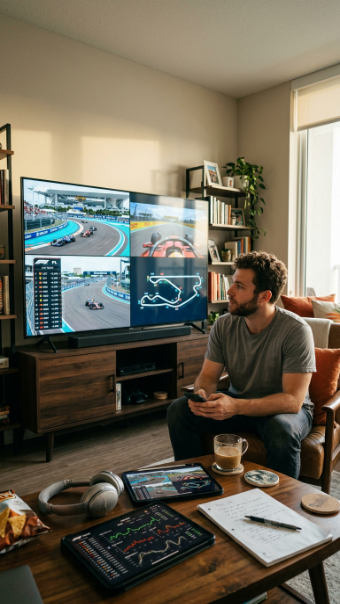
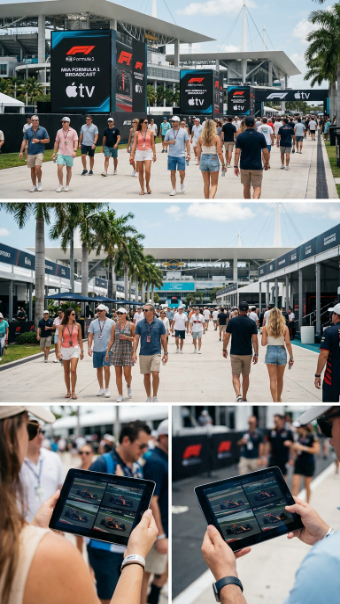
The company is using one of F1’s most visible U.S. weekends to promote 4K Dolby Vision coverage, multi-view feeds and deeper technical programming for American viewers.
Apple TV’s first season as Formula 1’s exclusive U.S. broadcast partner is getting a high-profile test in Miami, where the company is using Grand Prix weekend as both a live sports production and a broader marketing stage for its expanding sports ambitions.
The Miami Grand Prix has become one of Formula 1’s most important American showcases, blending racing, celebrity culture, luxury branding and a growing fan base that has helped the sport increase its visibility in the United States. This year, it carries another layer of significance. It is the first Miami race under Apple TV’s five-year U.S. rights deal, and the company is treating the weekend as a chance to demonstrate what it believes a modern F1 broadcast should look and feel like.
Apple entered the season promising a more immersive experience than traditional cable coverage, and Miami is the clearest attempt so far to put that promise in front of a broad audience. The service is offering races in 4K Dolby Vision with 5.1 surround sound, while giving viewers access to multi-view displays that can show up to four live feeds at once. Those feeds include the main race broadcast, in-car cameras, timing and scoring channels, driver-focused views and other data-rich angles designed for fans who want more control over how they follow the race.
That approach reflects a larger change in how premium sports rights are being sold and consumed. For decades, the American F1 experience depended largely on a single linear television feed, often built around commentary and pictures produced elsewhere. Apple TV is trying to make the stream itself part of the product, combining live video quality, alternate feeds, on-demand replays, data tools and cross-platform promotion across its wider ecosystem.
Miami gives Apple a strong stage for that pitch. The race is one of Formula 1’s highest-profile U.S. events and traditionally attracts casual viewers as well as dedicated fans. For Apple, the weekend functions as a second launch of sorts after the season-opening races. Company executives have framed Miami as a moment to reintroduce the product to viewers who may not have followed the early part of the season closely but are likely to notice Formula 1 when it arrives in South Florida.
The timing is especially useful because Formula 1 is returning from an unplanned break in the schedule. Miami is the first Grand Prix since Japan, after April races in Bahrain and Saudi Arabia were called off. That gap has given Apple more room to build anticipation and market the event as a restart for the season, not simply another race weekend.
The company’s strategy is not limited to sharper pictures. Apple TV has added programming intended to make F1 more understandable for new fans while giving established viewers more detailed analysis. One new show, “Circuits in Focus,” features 2016 world champion Nico Rosberg and creator Emelia Hartford previewing each track, including strategy, overtaking zones and key technical challenges. Another, “POV,” is designed as a post-race technical analysis program, with former Red Bull Racing senior technician Calum Nicholas and engineer Christina Roki examining decisive moments from the weekend.
Those programs matter because F1 can be difficult for newcomers to decode. A race is not only about which driver is fastest. Tire degradation, aerodynamic efficiency, pit strategy, battery deployment, traffic, safety cars and track position all shape the result. Apple’s bet is that a more explanatory broadcast can serve both ends of the audience: casual viewers who need a guide and committed fans who want deeper technical context.
The technical layer is also central to the company’s multi-view push. F1 is unusually suited to alternate feeds because so much action happens away from the lead battle. A driver fighting through the midfield, a team preparing a pit stop, or a contender managing tire wear can be crucial to the race long before it becomes obvious on the main feed. By allowing viewers to follow multiple streams at once, Apple is trying to turn that complexity into a feature rather than a barrier.
For longtime F1 fans in the United States, the change is significant. ESPN carried the sport from 2018 through 2025, relying heavily on the Sky Sports broadcast feed. Apple TV has retained access to Sky Sports coverage while also integrating F1 TV-style options, giving viewers more choice over commentary and presentation. The result is an attempt to satisfy viewers who liked the familiar international broadcast while offering a more interactive experience for subscribers who expect digital flexibility.
The move also places Apple more directly in the competition for live sports. The company has already built sports products around Major League Soccer and Major League Baseball, but Formula 1 gives it a global, premium, technology-friendly property with a younger and increasingly diverse audience in the United States. The sport’s growth has been fueled by Netflix’s “Drive to Survive,” expanded U.S. races, social media and a calendar that now treats America as a strategic market rather than a secondary stop.
Apple’s advantage is its ecosystem. The company is promoting F1 not only through Apple TV but also through Apple Sports, Apple Maps, Apple Music, Apple News and podcasts. Fans can use detailed circuit layouts, follow standings and live updates, listen to driver-curated playlists and move between race content and related programming. That kind of integration is difficult for a traditional broadcaster to replicate because it depends on owning multiple consumer platforms at once.
There are also experiments beyond the home screen. Sunday’s Miami race is being shown in dozens of IMAX locations in the United States and in Times Square, while a Tubi alternate cast is aimed at younger digital audiences. Those efforts suggest Formula 1 and Apple are not only chasing existing fans. They are trying to turn a race weekend into a distributed entertainment event, visible across theaters, phones, televisions, public spaces and social platforms.
The central business question is whether the audience will follow. Apple has not released viewership figures for the first races of the season and is not part of Nielsen’s standard ratings system. That makes direct comparison with ESPN’s previous F1 audiences difficult. Executives have said they are pleased with early uptake and feedback, particularly around video quality and multi-view use, but the real test will come over a full season: whether fans subscribe, stay engaged and accept streaming as the default home for F1 in the United States.
The shift carries risks. Some fans accustomed to finding races on cable may object to another subscription. Others may prefer a simpler broadcast rather than a menu of feeds and features. Live sports also leave little margin for technical failure. A buffering stream, delayed feed or confusing interface can quickly damage trust, especially during a race where seconds matter.
Still, the Miami Grand Prix is exactly the kind of event Apple wants for its argument. It is glamorous, visual, data-heavy and culturally prominent. It rewards high-quality screens and interactive viewing. It attracts both serious racing followers and casual viewers who may arrive through celebrity appearances, social clips or curiosity about the spectacle.
For Formula 1, the partnership offers access to Apple’s marketing power and product design culture at a time when the sport is trying to deepen its American footprint. For Apple, F1 offers something increasingly valuable in streaming: appointment viewing. In a fragmented entertainment market, live sports remain one of the few categories that can gather large audiences in real time and justify premium rights fees.
Miami will not decide the success of the deal on its own. But it will reveal how Apple wants the next phase of F1 broadcasting to feel: sharper, more customizable, more explanatory and more deeply connected to the devices and services fans already use.
The race will still be settled on track, by tire choices, overtakes, mistakes and strategy calls under the South Florida sun. But off the track, another contest is underway. Apple is trying to prove that the future of Formula 1 in America is not just a broadcast rights agreement. It is a new viewing platform, built around the belief that fans no longer want simply to watch the race. They want to control how close they can get to it.